A low asking price is the most misleading fact in the cheap land Nevada market. A parcel can cost very little to acquire and still be expensive to use, insure, access, supply with water, or resell. Before you compare counties or financing terms, treat every listing as an unfinished project with unknown infrastructure. The right question isn't, “How cheap is this land?” It's, “What will this parcel cost me before it can serve its intended purpose?” Water rights, septic approval, zoning, legal access, utilities, and title conditions determine that answer. Price matters, but it comes after usability. Table of Contents Why Cheap Nevada Land Is Not Always Affordable The three silent costs behind a low price How Nevada's Land Ownership Pattern Shapes the Market Nevada land tenure snapshot Where Cheap Nevada Parcels Actually Show Up Match the county to the intended use What Inexpensive Nevada Parcels Often Lack What the missing features mean for use The Risks Most Buyers Underestimate Ask these questions before paying Financing Options for First-Time and Credit-Limited Buyers Nevada land financing options compared Your Next Steps Before You Buy Verify the parcel before negotiating Why Cheap Nevada Land Is Not Always Affordable A low listing price doesn't prove that a parcel is buildable, homestead-ready, or even practically reachable. Remote Nevada land can look attractive because the seller is pricing raw ground, while the buyer is mentally pricing a future cabin, RV site, workshop, or investment. Those are different assets. Nevada's arid conditions make water the first cost question. A domestic well may qualify for a limited exemption only when it serves culinary and household needs for a single-family dwelling and stays within 2 acre-feet per year, approximately 651,700 gallons, according to the Nevada guide to water wells. That exemption isn't a general license for commercial activity, agriculture, multiple residences, or intensive irrigation. The three silent costs behind a low price Utility connection is often missing entirely. A parcel may sit far from power infrastructure, with no economical path to a grid connection. Solar, batteries, generators, or a long utility extension can change the purchase decision before construction begins. Water sourcing can also erase the apparent bargain. You need to know whether a domestic well is legally available, whether the basin has restrictions, whether a prior right exists, and whether hauling and storage are the only realistic alternatives. Surface ownership doesn't automatically guarantee usable groundwater. Site and use restrictions are just as important. Zoning, setbacks, wastewater rules, access easements, deed restrictions, and improvement covenants can prevent the use you had in mind. A parcel can be large enough for recreation but unsuitable for a legal residence. Practical rule: Don't make an offer until you can describe the parcel's water plan, wastewater plan, access rights, and permitted use in writing. Nevada's inexpensive land market rewards skepticism. Start with the APN, county records, and the intended use. If you want full-time housing, recreational camping, agricultural activity, or a long-term hold, each purpose creates a different due-diligence standard. How Nevada's Land Ownership Pattern Shapes the Market Nevada's cheap private land exists inside a much larger public-land system. The Bureau of Land Management's Nevada overview reports that it administers nearly 48 million acres, about 63% of the state's land base. That acreage is public land, not a supply of ordinary residential lots that buyers can purchase. The ownership pattern explains why private parcels can be scattered, isolated, and inconsistent. Public, private, state, tribal, and local holdings may sit beside one another. Two parcels that appear close on a map can have completely different access rights, development potential, and title histories. Nevada's history also matters. After the 1846 Treaty of Guadalupe Hidalgo transferred the territory from Mexico to the United States, Nevada entered statehood in 1864 without claiming most unreserved federal land. The federal government therefore retained a dominant role in land administration. Open-range cattle and sheep operations, silver discovered near Virginia City in 1859, and federal mining laws adopted in 1866 and 1872 all shaped how land was used and recorded. Nevada land tenure snapshot Category Approximate share Implication for buyers BLM-administered land About 63% of Nevada's land base Much of the surrounding acreage isn't available for private residential purchase BLM acreage Nearly 48 million acres A large public-land footprint can separate private parcels from services and population centers Privately owned land Minority of the state's total land area Private inventory may be fragmented and highly variable by county Other public, state, tribal, and local holdings Varies by location Parcel-level mapping and title review are essential This geometry creates several recurring listing types. Some parcels sit in rural subdivisions created decades ago. Others reflect mining-era claims, ranch divisions, or isolated private holdings surrounded by public acreage. The low price may reflect weak access, limited services, or a narrow buyer pool rather than a hidden development opportunity. Review the recorded legal description, not just a seller's map pin. Confirm whether a public road reaches the parcel, whether an easement is recorded, and whether the apparent route crosses land controlled by someone else. A visible track isn't proof of legal access. The buyer who understands Nevada's ownership pattern looks for usable private land, not merely an inexpensive patch inside a vast desert expanse. Where Cheap Nevada Parcels Actually Show Up Cheap Nevada land appears most often in remote counties and older rural subdivisions, where distance from employment centers and utilities keeps demand narrow. Nye County is a common search area for buyers considering desert recreation, long-term holding, or rural living. Elko and Lander can appeal to buyers seeking larger open-country parcels, while Pershing, Humboldt, Esmeralda, and Lincoln offer different combinations of remoteness, road access, and nearby services. The right county depends on your use. Don't choose a location solely because a listing platform sorts it into a low-price category. Match the county to the intended use Nye County: Often attracts buyers interested in desert recreation, off-grid concepts, acreage, and long-term ownership. Verify water-basin conditions, county zoning, and access before treating a parcel
You've found a Colorado parcel with mountain views, a low advertised monthly payment, and a seller who says you won't need a bank or credit check. The offer feels accessible, especially if a traditional land loan isn't realistic. But the payment is only one part of the commitment. Before signing, you need to understand the contract, property taxes, access, water, septic feasibility, county rules, and the total amount you'll pay over time. Owner financed land in Colorado can be a practical path to ownership, particularly for buyers seeking smaller rural parcels, recreational acreage, or a future homesite. It can also create long-term obligations that a listing rarely explains. The right question isn't just, "Can I make the monthly payment?" It's, "Can I legally use, afford, maintain, and eventually resell this parcel under the terms I'm accepting?" Table of Contents Understanding Why Owner Financing Fits Colorado Buyers Why the Colorado market attracts this buyer What Is Owner Financed Land and How Does It Work The monthly payment isn't the entire deal Navigating Colorado Legal Requirements and Contract Terms Documents that define the relationship Read default language before the payment schedule Analyzing Regional Market Data and Average Costs Colorado Land Market Overview Tax Implications and Long-Term Financial Considerations Separate financing cost from holding cost Ask what happens over the full term Water Rights and Buildability Challenges in Colorado Verify the intended use with the county Essential Due Diligence Steps Before Signing Confirm the land before evaluating the deal Check title, water, and recurring obligations Understanding Why Owner Financing Fits Colorado Buyers A buyer finds a Colorado parcel with an affordable monthly installment and plans to use it for occasional camping or a future homesite. The payment fits the budget, yet the ownership decision involves more than the installment. Property taxes, road access, water rights, wastewater options, maintenance, and resale conditions can continue for years after the contract is signed. A remote parcel can also be difficult for a bank to finance. The buyer may see privacy, recreation, or future value, while a conventional lender may focus on uncertain access, limited utilities, unusual collateral, or underwriting rules the property does not meet. Owner financing can address that lending barrier because the buyer negotiates payment terms directly with the seller rather than relying on a bank. It may suit buyers with limited savings, thin credit files, or plans for land that will not produce immediate income. The arrangement changes who receives the payments, however. It does not change county rules, property conditions, or the buyer's long-term responsibilities. Why the Colorado market attracts this buyer Colorado offers both high-value acreage and smaller parcels that may appeal to budget-conscious buyers. One statewide snapshot lists 13,261 properties for sale, covering 906,497 acres, with a median list price of $695,000 and a median price per acre of $12,990 (Colorado land market data). Those figures describe the wider market, not the likely cost or usability of one specific parcel. Smaller owner-financed properties can attract buyers who want manageable acreage rather than a working farm or large ranch. Flexible installments may make the purchase possible, but buyers should calculate the full obligation. Ask who pays property taxes, whether insurance or association charges apply, how road or utility costs are handled, and what happens if the parcel cannot support the intended use. A practical guide to buying land without traditional credit explains financing alternatives, while property research must answer separate questions. Can the buyer legally camp or build? Does the parcel have usable water rights and a lawful wastewater solution? Can the buyer reach it year-round? Financing can spread the purchase cost, but it cannot supply those rights or approvals. Practical rule: Treat flexible financing as a payment arrangement, not as proof that the property is suitable for your plans. What Is Owner Financed Land and How Does It Work Owner financing means the seller accepts payments over time instead of requiring the buyer to obtain a conventional loan from a bank. The seller effectively becomes the financing party, although a title company, attorney, or loan servicer may help prepare documents, record instruments, or process payments. The exact structure varies, but the process usually follows a straightforward sequence: The buyer and seller agree on the parcel and purchase terms. The agreement should identify the correct property, price, payment obligations, and responsibilities during the payment period. The buyer signs the financing documents. These may include a land purchase contract, promissory note, deed, or security instrument, depending on the structure. The buyer makes the required initial payment and recurring installments. The contract should state the due date, payment amount, interest treatment, late fees, and maturity terms. The seller transfers or retains title according to the agreement. Some arrangements transfer the deed at closing while securing the seller's interest through a recorded instrument. Others delay deed delivery until the balance is paid. The monthly payment isn't the entire deal Listings may emphasize zero down payments, no credit checks, or a low monthly amount. Those features can reduce the cash needed to begin, but they don't reveal the total cost. The buyer also needs to examine the interest rate, payment duration, final maturity date, possible balloon payment, taxes, association dues, insurance needs, and maintenance responsibilities. A long payment schedule can make a parcel appear affordable while increasing the amount paid before the balance is cleared. A balloon payment can create a separate risk if the buyer must pay a large remaining balance at a stated date. The contract should make these obligations easy to identify before signing. The buyer also needs to know who holds legal title during the term. Ask whether a deed is recorded at closing, whether the seller retains title, what security document is recorded, and what conditions trigger final deed delivery. If the answer is unclear, the buyer shouldn't rely on a verbal explanation. Navigating Colorado Legal Requirements and Contract Terms An owner-financed land purchase is not an informal handshake arrangement merely because a bank is not involved. Colorado's land
You've found a parcel that looks perfect online. The trees are attractive, the price is low, and the listing promises privacy. Then you call the county and learn that the road isn't maintained, the zoning doesn't allow a residence, and nobody can confirm the well yield. That isn't a minor inconvenience. It's how a dream property becomes an expensive storage lot. The practical homesteading how to process starts before seeds, chickens, or a cabin. You need to prove that the land can legally, physically, and financially support the life you want to build. The Homestead Act offers a useful historical reminder. Between 1862 and 1934, about 1.6 million homestead entries were successfully patented, transferring roughly 270 million acres across 30 states, according to the National Park Service's historical summary. Land access mattered, but so did residence and improvement. Modern buyers face the same basic question, without the federal program: can this parcel support real use, not just ownership? Table of Contents What Homesteading Actually Requires Before You Plant Anything Start with legal land use Prove water before you budget improvements Treat power and waste as site constraints Vetting Land So Your Homestead Can Survive Its First Year Run the county check before the closing check Verify water, soil, and access independently Buying a First Homestead Parcel Without Draining Your Savings Compare the acquisition paths Building Water, Power, and Waste as a Staged Project Phase one establishes water security Phase two matches power to real loads Phase three handles waste legally Shelter, Zoning, and Permits That Make a Homestead Legal Confirm the dwelling path first Protect the property after construction Why a Micro Homestead Beats a Dream Acreage at the Start Your First Twelve Months on the Homestead Months one through three Months four through six Months seven through nine Months ten through twelve What Homesteading Actually Requires Before You Plant Anything Most beginner advice starts with crops and livestock. That's backwards. Your first homesteading how to decision is whether the parcel can support legal land use, reliable water, workable power, and compliant waste management. Start with legal land use Call the county planning department before you make an offer. Ask whether the parcel allows a primary residence, manufactured home, tiny home, RV occupancy, agricultural buildings, workshops, poultry structures, livestock shelters, and commercial activity. Ask for the rules in writing, including setbacks, minimum dwelling standards, access requirements, and permit sequences. A charming cabin doesn't help if the county classifies it as an unpermitted dwelling. A large barn doesn't solve the problem if residential use is prohibited. Covenants and homeowners association rules can impose restrictions even when county zoning appears favorable. Prove water before you budget improvements A parcel without validated water access isn't cheap land. It's an unresolved engineering problem. Check well records, neighboring well depths, water rights, seasonal reliability, surface-water restrictions, and testing requirements before you plan occupancy. For zero-infrastructure sites, industry guidance places a hydrogeologist report at about $500 to $1,500, and estimates a fully installed off-grid water system for a family of four at about $15,000 to $30,000, as outlined in this off-grid water system planning guide. Those figures aren't a promise for your property. They show why water validation belongs in the purchase decision, not at the end of your budget. Treat power and waste as site constraints Check the distance to grid service, the location of utility easements, solar exposure, winter shading, and generator access. Then determine whether septic, greywater, composting toilets, or another waste system is legal under local health rules. Soil fertility is useful, but it can't override a failed septic test. A flat building site is valuable, but it doesn't compensate for a road that becomes inaccessible during wet weather. Your first year will be won by boring infrastructure decisions made before planting begins. Practical rule: Don't buy acreage because it looks rural. Buy it only after you understand how people, water, power, waste, and emergency vehicles will reach and use it. Vetting Land So Your Homestead Can Survive Its First Year A property visit is not a casual walk. It's a field inspection. Bring the listing, parcel map, survey, notebook, phone camera, boots, and a list of questions that the seller may not think to answer. Run the county check before the closing check Start with the county planner. Ask about zoning, minimum dwelling size, manufactured homes, accessory buildings, animal limits, road standards, septic approval, well permits, and temporary occupancy. Don't rely on a listing description or a seller's interpretation of “agricultural.” Check flood maps and surface drainage. Walk after rain if possible, inspect gullies and low points, and identify where runoff would travel through the building site. A parcel can look dry during a short visit and still require expensive grading or flood mitigation. Review the survey line by line. Look for access easements, utility corridors, shared driveways, drainage easements, and restrictions on where you can build. If you don't have a current survey, use this land survey requirements guide to identify the documents and questions that need attention. Verify water, soil, and access independently Ask for well logs from the property and nearby parcels. Confirm depth, reported yield, construction details, and testing history. If the property has a shared well, read the maintenance agreement and confirm who pays for repairs, electricity, testing, and replacement. Test soil rather than guessing from vegetation. You need to understand texture, drainage, compaction, contamination risk, and whether the proposed garden area is suitable. Review any percolation testing for a septic system, but remember that a test for one location doesn't automatically approve every building site. Walk the road in the conditions that matter. Confirm whether access is public or private, who maintains it, whether the easement reaches the entire parcel, and whether a large delivery truck, fire engine, or septic installer can reach the intended building area. Use a simple red-flag list before you fall in love with the property: Flood exposure: Low areas, drainage channels, and mapped flood zones can restrict construction. Restrictive
Small-acreage land development in 2026 typically runs $20,000 to $100,000 or more per acre, with the final bill driven less by acreage than by utility distance, road length, and terrain. A parcel can look inexpensive at the listing stage and still require a much larger investment before it becomes build-ready. That's why the popular advice, “Just estimate the cost per acre,” often fails first-time buyers. A per-acre figure is useful for setting a broad expectation, but it doesn't tell you whether the property needs a long driveway, a private well, an engineered septic system, extensive grading, or a power-line extension. A better question is: Which infrastructure line items will inflate my budget? A widely cited 2026 estimate places average U.S. land development costs at about $20,000 to $100,000 per acre, depending on lot size, clearing, grading, and utility work. In highly populated states, many projects fall between $22,000 and $55,000 total, with California and New York generally toward the higher end, according to HomeGuide's 2026 land development cost guide. Other estimates put development at roughly $2,000 to $150,000 overall, while site preparation alone may be estimated around $3 per square foot, as described by Angi's site development cost overview. Those figures aren't contradictory. They reflect different property sizes, locations, site conditions, and definitions of “development.” The sections below separate the bill into its practical layers, so you can compare parcels based on their real improvement burden rather than their advertised price. Table of Contents Why Land Development Costs Surprise First-Time Buyers The four cost multipliers Utility Connections and Infrastructure What each connection can involve Roads, Driveways, Grading, and Site Prep The work behind the entrance Permits, Surveys, and Soft Costs Why sequence matters Septic or Sewer and Well or Water Wastewater choices Water choices Two Small-Acreage Case Studies Compared Budgeting Template and Order of Operations A practical worksheet The order that prevents rework Why Land Development Costs Surprise First-Time Buyers Raw land isn't a finished homesite. It's a property that may still need access, drainage, utilities, a building pad, wastewater treatment, surveys, engineering, and government approvals. Each item has its own contractor, schedule, and pricing logic, so acreage alone rarely predicts the final cost. The broad 2026 range of $20,000 to $100,000 or more per acre for small-acreage projects is a useful starting point, not a bid. LandCalculators' development cost breakdown points to utilities, road access, permits, and site-specific improvements as the budget drivers that simple per-acre summaries often miss. In practice, a cheap parcel may carry the highest development burden because it sits far from public infrastructure or requires difficult earthwork. The four cost multipliers Utility distance usually creates the biggest swing. A parcel near existing water, sewer, electric, gas, and telecommunications can avoid long extensions, deep trenching, easement work, and difficult road crossings. A remote lot may need entirely private systems or new infrastructure from the nearest available connection. Road frontage and driveway length matter because contractors price excavation, aggregate, drainage structures, culverts, and paving by the work required. A short entrance beside an existing maintained road is a different project from a long driveway crossing uneven ground. Terrain and earthmoving can turn a straightforward homesite into an excavation project. Slopes, rock, poor drainage, trees, and the need to import or remove soil affect both labor and equipment time. Permits and studies add a less visible layer. Surveys, septic evaluations, stormwater plans, environmental reviews, engineering drawings, and local fees may be required before construction begins, and the requirements vary by jurisdiction. Practical rule: Treat every listing price as the acquisition cost only. Treat access, utilities, site preparation, wastewater, water supply, and approvals as a separate project budget. The rest of your estimate should follow those layers. First verify utility availability, then price physical access and earthwork, then confirm permitting and wastewater options. That sequence keeps a low sticker price from disguising an expensive build-ready conversion. Utility Connections and Infrastructure The cheapest parcel can become the most expensive one to make build-ready. Utility lines behave like a meter that keeps running with distance. A provider may need to extend a line, trench through difficult soil, cross a road, obtain an easement, install a transformer, or require the owner to contribute toward infrastructure serving more than one parcel. Industry guidance cited by Tools Real Estate's land development calculator places utility-heavy work around $25,000 to $45,000 per acre for water, sewer, electric or gas, and telecommunications, with stormwater management adding roughly $15,000 to $30,000 per acre. Sites near existing mains may stay toward the lower end. Remote or poorly drained parcels can let infrastructure consume the budget before construction begins. What each connection can involve A water connection may include a tap, meter, trench, road crossing, and private line from the meter to the building site. Sewer work can require a tap, lateral, lift system, or extended line where gravity flow is unavailable. Electric service may involve poles, underground conduit, a transformer, and a line extension. Telecommunications are easy to underestimate. A nearby pole does not guarantee service to the homesite. The provider may still need to extend cable or fiber, cross private property, or arrange an easement. Natural gas matters only where a network exists. A rural parcel may instead require propane or another private fuel arrangement. The useful comparison is between acreage and connection distance. Utility proximity is more valuable than acreage because every added stretch of trench can bring excavation, restoration, permits, and access complications. Rock, pavement, wetlands, and steep slopes can raise the bill further. Stormwater controls may also be required early, rather than treated as a minor finishing item. Utility Connection Cost Ranges per Acre (2026) Low Range High Range Primary Swing Factor Water Qualitative estimate varies by provider Qualitative estimate varies by provider Distance to main, road crossing, tap requirements Sewer Qualitative estimate varies by provider Qualitative estimate varies by provider Main elevation, lateral length, lift requirements Electric Qualitative estimate varies by provider Qualitative estimate varies by provider Line extension, transformer, overhead or underground
You wake before sunrise in a small cabin, reach for the coffee maker, and remember that nothing happens unless your own systems can make it happen. Solar panels are collecting energy, batteries are holding yesterday's surplus, a water tank or well supplies the kitchen, and wastewater has to move through an approved on-site system. The morning can feel ordinary, but the infrastructure behind it is yours to monitor. That's the practical answer to what is off grid living. It isn't a cabin in the woods, a tiny house, or a home without a monthly electric bill. It's a way of operating a property without depending on public electricity, water, sewage, or gas services. You're replacing passive utility access with equipment, planning, maintenance, and legal approvals. The idea attracts people seeking privacy, resilience, lower dependence on utilities, or a practical path to rural land ownership. It also describes a very different reality for communities that lack reliable access to centralized infrastructure. In 2023, about 666 million people lacked electricity, even though electricity access had reached roughly 92% of the world's population, and about 8 in 10 unelectrified people lived outside cities according to the Tracking SDG 7 electricity-access report. For a first-time land buyer, the most important question isn't whether off-grid living sounds appealing. It's whether a specific parcel can legally and practically support independent power, water, waste handling, and communications. Understanding those systems before you buy can keep an inexpensive parcel from becoming an unusable one. Table of Contents Introduction to Life Beyond Public Utilities Independence changes the daily rhythm What Off Grid Living Means in Practice Independence comes in degrees Voluntary and involuntary off-grid situations differ The Four Core Systems That Make Off Grid Living Work Power begins with the loads Water requires a legal source and a treatment plan Waste has to stay on the property safely Communications support safety and maintenance Real Costs of Going Off Grid and How to Budget A planning table for early comparisons Budget for replacement, not only installation Legal Zoning and Land Suitability Checks Before You Buy Use a parcel-level checklist Treat utility feasibility as a purchase condition Who Off Grid Living Suits Best and Common Misconceptions A simple fit comparison Your Next Steps Toward Off Grid Land Ownership Introduction to Life Beyond Public Utilities Grid-connected life hides most of its infrastructure. You flip a switch and the utility supplies electricity. You turn a faucet and a public system, well, or municipal provider delivers water. You flush a toilet and the waste disappears from view. Off-grid living makes each connection visible, because the homeowner is responsible for designing and maintaining the replacement. A well-planned home can still feel comfortable. Lights, refrigeration, internet access, hot water, and ordinary kitchen appliances can all fit into an independent setup, but each one consumes resources that must be generated, stored, filtered, pumped, or disposed of. The difference is less about giving up modern life and more about managing the systems that make modern life possible. Independence changes the daily rhythm On a cloudy stretch of weather, you may postpone a high-energy task. A pump may need electricity from a battery bank, and a battery bank depends on earlier production and careful capacity planning. A water tank needs inspection, while a septic or composting system needs appropriate use and maintenance. These tasks aren't dramatic, but they become part of the household routine. That responsibility creates the central trade-off. Public utilities offer convenience and shared infrastructure, while off-grid systems offer greater control over where and how a property operates. A remote parcel may make an independent system more practical than waiting for a utility extension, especially where roads, population density, or distance make centralized connections difficult. Off-grid living works best when you treat the property as an operating system, not as a house with a few solar panels. The timing also matters globally. Rural electrification has improved over time, rising from about 63% in 2000 to 73% in 2014 and around 80% in 2018, according to the World Bank rural electrification report. Yet rural access reached 83% in 2020, compared with 97% urban access, leaving decentralized systems relevant for remote settlements as well as voluntary lifestyle choices. Before buying land, use that perspective to ask practical questions. Can local rules allow a dwelling without public utilities? Can the soil support septic treatment? Is water legally available, and can a vehicle reach the site year-round? The attractive view comes after those answers, not before them. What Off Grid Living Means in Practice Think of an off-grid household as a mini utility company serving one property. Instead of paying a utility to generate and deliver electricity, you generate power with solar panels or another source, convert it through an inverter, store it in batteries, and decide how to use it. Instead of connecting to a municipal water line, you collect, pump, filter, or haul water. Instead of sending sewage into a public network, you process it on-site through a permitted system. That analogy clarifies why off-grid living is more than a building style. A tiny home connected to public electricity and sewer services isn't fully off-grid. A large rural home with solar, batteries, a well, and septic can be off-grid if it operates independently. Homesteading may include food production and livestock, but those activities aren't required for a property to qualify as off-grid. Independence comes in degrees Some homes are fully disconnected from public utilities. Others use a hybrid arrangement, such as solar and batteries with a utility connection, or a private water source while remaining connected to the electric grid. A backup generator can support an independent power system, but it doesn't remove the need to plan fuel storage, maintenance, noise, and local compliance. The defining feature is utility independence, not a particular architectural look. A modern cabin, manufactured home, workshop, or conventional house may use off-grid infrastructure if the systems are properly designed and approved. Voluntary and involuntary off-grid situations differ A buyer choosing an isolated parcel
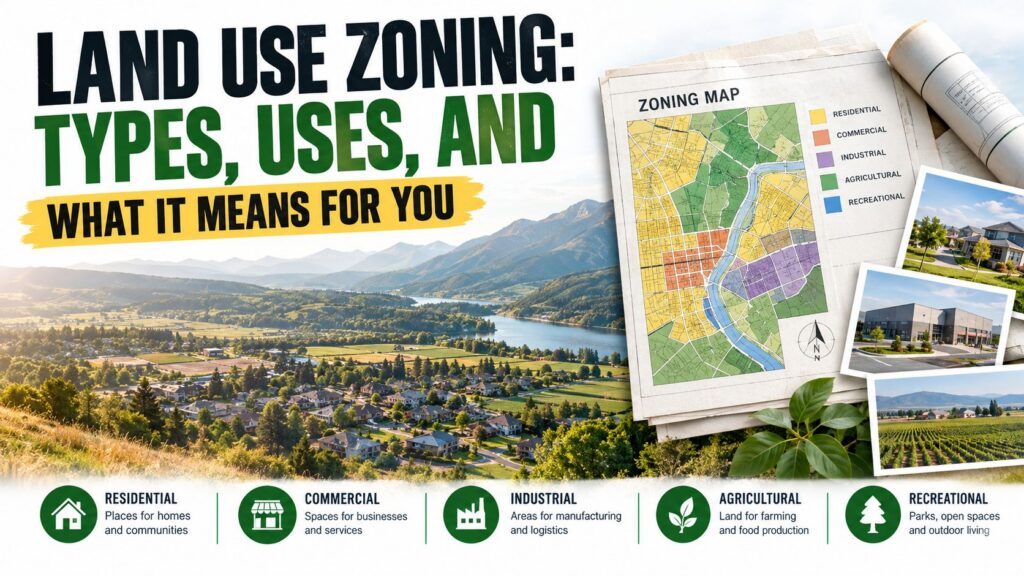
You've found a five-acre parcel online that looks almost too affordable to ignore. The photographs show open sky, a rough access road, and plenty of room for a cabin, workshop, or small homestead. Then you notice a short listing code, perhaps “A-1,” “R-R,” or “R-3,” and realize the parcel's price says nothing about what you're legally allowed to do there. That code is part of land use zoning, the local rule system that controls how property may be used and developed. Zoning can decide whether you may build a home, place a manufactured house, keep livestock, operate a business, install an accessory dwelling, or develop a solar array. It also controls less obvious details, including where a structure can sit, how tall it may be, how much parking it needs, and whether the parcel has enough usable area to support the plan. Table of Contents Why Zoning Matters When You Buy Land Zoning is a location-management system The Main Zoning Types Explained Simply Residential districts Mixed-use districts Commercial districts Industrial districts Agricultural, rural, and conservation districts How to Find a Property's Zoning Designation Begin with the official parcel map Read the map and ordinance together Call when the map leaves questions What Uses Each Zone Actually Allows Variance vs Rezoning and When to Use Each The two requests solve different problems Cost and timing require local confirmation Beyond the Label Implementation Rules That Decide What You Build Rules that shrink the usable site Overlays and non-zoning approvals A Pre-Purchase Zoning Checklist for Land Buyers Run the parcel through these checks Why Zoning Matters When You Buy Land A deed gives you ownership. It doesn't automatically give you permission to build. Suppose you buy the inexpensive rural parcel, pay the seller, and receive the deed. Later, you learn that the Rural Residential district prohibits manufactured housing. Or the Agricultural district requires a larger minimum parcel before a dwelling is allowed. A Commercial district may permit shops, offices, or storage but prohibit a private residence as the primary use. The land is yours, yet the project you imagined may not be legal. The same problem can affect smaller plans. A buyer might want to place a cabin, park an RV while building, dig a well, install septic, or keep a few animals. Each activity may involve zoning, building regulations, health rules, road-access standards, or separate county approvals. A cheap parcel becomes expensive when the buyer discovers that the intended use requires a conditional permit, a variance, a larger lot, or infrastructure the site can't support. Practical rule: Treat the zoning code as part of the property itself. Before you evaluate the view, evaluate the rules. Zoning is a location-management system Municipalities use zoning to separate or organize land uses. A community may place homes away from heavy industrial activity, reserve commercial corridors for businesses, protect farmland from scattered development, or limit construction near waterways. The system usually answers three practical questions: What may happen here? This covers uses such as a single-family home, retail store, warehouse, farm operation, or utility facility. Where may it happen? Setbacks, lot coverage, access rules, and building envelopes control placement. What conditions apply? Parking, height, landscaping, drainage, occupancy, and review requirements can change the feasibility of an otherwise permitted use. Zoning became a major municipal land-use tool in the United States during the early twentieth century. Los Angeles adopted what's widely cited as the country's first municipal zoning ordinance on July 25, 1904, and New York City adopted the first major U.S. zoning ordinance on July 25, 1916. By the end of 1916, 8 cities had adopted zoning ordinances. By 1926, 68 additional cities had done so, and by 1936, 1,246 more municipalities had adopted ordinances covering roughly 70% of the U.S. population, as summarized in the history of zoning in the United States. The Supreme Court's 1926 Euclid v. Ambler Realty decision upheld zoning as constitutional, which helped accelerate adoption across the country. Zoning still affects major housing markets. The 2019 National Longitudinal Land Use Survey covered about 1,700 jurisdictions across the 50 largest U.S. metropolitan areas, illustrating the reach of modern land-use regulation in the HUD User Cityscape publication. The Main Zoning Types Explained Simply Think of zoning as a system that changes as you move from a city center toward open country. The names and codes vary by jurisdiction, but the broad categories help you interpret what a parcel may support. Residential districts Residential zoning generally supports housing. A low-density district, often labeled something such as R-1, may allow detached single-family homes on relatively large lots while excluding duplexes, townhomes, and apartment buildings. A higher-density district, perhaps labeled R-3, may allow smaller lots, townhomes, or small apartment buildings. The code matters more than the letter. One county's R-1 district may allow accessory dwelling units, while another may restrict them. One community may allow manufactured homes in a residential district, while another may require a special district or separate approval. Mixed-use districts Mixed-use zoning combines activities that are often separated elsewhere. A building might contain a shop, café, or office on the ground floor and apartments above. These districts can support walkable development, but they may also carry design standards, parking requirements, sign rules, and limits on operating hours. Commercial districts Commercial zoning ranges from neighborhood retail to larger auto-oriented corridors. A neighborhood commercial district might allow a small grocery, personal-service business, or office. A heavier commercial district may permit vehicle sales, repair uses, storage yards, or larger retail structures. A commercial designation doesn't automatically mean you can live there. Residential use may be prohibited, limited to an upper-floor unit, or subject to a special approval. Industrial districts Industrial districts support employment and production. Light industrial areas may allow assembly, fabrication, warehouses, or contractor yards with controls on noise, traffic, and outdoor storage. Heavy industrial districts are more likely to sit near rail lines, ports, or major freight routes and may involve stricter environmental and safety regulation. Agricultural, rural, and conservation districts Agricultural zoning
You're sitting at your laptop, looking at a rural parcel advertised for $99 per month, no bank involved, no complicated application, and a checkout button that makes ownership feel one click away. That monthly payment may be attractive, but it tells you almost nothing about whether you can legally reach the property, build on it, obtain clear title, or recover your money if the seller can't deliver what was promised. A land purchase agreement is the document that answers those questions. In an owner-financed deal, it can be more important than the listing, the seller's emails, and the payment schedule itself. The agreement must protect your right to use the parcel, define how ownership changes, and spell out what happens when either party fails to perform. Table of Contents What a Land Purchase Agreement Actually Does The contract has three jobs Anatomy of the Core Clauses Clauses that carry the most weight Title Work and Due Diligence Before You Sign Rural land needs a different checklist Owner Financing Compared to a Standard Sale Negotiating Terms That Actually Matter A realistic negotiation From Signed Contract to Recorded Deed A practical closing sequence Closing Checklist and Common Mistakes What a Land Purchase Agreement Actually Does A land purchase agreement is a binding contract between the buyer and seller. It identifies the parcel, sets the price and payment terms, establishes deadlines, and creates the conditions for transferring ownership. A listing describes an opportunity. The contract creates enforceable obligations. That distinction matters with vacant land because a parcel can look usable online while carrying serious restrictions in the public records. A listing might show a road nearby, but the property may lack recorded legal access. It might appear suitable for a cabin, yet zoning, septic limitations, floodplain rules, wetlands, or utility problems can make the intended use impractical. The contract has three jobs First, it transfers equitable rights. In a standard sale, the buyer usually receives a deed at closing. In an owner-financed land contract, the seller may retain legal title until the buyer finishes paying, while the buyer receives contractual or equitable rights under the agreement. That difference affects resale, refinancing, inheritance, and protection against the seller's later actions. Second, it defines default consequences. The agreement should state how much notice a party receives, how a default can be cured, whether the seller must refund payments, and whether the seller must use judicial foreclosure instead of canceling the contract. A vague default clause gives the seller too much room to interpret the outcome after the buyer has invested money. Third, it controls the investigation period. The buyer needs time to verify title, access, boundaries, zoning, mineral reservations, taxes, and physical conditions before becoming fully committed. The contract should make that review an express contingency, not an informal promise. Practical rule: Treat the agreement as the deal's safety system. If a protection isn't written into it, assume you don't have that protection. Land contracts have a long history, from private seller financing to transactions that changed national boundaries. The U.S. Department of State's history of the Gadsden Purchase describes a major territorial agreement finalized in 1854, when the United States paid Mexico $10 million for 29,670 square miles. The Louisiana Purchase, finalized in 1803, involved roughly 828,000 square miles and about $15 million, according to the same verified historical record. The scale is different, but the principle remains: a land agreement defines rights, obligations, and consequences. Anatomy of the Core Clauses A strong agreement starts with precision. The parties' full legal names must match the people or entities shown in the title records. The property description should use the legal description from the deed or county record, not only a street address, parcel nickname, map pin, or seller-created shorthand. The payment section needs more than a monthly figure. It should identify the purchase price, down payment if any, principal balance, interest rate, payment due date, late charges, grace period, amortization method, and any balloon payment. If the seller can demand the entire balance after a missed payment, that right must be unmistakable. Earnest money also needs clear handling instructions. The agreement should state the amount, who holds it, when it becomes refundable, and what happens if the buyer terminates under a contingency. Never rely on an email promise that the deposit will be returned. Clauses that carry the most weight The closing and possession provisions should identify the target closing date, the documents each party must deliver, and when the buyer can enter or use the parcel. A buyer shouldn't assume possession follows the first payment unless the contract says so. The seller's representations should cover ownership, authority to sell, liens, pending claims, taxes, access information, and known restrictions. These statements won't replace title work, but they create a written record against which the seller's disclosures can be evaluated. The owner-financed provisions deserve special attention: Warranty deed requirement: State that the seller will deliver a properly executed warranty deed after the final payment, subject only to listed exceptions. Recording right: Require recording of a memorandum of land contract or another permitted notice of the buyer's interest. Default procedure: Demand specific notice and cure terms, and clarify whether the seller must pursue judicial foreclosure instead of using a shortcut forfeiture process. Payoff process: Require a written payoff statement and define when the deed must be delivered and recorded after payment clears. Assignment terms: Explain whether the buyer can assign the agreement, place it in a trust, or transfer it with the seller's consent. Clause Plain-Language Purpose Non-Negotiable for Owner Financing Legal description Identifies the exact parcel Yes Payment schedule Explains what the buyer owes and when Yes Due diligence contingency Gives the buyer an exit if records or use don't work Yes Default and cure Defines the process after missed performance Yes Memorandum recording Gives public notice of the buyer's contract interest Strongly recommended Final deed Establishes how legal title transfers Yes Seller representations Records key promises about title and property Yes Assignment Controls
You bought a five-acre parcel with a clear plan: keep one homesite for your family, split off the rest, and perhaps sell the new lots later. Then the planning department asks for a current survey, a preliminary plat, road frontage details, drainage information, utility plans, and proof of legal access. The project that looked like a line drawn across a map turns out to be a regulated approval process. That's the reality behind how to subdivide land. A parcel may appear large enough for several lots, yet fail because the new parcels lack frontage, usable access, compliant setbacks, or a practical way to receive water, sewer, or septic service. The safest approach is to test buildability before paying for a full design. Table of Contents What Subdividing Land Really Means Three concepts buyers often confuse Zoning, Access, and Setbacks You Must Clear First Subdivision requirements at a glance The Full Subdivision Workflow From Sketch to Recording Follow the agency's sequence Realistic Timelines and Where the Time Goes Conditions can outlast the review Cost Drivers Most Buyers Underestimate Subdivision cost drivers Pitfalls That Sink Otherwise Promising Splits Access and frontage are separate questions Rules are moving in different directions A Pre-Subdivision Checklist Before You Commit What Subdividing Land Really Means Subdivision means creating legally recognized parcels from a parent parcel under the rules of the local planning authority. The owner doesn't decide what counts as a subdivision. The county, municipality, or other approving authority does, and its definition may distinguish between a minor split, a short plat, a full subdivision, and a simple lot line adjustment. An informal division is only an idea until the government approves and records the required documents. New boundaries generally need to be based on a current survey and fixed through an approved, registered plan or plat. Ontario's subdivision regulation requires a plan of subdivision to be prepared from a current survey, while New Jersey's rules require subdivision plats to be prepared by a licensed professional land surveyor using a current and accurate survey. Three concepts buyers often confuse Informal split: You sketch a proposed boundary or agree privately to transfer part of the property. That doesn't necessarily create a legal, separately conveyable lot. Lot line adjustment: You move a boundary between existing parcels without necessarily creating an additional buildable parcel. The local process may be simpler, but approval is still jurisdiction-specific. Recorded subdivision: The authority approves the plat, required conditions are satisfied, and the final document is recorded. The recorded plan establishes the new legal parcels, easements, rights of way, and other matters shown on it. A paper subdivision can therefore be legally valid while remaining impractical for construction. A proposed lot might meet the area requirement but have no permanent access, insufficient road frontage, an unusable shape, or no viable septic area. Building departments and lenders care about those details because a legal parcel isn't automatically a buildable parcel. The technical foundation is the survey. In British Columbia, when original corner evidence can't be confirmed, the surveyor must measure between undisputed corners and divide the distance proportionally among the new lots or legal subdivisions. That illustrates the core principle: new lot lines must connect to authoritative boundary evidence, not informal stakes or an owner's estimate. Zoning, Access, and Setbacks You Must Clear First Before ordering engineering, read the zoning map and the subdivision code for the specific parcel. The initial question isn't whether the land is large enough. It's whether the proposed lots can satisfy lot area, frontage, access, setbacks, utilities, drainage, and land-use requirements at the same time. A practical review has three separate layers: Zoning and land-use entitlement: This determines whether the proposed use and lot pattern are allowed. Subdivision approval: This tests the layout, roads, easements, servicing, drainage, and survey documents. Construction permits: These address the actual building, driveway, septic system, grading, and other site work. Treating those layers as interchangeable causes expensive redesign. A zoning district might permit a certain lot size, while subdivision standards require frontage on a dedicated or improved street. A lot might pass both tests and still need a construction permit that depends on setbacks, driveway access, stormwater controls, or septic approval. For a plain-language starting point on reading the land-use side of the problem, review this guide to property zoning in the United States. Then confirm every conclusion against the current local code and a planning staff member's written guidance. Subdivision requirements at a glance Layer Typical Requirement Where It Is Checked Zoning and land use Permitted use, minimum lot area, density, and setbacks Zoning map, zoning code, planning department Subdivision approval Plat format, lot configuration, roads, easements, frontage, and improvements Subdivision code and planning review Construction permits Building envelope, driveway, drainage, utilities, septic, and site plans Building, engineering, public works, and health departments Access deserves early attention because it can eliminate an otherwise attractive layout. Confirm whether each proposed lot has direct frontage, a recorded access easement, or another form of permanent legal access accepted by the jurisdiction. Don't assume a dirt track, family agreement, or historical use will satisfy the building department. Setbacks create a second hidden constraint. Draw the required building envelope on the proposed lot, not just the outer boundary. If the envelope disappears because of a narrow shape, slope, wet area, access corridor, or neighboring restriction, the lot may be divisible on paper but unusable in practice. The Full Subdivision Workflow From Sketch to Recording The process usually starts with a conversation, not a finished survey. Bring planning staff a parcel map, basic ownership information, the intended lot count, and a rough sketch showing access. The pre-application meeting can expose fatal issues before you pay for detailed engineering. The surveyor then establishes the parent parcel's boundaries and prepares the technical base for the layout. Depending on the site, the design team may also need topography, drainage information, utility locations, environmental constraints, and road concepts. A useful explanation of the documents involved appears in this guide to land survey requirements.
You've found a rural parcel listed for less than you expected, and the monthly payment looks manageable. Then you notice the road may be private, power lines stop miles away, and the county website says little about whether you can build. That's the point where buying cheap land stops being a simple bargain hunt and becomes a total-cost decision. The right question isn't only, “How low is the price?” It's, “Why is this land inexpensive, what will ownership cost, and can I legally use it for my purpose?” This guide shows how to buy cheap land without confusing a low listing price with a low-cost property. Table of Contents Why Cheap Land Is Harder to Find Than You Think Why geography controls the bargain Finding Affordable Parcels Using Smart Search Strategies Build the search around the use Treat every listing as an opening claim Contact owners with focused questions The Hidden Costs That Make Cheap Land Expensive Infrastructure changes the definition of affordable Carrying costs and tax status Using Zero-Down Owner Financing to Acquire Land Understand the agreement before the payment Match the payment to your ownership plan Negotiating and Choosing Between Payment Options Negotiate the terms, not only the price Questions that expose the real deal Your Action Plan for Buying Affordable Land Follow the verification sequence Why Cheap Land Is Harder to Find Than You Think A first-time buyer often searches by price, sorts from lowest to highest, and assumes the cheapest result is the best starting point. That approach produces plenty of listings, but it doesn't separate usable rural land from parcels with no legal access, severe terrain, restrictive zoning, or no practical water solution. The national market gives useful context. USDA has tracked U.S. farmland values since 1912, and its long record shows how dramatically land values can change. Average farm real estate values were about $69 per acre in 1920, fell to roughly $31 per acre in 1934, and reached $131 per acre by 1963. USDA reported an average of $4,500 per acre in 2026, an increase of $150 per acre, or 3.4%, from 2025. These figures come from the USDA 2026 land values report. Why geography controls the bargain Affordable land is concentrated in places where population density, agricultural productivity, and development pressure are limited. Recent reporting places the median county farm real estate value at $4,382 per acre, while only 2% of U.S. counties, 61 out of 3,072, average under $1,000 per acre. The cheapest county medians cluster in the arid West and northern Plains, according to this U.S. land value report. New Mexico has the lowest state county median in that reporting, at $796 per acre, while Rhode Island reaches $24,586 per acre, creating a 31-fold gap. Nevada, Wyoming, and New Mexico also frequently appear among lower-cost markets in USDA regional data. Practical rule: Cheap land usually reflects local economics, water access, soil productivity, or limited development demand. It rarely appears cheap because a seller simply forgot to update the listing. A low price can still be attractive if your goal is recreation, long-term holding, or a modest off-grid project. It becomes dangerous when you need immediate residential use but haven't confirmed access, septic feasibility, water rights, or permitted structures. Start with the county, not the listing headline. Finding Affordable Parcels Using Smart Search Strategies A disciplined search keeps you from spending hours on parcels that never fit your budget or intended use. Begin by writing down the total cash you can commit, the maximum monthly payment you can sustain, and the purpose of the land. A recreational parcel, future homesite, and agricultural holding require different filters. Build the search around the use Use budget collections to create a first pass, but don't treat the price band as your final decision. A parcel under a low threshold may fit your purchase budget while failing your access or development requirements. Conversely, a slightly higher-priced parcel near an existing road or utility corridor may carry a lower total cost. Search by state and county next. Low-cost opportunities are more common in sparse-population, non-coastal markets, particularly in the West and northern Plains. The seven-step state land search guide can help organize that process, but county-level verification still belongs to the buyer. Use a spreadsheet with columns for: Parcel identity: Record the parcel number, legal description, acreage, and listing location. Intended use: Note whether camping, an RV, a dwelling, livestock, or recreational use is permitted. Access status: Separate a visible route from a recorded legal easement. Infrastructure distance: Record what you learn about power, water, septic, and road conditions. Ownership cost: Add taxes, association charges if any, financing obligations, and planned improvements. Treat every listing as an opening claim Map images and listing descriptions are useful for narrowing choices, not proving suitability. Check the county assessor's parcel map, planning department records, recorded plat, and deed history. Ask the county whether the parcel has legal access, what zoning applies, whether minimum build requirements exist, and whether any recorded restrictions affect your plans. Then contact the utility providers and local contractors. A power company can explain whether service is nearby, while a well contractor or health department can describe local water and septic conditions. You don't need perfect estimates at the search stage, but you do need enough information to reject obviously unsuitable parcels. Contact owners with focused questions When a property survives the first review, ask the seller for the legal description, title information, access documents, tax status, and known restrictions. Don't rely on a promise that “people camp there” or “utilities are close.” Those statements may describe informal use rather than a legally permitted or financially practical use. The process works because each filter removes a different risk. Price identifies possibility, geography improves the odds, county records establish legal facts, and a site visit tests physical reality. The Hidden Costs That Make Cheap Land Expensive The purchase price can be the smallest part of owning raw land. A parcel that looks affordable online may need
You're scrolling through listings late at night when a five-acre parcel appears for far less than nearby rural tracts. The photos show pine trees, open sky, and a road that looks perfectly usable. The description says “off-grid potential,” and the price feels like an invitation to act before someone else takes it. That's exactly when buyers get into trouble. Off grid land for sale isn't a lifestyle purchase first. It's a six-factor screening problem involving access, water, septic, power, zoning, and total setup cost. A low listing price may reflect missing infrastructure, a difficult road, restrictive covenants, or land that can't support the home you want. The practical question isn't “How much does this acreage cost?” It's “Can this parcel legally and physically support the life I'm planning, and what will it cost to make that possible?” Table of Contents The Off-Grid Land Trap Most Buyers Walk Into Treat the parcel like a screening exercise What Off-Grid Living Actually Means for a Parcel Remote does not always mean off-grid Verifying Access, Water, and Septic Before You Buy Access must be both legal and physical Water needs evidence, not optimism Septic is a soil question Solar and Wind Potential by Site and Region A simple solar sizing check Zoning, Building Codes, and Use Restrictions Verify the intended structure directly Search the records that survive the sale Financing Options for Off-Grid Land Buyers Real Setup Costs Behind an Off-Grid Property Price the parcel as a livable property A Final Checklist and Common Mistakes to Avoid Mistakes that turn bargains into burdens The Off-Grid Land Trap Most Buyers Walk Into The buyer in that late-night example usually starts with price per acre. That's the wrong starting point. A cheap parcel can be a good purchase, but it can also be a piece of land with no recorded access, no viable well location, no septic approval, or a buildable area squeezed between setbacks and steep terrain. Listing photos won't show a road after heavy rain. They won't reveal whether the access route crosses private land, whether the driveway becomes impassable in winter, or whether the nearest power pole sits much farther away than the listing suggests. They also won't tell you whether the county permits a full-time residence, a tiny home, an RV, or a seasonal cabin. Treat the parcel like a screening exercise Work through these questions before you make an offer: Access: Do you have a recorded easement or public road connection, and can a normal vehicle reach the site throughout the year? Water: Is there a workable well location, a documented spring, legal rainwater collection, or another permitted source? Septic: Has the soil passed a perc test or other required evaluation, and is there enough suitable ground for the system? Power: Can solar, wind, or a generator system meet the intended demand without excessive clearing or fuel dependence? Zoning: Can you build and occupy the structure you want under current county rules? Total setup cost: What will access improvements, water, waste treatment, shelter, permits, and labor add to the land price? USDA's 2024 Tenure, Ownership, and Transition of Agricultural Land survey reported 2.1 million landlord ownership arrangements, with 87% classified as non-operating landlords who owned 79% of rented land. Landlords received $34.1 billion in rental income, while the value of land and buildings for owned acres rented out reached $1.7 trillion, according to the USDA agricultural land survey. Those figures describe agricultural ownership, not every off-grid listing, but they show why rural property ownership can be fragmented and held long term. A low-friction purchase structure may appeal to buyers, but financing convenience never replaces due diligence. Practical rule: Screen the parcel before you screen the price. If one of the six factors fails, the bargain may be unusable. What Off-Grid Living Actually Means for a Parcel Off-grid living means your property must function without dependable municipal support. That requires more than a solar panel and a cabin. You need a coordinated system for power, water, waste, and shelter, with each layer sized for the site and the people using it. Think about a remote cabin during a cold week. The cabin needs electricity for lights, refrigeration, communications, and pumps. It needs potable water from a well, spring, tank, or permitted collection system. It needs a way to handle wastewater and human waste. Finally, the shelter itself must satisfy applicable building and occupancy rules. If any one layer fails, the property may remain usable for recreation but not for the full-time homestead you had in mind. Remote does not always mean off-grid A parcel can be remote and still have nearby utility infrastructure. Another parcel can sit close to a maintained road but lack affordable hookups. The important distinction is whether the property has functioning connections or whether you must create independent systems. Some buyers choose a hybrid arrangement. They might use grid electricity but install a private well and septic system, or use solar with a backup generator while relying on a permitted utility connection for water. Hybrid systems can reduce operational risk, but they still require verification of connection availability, fees, easements, and county approval. The largest technical cost driver is usually distance from existing infrastructure. The utility installation cost guidance from HomeGuide places the overall cost of bringing utilities to raw rural land at about $9,000 to $34,500 or more, with electric service commonly priced at $5 to $25 per linear foot. Those figures vary by terrain, provider, and distance, but the lesson is straightforward. A parcel that looks inexpensive can become materially more expensive if every service must be extended from far away. Don't design the dream system before identifying the actual need. List the shelter type, occupants, appliances, water demand, heating method, seasonal use, and permitted waste solution. Then evaluate whether the land can support that combination. Verifying Access, Water, and Septic Before You Buy These three checks decide whether many off-grid parcels are livable. Handle them before closing, not after you've paid for a survey,