

You're sitting at your laptop, looking at a rural parcel advertised for $99 per month, no bank involved, no complicated application, and a checkout button that makes ownership feel one click away. That monthly payment may be attractive, but it tells you almost nothing about whether you can legally reach the property, build on it, obtain clear title, or recover your money if the seller can't deliver what was promised.
A land purchase agreement is the document that answers those questions. In an owner-financed deal, it can be more important than the listing, the seller's emails, and the payment schedule itself. The agreement must protect your right to use the parcel, define how ownership changes, and spell out what happens when either party fails to perform.
Table of Contents
- What a Land Purchase Agreement Actually Does
- Anatomy of the Core Clauses
- Title Work and Due Diligence Before You Sign
- Owner Financing Compared to a Standard Sale
- Negotiating Terms That Actually Matter
- From Signed Contract to Recorded Deed
- Closing Checklist and Common Mistakes
What a Land Purchase Agreement Actually Does
A land purchase agreement is a binding contract between the buyer and seller. It identifies the parcel, sets the price and payment terms, establishes deadlines, and creates the conditions for transferring ownership. A listing describes an opportunity. The contract creates enforceable obligations.
That distinction matters with vacant land because a parcel can look usable online while carrying serious restrictions in the public records. A listing might show a road nearby, but the property may lack recorded legal access. It might appear suitable for a cabin, yet zoning, septic limitations, floodplain rules, wetlands, or utility problems can make the intended use impractical.
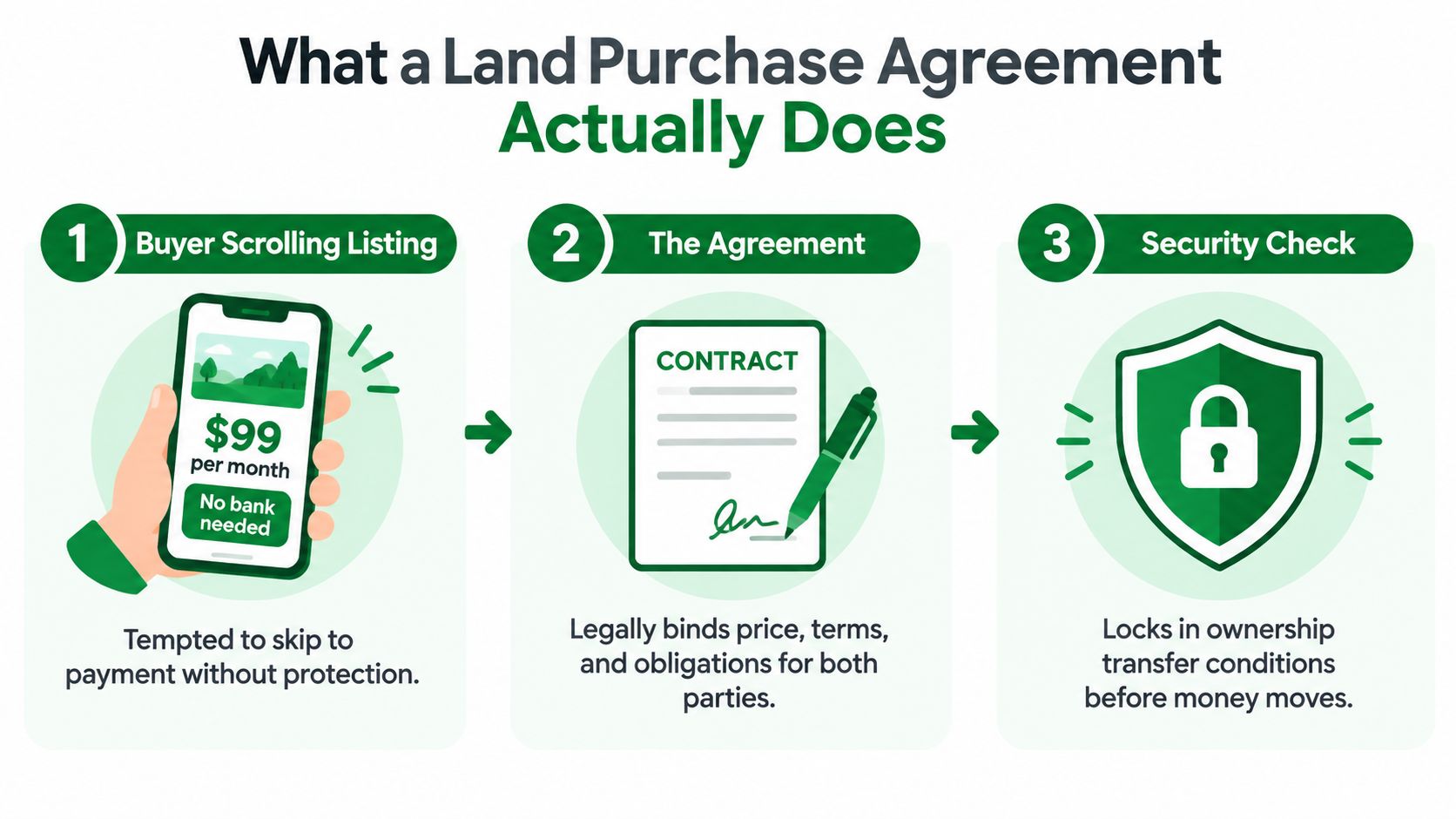
The contract has three jobs
First, it transfers equitable rights. In a standard sale, the buyer usually receives a deed at closing. In an owner-financed land contract, the seller may retain legal title until the buyer finishes paying, while the buyer receives contractual or equitable rights under the agreement. That difference affects resale, refinancing, inheritance, and protection against the seller's later actions.
Second, it defines default consequences. The agreement should state how much notice a party receives, how a default can be cured, whether the seller must refund payments, and whether the seller must use judicial foreclosure instead of canceling the contract. A vague default clause gives the seller too much room to interpret the outcome after the buyer has invested money.
Third, it controls the investigation period. The buyer needs time to verify title, access, boundaries, zoning, mineral reservations, taxes, and physical conditions before becoming fully committed. The contract should make that review an express contingency, not an informal promise.
Practical rule: Treat the agreement as the deal's safety system. If a protection isn't written into it, assume you don't have that protection.
Land contracts have a long history, from private seller financing to transactions that changed national boundaries. The U.S. Department of State's history of the Gadsden Purchase describes a major territorial agreement finalized in 1854, when the United States paid Mexico $10 million for 29,670 square miles. The Louisiana Purchase, finalized in 1803, involved roughly 828,000 square miles and about $15 million, according to the same verified historical record. The scale is different, but the principle remains: a land agreement defines rights, obligations, and consequences.
Anatomy of the Core Clauses
A strong agreement starts with precision. The parties' full legal names must match the people or entities shown in the title records. The property description should use the legal description from the deed or county record, not only a street address, parcel nickname, map pin, or seller-created shorthand.
The payment section needs more than a monthly figure. It should identify the purchase price, down payment if any, principal balance, interest rate, payment due date, late charges, grace period, amortization method, and any balloon payment. If the seller can demand the entire balance after a missed payment, that right must be unmistakable.
Earnest money also needs clear handling instructions. The agreement should state the amount, who holds it, when it becomes refundable, and what happens if the buyer terminates under a contingency. Never rely on an email promise that the deposit will be returned.
Clauses that carry the most weight
The closing and possession provisions should identify the target closing date, the documents each party must deliver, and when the buyer can enter or use the parcel. A buyer shouldn't assume possession follows the first payment unless the contract says so.
The seller's representations should cover ownership, authority to sell, liens, pending claims, taxes, access information, and known restrictions. These statements won't replace title work, but they create a written record against which the seller's disclosures can be evaluated.
The owner-financed provisions deserve special attention:
- Warranty deed requirement: State that the seller will deliver a properly executed warranty deed after the final payment, subject only to listed exceptions.
- Recording right: Require recording of a memorandum of land contract or another permitted notice of the buyer's interest.
- Default procedure: Demand specific notice and cure terms, and clarify whether the seller must pursue judicial foreclosure instead of using a shortcut forfeiture process.
- Payoff process: Require a written payoff statement and define when the deed must be delivered and recorded after payment clears.
- Assignment terms: Explain whether the buyer can assign the agreement, place it in a trust, or transfer it with the seller's consent.
| Clause | Plain-Language Purpose | Non-Negotiable for Owner Financing |
|---|---|---|
| Legal description | Identifies the exact parcel | Yes |
| Payment schedule | Explains what the buyer owes and when | Yes |
| Due diligence contingency | Gives the buyer an exit if records or use don't work | Yes |
| Default and cure | Defines the process after missed performance | Yes |
| Memorandum recording | Gives public notice of the buyer's contract interest | Strongly recommended |
| Final deed | Establishes how legal title transfers | Yes |
| Seller representations | Records key promises about title and property | Yes |
| Assignment | Controls future transfer or resale rights | Important |
The contract should also address tax proration, insurance responsibilities, maintenance, notices, dispute resolution, and the law governing the agreement. Don't accept a clause that says the seller can reclaim the land and keep every payment without explaining the legal process. That provision can turn a payment problem into a total loss of accumulated equity.
Title Work and Due Diligence Before You Sign
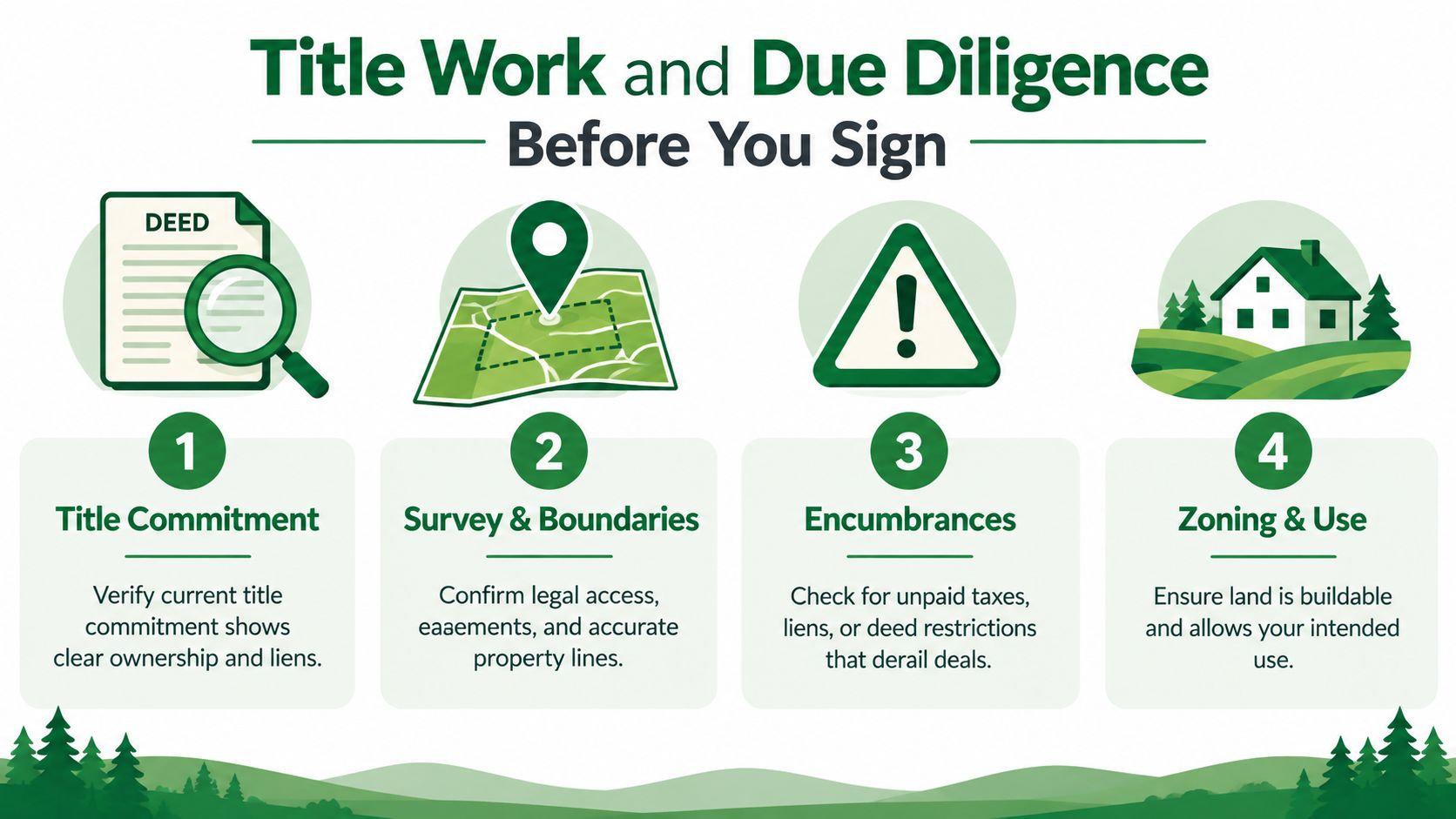
Don't sign first and investigate later. A buyer should make the agreement contingent on satisfactory title, access, survey, zoning, and physical-use review.
Start by ordering a current title commitment from a title company or qualified abstractor. Review the vesting deed, the chain of recorded ownership, open mortgages, tax liens, judgments, easements, restrictions, and mineral reservations. Search the seller's name as well as the parcel. A seller may own the land but still lack the ability to convey it free of an undisclosed lien or competing claim.
Pew's research illustrates why recording assumptions are dangerous. Its survey found that 78% of surveyed land contracts were recorded, 10% were not recorded, and 12% of buyers didn't know whether recording had occurred. Pew also estimated that the true number of active land contracts could range from 371,000 to 1 million after accounting for survey error, as explained in its land contract risk analysis.
Rural land needs a different checklist
Legal access comes first. Confirm that the parcel touches a public road or benefits from a recorded easement. Check the easement's width, route, permitted uses, maintenance duties, and whether it allows vehicles, utilities, construction traffic, and emergency access. A visible dirt track isn't proof of legal ingress and egress.
Boundaries need documentary support. Obtain a recent survey or reliable recorded plat. Compare the legal description, parcel map, monuments, fences, roads, and neighboring claims. For practical guidance on when a survey may be necessary, review these land survey requirements.
Mineral and water rights require separate attention. A deed can transfer the surface while reserving minerals to another party. Look for oil, gas, coal, timber, water, grazing, and access reservations. If the seller says the rights are included, require that promise to appear in the contract and, where applicable, the deed.
Use must be confirmed with the local authority. Verify zoning, minimum lot size, setbacks, manufactured-home rules, short-term rental restrictions, septic feasibility, floodplain status, wetlands, and utility availability. “Vacant” means there's no structure. It doesn't mean the parcel is buildable.
Tie every investigation to a written contingency. If the title commitment reveals a problem, the access review fails, or the survey conflicts with the listing, you need a contractual right to terminate or renegotiate before your money becomes difficult to recover.
Owner Financing Compared to a Standard Sale
A standard cash or bank-financed sale usually ends with a deed transfer at closing. The buyer pays the purchase price, the seller receives funds, and the deed is recorded. A lender may review title, require insurance, and control the closing process.
An owner-financed land contract changes that sequence. The seller accepts installment payments and may keep legal title until the balance is paid. The buyer still needs strong contractual rights, but the seller controls the deed and may have greater advantage if the agreement uses weak default language.
That distinction creates a different risk profile. A mortgage borrower generally faces a foreclosure process governed by state law and loan documents. A land-contract buyer may face a forfeiture or eviction-style remedy, depending on the jurisdiction and agreement. The buyer can lose possession and accumulated equity if the contract permits cancellation after default.
Pew describes land contracts as a significant housing-finance mechanism. Its statement on land contracts estimates that about 8 million Americans, roughly 5% of home-financing borrowers, have used one at some point, and about 1.4 million Americans were actively using one as of 2024. The same source reports about 490,000 recorded land contracts nationwide from 2005 to 2022, including 383,000 for residential properties.
| Contract Element | Standard Cash or Bank Sale | Owner-Financed Land Contract |
|---|---|---|
| Title transfer | Usually occurs at closing | Often occurs after final payment |
| Financing party | Bank or cash buyer | Seller |
| Buyer's interest | Deed ownership after closing | Contractual or equitable interest before payoff |
| Default risk | Loan remedies and foreclosure rules | Contract forfeiture or foreclosure language may apply |
| Due diligence | Often supported by lender requirements | Buyer must enforce protections directly |
| Recording | Deed is recorded at closing | Memorandum and final deed need deliberate handling |
| Balloon risk | Depends on loan terms | Common if the contract requires a lump-sum payoff |
| Resale | Buyer owns the deeded property | Assignment or payoff may be needed before resale |
Buyers considering seller financing should also understand how no-credit transactions work in practice. This guide to buying land with no credit explains the general appeal, but it doesn't remove the need to verify title, access, permitted use, and default remedies.
Negotiating Terms That Actually Matter
A remote buyer receives an offer for a parcel with $99 down and $199 monthly payments. The seller wants a quick electronic signature and says the legal access is “via existing road.” The buyer's first instinct is to negotiate the price. That's usually the wrong opening move.
The buyer should ask for the recorded access instrument, a longer inspection period, and a clear right to terminate if title, access, survey, or intended use doesn't check out. Those terms protect the transaction's basic value. A lower price doesn't help if the buyer can't legally reach the parcel.

A realistic negotiation
The seller refuses to change the monthly amount but agrees to provide the title commitment and recorded easement. The buyer then asks who pays for a survey. The seller won't pay for a full boundary survey, but accepts a clause allowing the buyer to order one during the review period and cancel if the legal description or access doesn't match.
Next, the buyer challenges the late-fee clause. The seller wants an immediate charge and broad cancellation rights. The buyer counters with written notice, a cure period, and no forfeiture while a documented payment dispute is being reviewed. That's a reasonable trade. The seller still receives protection against nonpayment, while the buyer avoids losing the parcel over an administrative mistake.
A balloon payment deserves direct questions. Ask when it's due, how the payoff is calculated, whether early payoff is allowed without penalty, and whether the seller will provide a written payoff statement. If the seller refuses to explain the balance, don't sign.
Negotiation advice: Give up on cosmetic concessions before you give up legal access, title protection, survey review, or a workable default remedy.
Sellers often hold firm on total price, down payment, and monthly amount. Buyers can frequently negotiate clearer access language, a longer review window, survey-cost allocation, permission for a manufactured home, assignment rights, and a discount or no penalty for early payoff. Put the proposal in a short, professional email with an expiration date. If the seller won't provide basic records or insists on an immediate irrevocable commitment, walk away.
From Signed Contract to Recorded Deed
Signing the agreement is the beginning of the closing process, not the end. Both parties should sign the correct version, complete any required notarization, and retain identical copies. Electronic execution can simplify a remote transaction, but the parties still need to confirm that the document satisfies the applicable state and county requirements.
Set up a reliable payment and document process. Escrow is preferable when available. If the seller handles payments directly, the agreement should identify the payment address or portal, receipt requirements, payoff method, late-payment procedure, and document custodian.
A practical closing sequence
- Execute and preserve the agreement. Save the signed PDF, signature certificate, exhibits, legal description, payment schedule, and seller disclosures in more than one secure location.
- Record notice of the buyer's interest. Ask whether the county accepts a memorandum of land contract or requires another filing. Confirm the recording receipt rather than assuming submission means completion.
- Confirm tax and insurance duties. Identify who pays property taxes before and during the installment period. The buyer should arrange any required liability or hazard coverage and keep proof available.
- Track every installment. Reconcile payments against the principal and interest schedule. Don't rely only on a bank statement if the seller's records determine the payoff balance.
- Request a written payoff statement. Before the final payment, obtain the exact balance, approved payment method, release requirements, and deed-delivery procedure.
- Review the final title evidence. The title commitment should be updated or otherwise reviewed for new liens, judgments, tax issues, or seller-related problems before the deed is accepted.
- Record the deed and confirm possession. The seller should deliver the deed required by the contract, and the buyer should verify county recording before treating the transfer as complete.
The legal description must remain consistent across the agreement, memorandum, deed, and county records. This land description guide can help buyers understand why parcel identifiers and formal descriptions matter more than an online map label.
County recording backlogs, missing payoff letters, unavailable notaries, and rural travel can slow the final transfer. Build enough time into the process to obtain written confirmation at each stage. The transaction is complete only when the required documents are signed, delivered, and recorded according to the contract and local procedure.
Closing Checklist and Common Mistakes
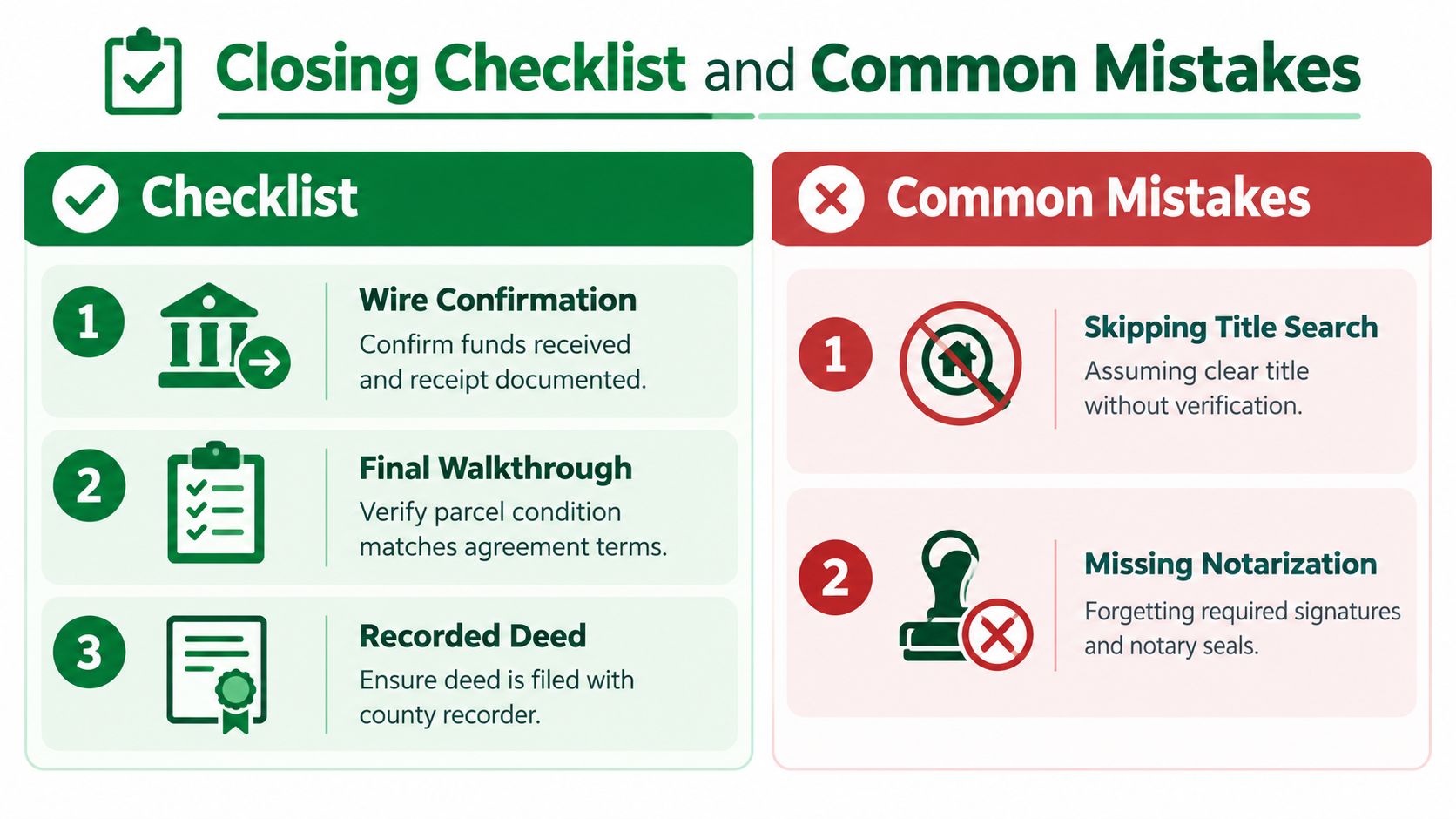
Use this checklist before treating an owner-financed land purchase as finished:
- Confirm funds: Keep the wire confirmation, payment receipt, and seller acknowledgment.
- Verify payoff: Obtain a written payoff statement before sending the final installment.
- Review title: Request updated title evidence and resolve new liens, judgments, taxes, or exceptions.
- Check the deed: Confirm the legal description, vesting names, required signatures, notarization, and deed type.
- Record the deed: Obtain the county recording number or stamped copy instead of relying on seller confirmation.
- Document possession: Complete a final walkthrough when access allows and save dated photographs.
- Preserve tax records: Keep the tax proration statement and the seller's contact information for unresolved billing questions.
- File applicable exemptions: Ask the local assessor whether homestead, agricultural, or other exemptions may apply.
The most common mistakes happen after the buyer believes the hard work is over. Buyers skip the final title pull, accept a quitclaim deed when the agreement calls for stronger title protection, overlook transfer taxes, or fail to verify that mineral and water rights are addressed in the recorded instrument.
Other buyers assume the seller-financing paperwork ends with the last payment. It doesn't. The buyer still needs the deed, recording confirmation, payoff documentation, payment history, and evidence that the seller's interest has been released where required.
The risk is not theoretical. The CFPB has cited expert estimates that more than 50% of land contracts end in loss of the home, while the National Consumer Law Center reports early default rates over 50% and public-data studies with failure rates above 50% in its testimony on alternative home financing. Those figures concern land-contract transactions broadly, but they support a clear recommendation: read the default, cure, title, and deed provisions with the same seriousness as the payment terms.
If you're comparing owner-financed parcels, LandZero provides online vacant-land listings, structured seller-financing options, electronic land-sale agreements, and a customer portal for managing payments. Review the property records and contract terms carefully, then visit LandZero to browse available land and start your due-diligence process.