

You've found a Colorado parcel with mountain views, a low advertised monthly payment, and a seller who says you won't need a bank or credit check. The offer feels accessible, especially if a traditional land loan isn't realistic. But the payment is only one part of the commitment. Before signing, you need to understand the contract, property taxes, access, water, septic feasibility, county rules, and the total amount you'll pay over time.
Owner financed land in Colorado can be a practical path to ownership, particularly for buyers seeking smaller rural parcels, recreational acreage, or a future homesite. It can also create long-term obligations that a listing rarely explains. The right question isn't just, "Can I make the monthly payment?" It's, "Can I legally use, afford, maintain, and eventually resell this parcel under the terms I'm accepting?"
Table of Contents
- Understanding Why Owner Financing Fits Colorado Buyers
- What Is Owner Financed Land and How Does It Work
- Navigating Colorado Legal Requirements and Contract Terms
- Analyzing Regional Market Data and Average Costs
- Tax Implications and Long-Term Financial Considerations
- Water Rights and Buildability Challenges in Colorado
- Essential Due Diligence Steps Before Signing
Understanding Why Owner Financing Fits Colorado Buyers
A buyer finds a Colorado parcel with an affordable monthly installment and plans to use it for occasional camping or a future homesite. The payment fits the budget, yet the ownership decision involves more than the installment. Property taxes, road access, water rights, wastewater options, maintenance, and resale conditions can continue for years after the contract is signed.
A remote parcel can also be difficult for a bank to finance. The buyer may see privacy, recreation, or future value, while a conventional lender may focus on uncertain access, limited utilities, unusual collateral, or underwriting rules the property does not meet.
Owner financing can address that lending barrier because the buyer negotiates payment terms directly with the seller rather than relying on a bank. It may suit buyers with limited savings, thin credit files, or plans for land that will not produce immediate income. The arrangement changes who receives the payments, however. It does not change county rules, property conditions, or the buyer's long-term responsibilities.

Why the Colorado market attracts this buyer
Colorado offers both high-value acreage and smaller parcels that may appeal to budget-conscious buyers. One statewide snapshot lists 13,261 properties for sale, covering 906,497 acres, with a median list price of $695,000 and a median price per acre of $12,990 (Colorado land market data). Those figures describe the wider market, not the likely cost or usability of one specific parcel.
Smaller owner-financed properties can attract buyers who want manageable acreage rather than a working farm or large ranch. Flexible installments may make the purchase possible, but buyers should calculate the full obligation. Ask who pays property taxes, whether insurance or association charges apply, how road or utility costs are handled, and what happens if the parcel cannot support the intended use.
A practical guide to buying land without traditional credit explains financing alternatives, while property research must answer separate questions. Can the buyer legally camp or build? Does the parcel have usable water rights and a lawful wastewater solution? Can the buyer reach it year-round? Financing can spread the purchase cost, but it cannot supply those rights or approvals.
Practical rule: Treat flexible financing as a payment arrangement, not as proof that the property is suitable for your plans.
What Is Owner Financed Land and How Does It Work
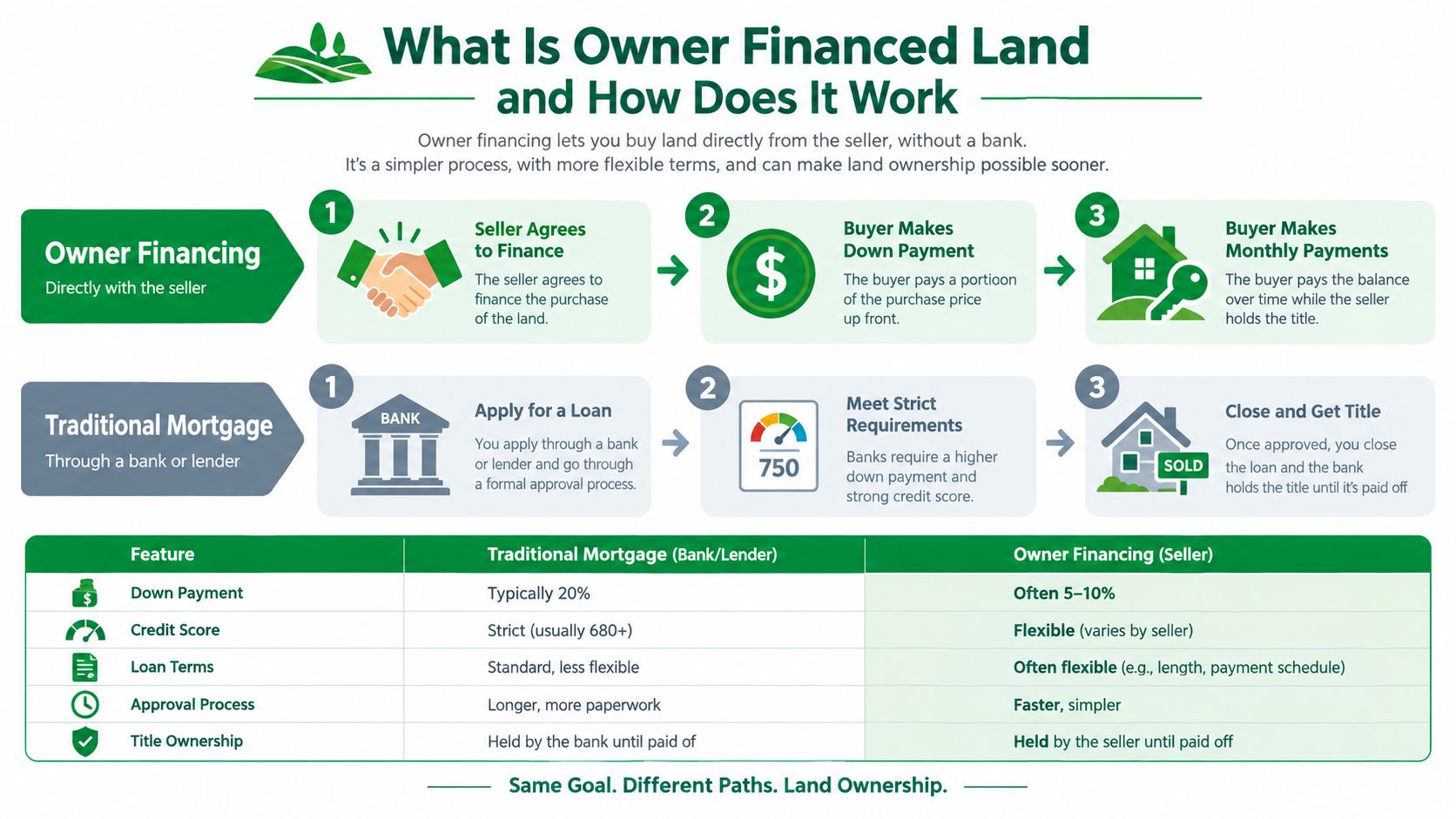
Owner financing means the seller accepts payments over time instead of requiring the buyer to obtain a conventional loan from a bank. The seller effectively becomes the financing party, although a title company, attorney, or loan servicer may help prepare documents, record instruments, or process payments.
The exact structure varies, but the process usually follows a straightforward sequence:
- The buyer and seller agree on the parcel and purchase terms. The agreement should identify the correct property, price, payment obligations, and responsibilities during the payment period.
- The buyer signs the financing documents. These may include a land purchase contract, promissory note, deed, or security instrument, depending on the structure.
- The buyer makes the required initial payment and recurring installments. The contract should state the due date, payment amount, interest treatment, late fees, and maturity terms.
- The seller transfers or retains title according to the agreement. Some arrangements transfer the deed at closing while securing the seller's interest through a recorded instrument. Others delay deed delivery until the balance is paid.
The monthly payment isn't the entire deal
Listings may emphasize zero down payments, no credit checks, or a low monthly amount. Those features can reduce the cash needed to begin, but they don't reveal the total cost. The buyer also needs to examine the interest rate, payment duration, final maturity date, possible balloon payment, taxes, association dues, insurance needs, and maintenance responsibilities.
A long payment schedule can make a parcel appear affordable while increasing the amount paid before the balance is cleared. A balloon payment can create a separate risk if the buyer must pay a large remaining balance at a stated date. The contract should make these obligations easy to identify before signing.
The buyer also needs to know who holds legal title during the term. Ask whether a deed is recorded at closing, whether the seller retains title, what security document is recorded, and what conditions trigger final deed delivery. If the answer is unclear, the buyer shouldn't rely on a verbal explanation.
Navigating Colorado Legal Requirements and Contract Terms
An owner-financed land purchase is not an informal handshake arrangement merely because a bank is not involved. Colorado's land contract form from the Colorado Real Estate Commission warns that, unless an exemption applies, federal and state laws may impose licensing, restrictions, and documentation requirements on private financiers (Colorado land contract form%20V2%20(fillable)_for%20use%20on%20or%20after%20January%201,%202026.pdf)).
That warning matters because the legal structure can change the obligations of the parties. A transaction may look like a simple installment sale, yet its terms and purpose could require a more careful compliance analysis. Buyers and sellers shouldn't assume that direct payments eliminate consumer-credit rules or make professional drafting unnecessary.
Documents that define the relationship
A strong contract package answers practical questions in writing:
- Property identification: The legal description, parcel details, and recorded information must match the land being sold. Buyers can review guidance on legal land descriptions to understand why a casual street address may not be enough.
- Payment obligations: The documents should state the principal balance, interest treatment, installment amount, due dates, maturity date, and any final balloon balance.
- Default procedures: The agreement should explain what counts as default, how notice is delivered, whether a cure period applies, and what remedies may follow.
- Title and recording: The contract should identify when ownership transfers, what gets recorded, and how the seller's interest is secured.
- Taxes and other charges: The parties should specify who pays property taxes, assessments, association dues, insurance, and any agreed maintenance costs during the payment period.
- Early payoff and transfer rights: The buyer should understand whether early payoff is permitted, whether a fee applies, and whether the buyer can sell or assign the agreement before paying it off.
Read default language before the payment schedule
Many buyers begin with the payment amount and skim the default section. Reverse that order. A missed payment can affect possession, title, accumulated equity, late charges, and the buyer's ability to recover money already paid. The consequences depend on the documents and applicable law, so the buyer shouldn't rely on a generic online form.
Legal review is especially sensible when the transaction uses a contract-for-deed structure, includes a balloon payment, involves unusual title arrangements, or places significant obligations on a private seller. A Colorado real estate attorney can explain whether the documents match the intended transaction and whether the buyer's protections are clear.
Analyzing Regional Market Data and Average Costs
A parcel advertised at a manageable monthly payment can still carry a high total price. Colorado land values vary with acreage, location, road access, development potential, recreation value, and parcel size. Comparing similar parcels helps separate a genuinely affordable purchase from financing that only makes an expensive property look accessible.
A current statewide listing snapshot reports 15,733 Colorado properties, 633,226 acres for sale, a median list price of $327,600, and an average property size of 40.4 acres (Colorado land listing data). The same listing pool identifies 945 owner-financed Colorado properties, with an average list price of $440,966, a median list price of $49,899, an average property size of 20 acres, and an average cost of $22,068 per acre.
These figures provide context, not a direct appraisal. General and owner-financed listings may cover different counties, parcel sizes, access conditions, zoning situations, and development prospects. Seller financing can also support a higher price per acre because payment access attracts buyers who cannot or do not want to use conventional lending.
Colorado Land Market Overview
| Metric | General Colorado Land | Owner-Financed Colorado Land |
|---|---|---|
| Properties listed | 15,733 | 945 |
| Average or median list price | Median $327,600 | Average $440,966, median $49,899 |
| Acreage or average property size | 633,226 acres total, average property size 40.4 acres | Average property size 20 acres |
| Price per acre | Median $12,990 | Average $22,068 |
A separate statewide view reports a median lot size of 38.6 acres and a median list price of $695,000. The difference between these snapshots shows why one statewide median cannot establish the value of a specific lot. Compare parcels with similar access, terrain, water availability, zoning, and intended use.
A Colorado cheap land search can help identify budget-oriented listings. Treat the advertised price as the starting point. Check taxes, road and access obligations, water rights, zoning, site work, and the full financing cost before deciding whether the parcel fits the budget. Affordability depends on both the purchase price and the long-term duties attached to ownership.
Tax Implications and Long-Term Financial Considerations
The most misleading number in an owner-financed listing is often the one buyers notice first, the monthly payment. That figure may be manageable while the complete ownership cost remains uncomfortable once interest, taxes, insurance, association charges, and maintenance are included.
Start with a written cost worksheet. Record the purchase price, initial payment, scheduled installments, interest, and any final balance. Then add recurring ownership expenses that continue whether or not the land is developed.
Separate financing cost from holding cost
Financing cost comes from the seller's payment terms. It includes interest and any documented fees associated with the agreement. Holding cost comes from owning the parcel. It may include property taxes, association dues, road charges, insurance appropriate to the site, vegetation management, access maintenance, security, and periodic travel to inspect remote land.
These costs don't disappear because the parcel is vacant. A buyer may not have a building to repair, but the land can still generate annual obligations. The contract should state who pays taxes and assessments during the financing period, and the buyer should verify whether taxes are current before signing.
Ask what happens over the full term
A low entry cost can help a buyer acquire land without a large upfront reserve. It can also leave less room for unexpected bills. If the agreement extends over a long period, the buyer should test the budget against changing income, travel costs, taxes, road conditions, and future development plans.
The relevant question is not just, “Can I start this purchase?” It's, “Can I carry this parcel while it remains undeveloped?” Current listing information shows a wide spread between owner-financed offerings, including listings with an average price of $440,966 and platforms describing some parcels starting under $20,000 with monthly payments around $249 (Colorado owner-financing listing information). That spread makes parcel-specific calculations essential.
A payment that fits today's budget may still be a poor deal if the buyer hasn't calculated taxes, interest, maintenance, and the final payoff obligation.
Water Rights and Buildability Challenges in Colorado
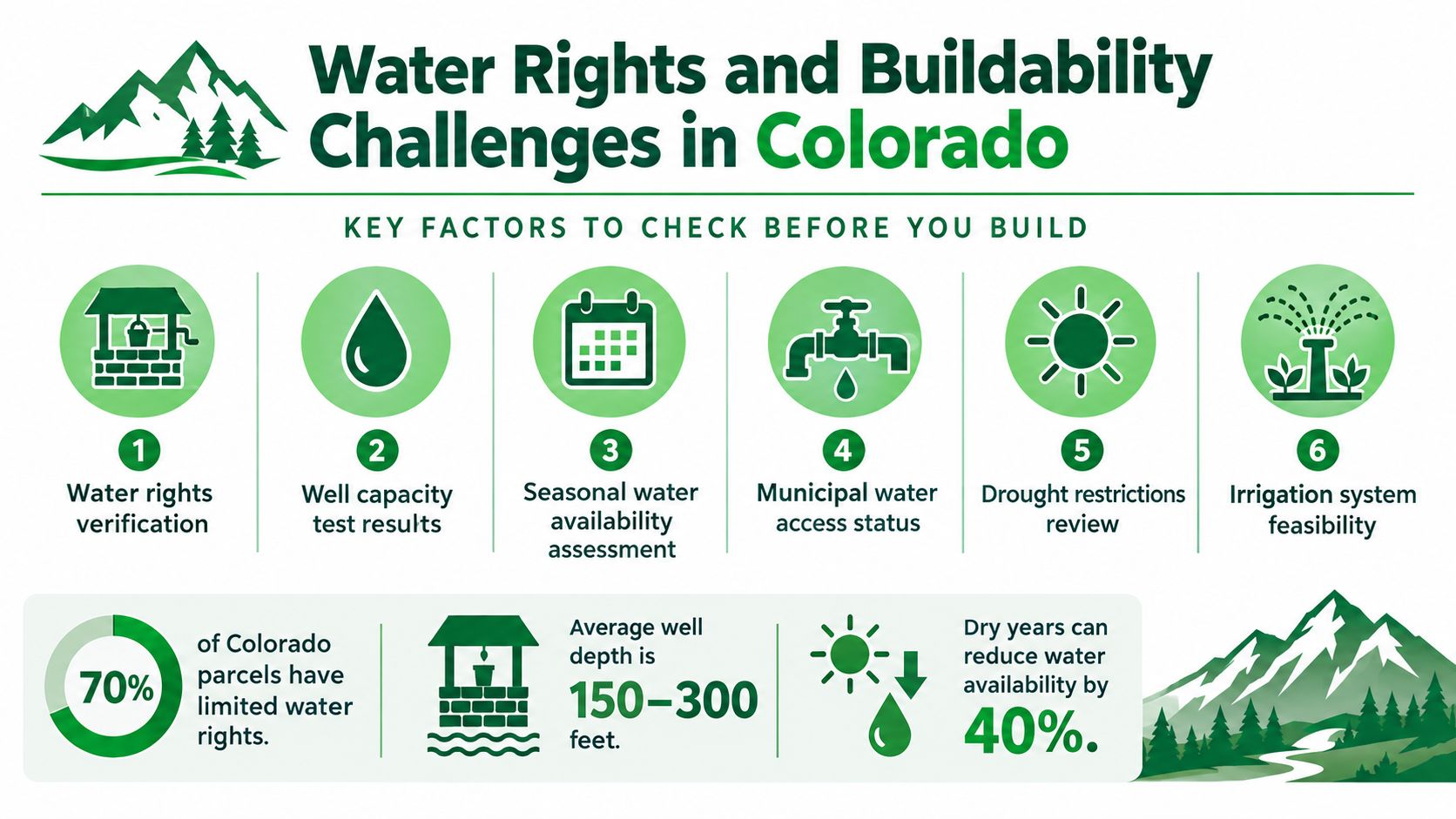
A parcel can look perfect on a map and still fail the buyer's intended use. In Colorado, water availability, wastewater feasibility, legal access, zoning, subdivision status, and site conditions can matter more than the financing structure.
Don't assume that a visible ditch, pond, or nearby well means the parcel includes usable water rights. Water rights may be separate from the land, and a listing's reference to water should prompt documentation requests rather than assumptions. Ask what rights convey, whether they're recorded, what use they support, and whether a well permit or other approval is required.
Verify the intended use with the county
A buyer interested in camping, RV use, off-grid living, or a future home should contact the county planning and building departments before signing. Ask direct questions about the specific parcel, not general questions about the surrounding area.
- Zoning: Confirm the permitted uses and whether recreational occupancy, RV placement, storage, agriculture, or residential construction is allowed.
- Subdivision status: Determine whether the parcel is a legally created lot and whether additional review is required.
- Access: Confirm both legal access and practical access. A recorded easement may exist, but the road may still be seasonal, steep, private, or difficult to maintain.
- Septic feasibility: Ask whether the soil, lot layout, and local rules support an approved wastewater system.
- Flood and site constraints: Request information about flood hazards, setbacks, slope, wetlands, and other conditions that could affect permits.
Boulder County illustrates why county-level research matters. Its guidance indicates that vacant parcels may require a Building Lot Determination, and site plan review applies to many vacant-parcel permit situations (Boulder County land-use guidance). Other counties may use different processes, so buyers must verify requirements where the parcel is located.
“Remote acreage” and “flexible zoning” are marketing descriptions, not permits. The county's written answer about the exact parcel is more useful than a listing headline.
Essential Due Diligence Steps Before Signing
Due diligence protects the buyer from purchasing a payment plan attached to unusable land. The strongest approach is to treat the parcel, contract, and future budget as three separate investigations. A favorable financing offer doesn't compensate for unclear title, missing access, or a property that can't support the buyer's intended use.
Confirm the land before evaluating the deal
Begin with the county and public records. Ask the planning department whether the parcel is a legal lot, what zoning allows, and whether the proposed use requires permits or additional review. Then verify the road situation in writing. Find out whether access is public or private, whether an easement is recorded, who maintains the road, and whether seasonal conditions affect practical access.
Next, investigate the physical site. Walk the parcel if possible, or arrange an inspection by someone who can document boundaries, terrain, road conditions, drainage, and nearby infrastructure. Aerial imagery can help you orient yourself, but it won't prove that a road is legally accessible or reliably passable.
Check title, water, and recurring obligations
A title search should identify ownership, liens, easements, restrictions, unpaid taxes, and other recorded interests. The buyer should confirm that the seller has authority to sell and that the legal description in the contract matches the title records.
Use this working checklist:
- Title: Order a title search and resolve liens, unpaid taxes, or ownership discrepancies before closing.
- Access: Confirm the legal easement or public-road connection and inspect the physical route.
- Water: Obtain written evidence of included water rights, well status, permits, or available alternatives.
- Wastewater: Ask the county whether septic evaluation or other sanitation approval is possible.
- Zoning: Get parcel-specific answers about building, camping, RV use, and off-grid plans.
- Restrictions: Review conservation easements, covenants, HOA or POA rules, and mineral interests.
- Budget: Add taxes, association charges, road expenses, inspections, utilities, maintenance, and financing costs to the payment.
- Contract: Have a qualified professional review title transfer, default remedies, late charges, payoff terms, and recording requirements.
Independent land-buying guidance identifies weak protections, unclear title transfer terms, missing easements, poor roads, and parcels that wouldn't pass ordinary financing review as risks buyers should investigate (Colorado land-buying red-flag checklist). Those issues don't always make a parcel worthless, but they can change its price, usability, resale prospects, and financing risk.
Before signing, ask the seller to provide every promise in writing. If the seller says water is available, document what “available” means. If the listing suggests camping is permitted, confirm the county rule for the exact parcel. If the deed transfers later, identify the trigger and recording process. A careful buyer doesn't reject every imperfect parcel. A careful buyer prices the risks, negotiates with clear information, and walks away when the obligations cannot be verified.
A practical way to begin is to compare Colorado parcels by location, budget, intended use, and financing structure, then investigate the county and contract before committing. LandZero offers vacant-land listings with online owner-financing options, so you can use its property information as a starting point for a documented due-diligence review.