
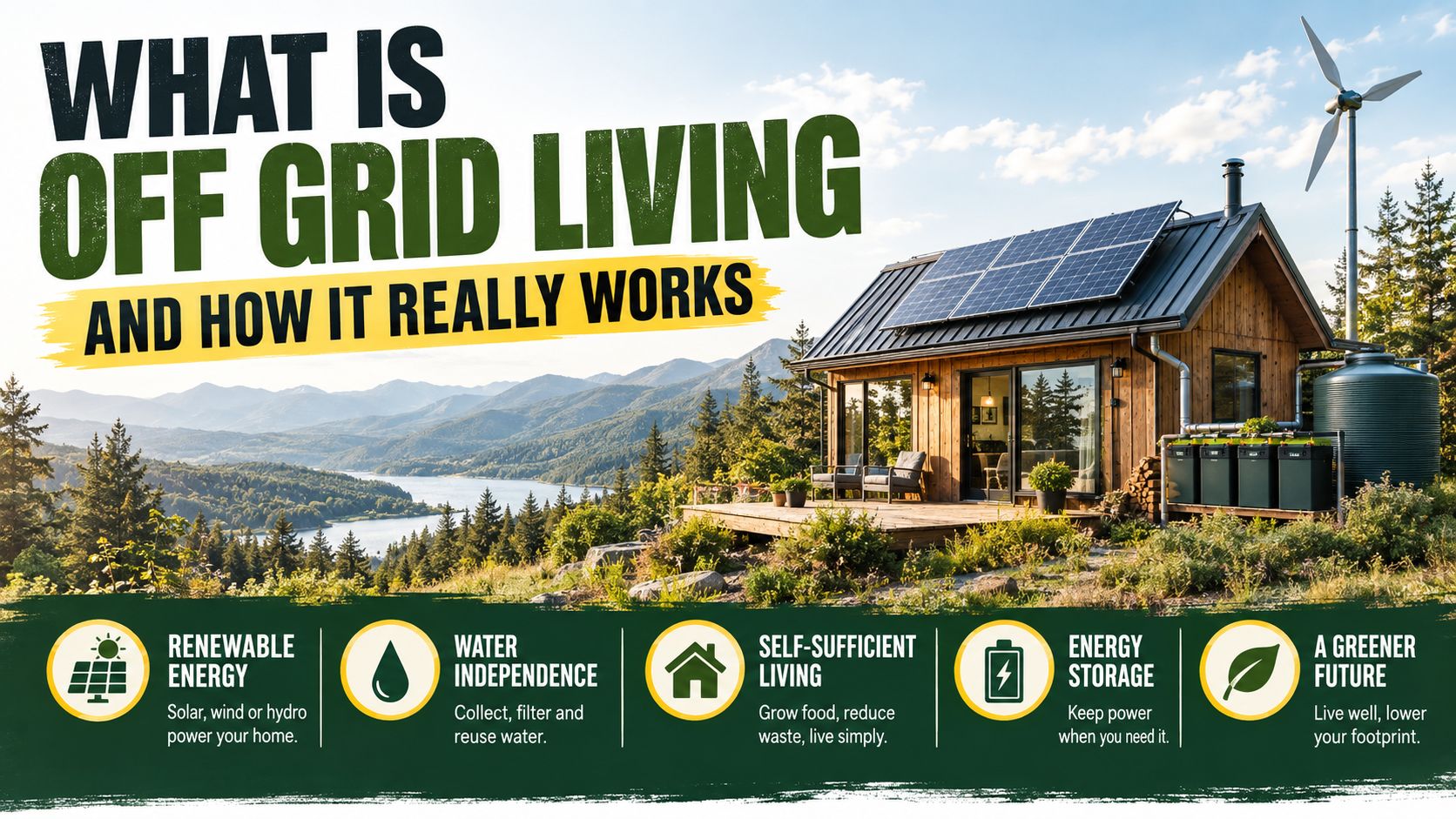
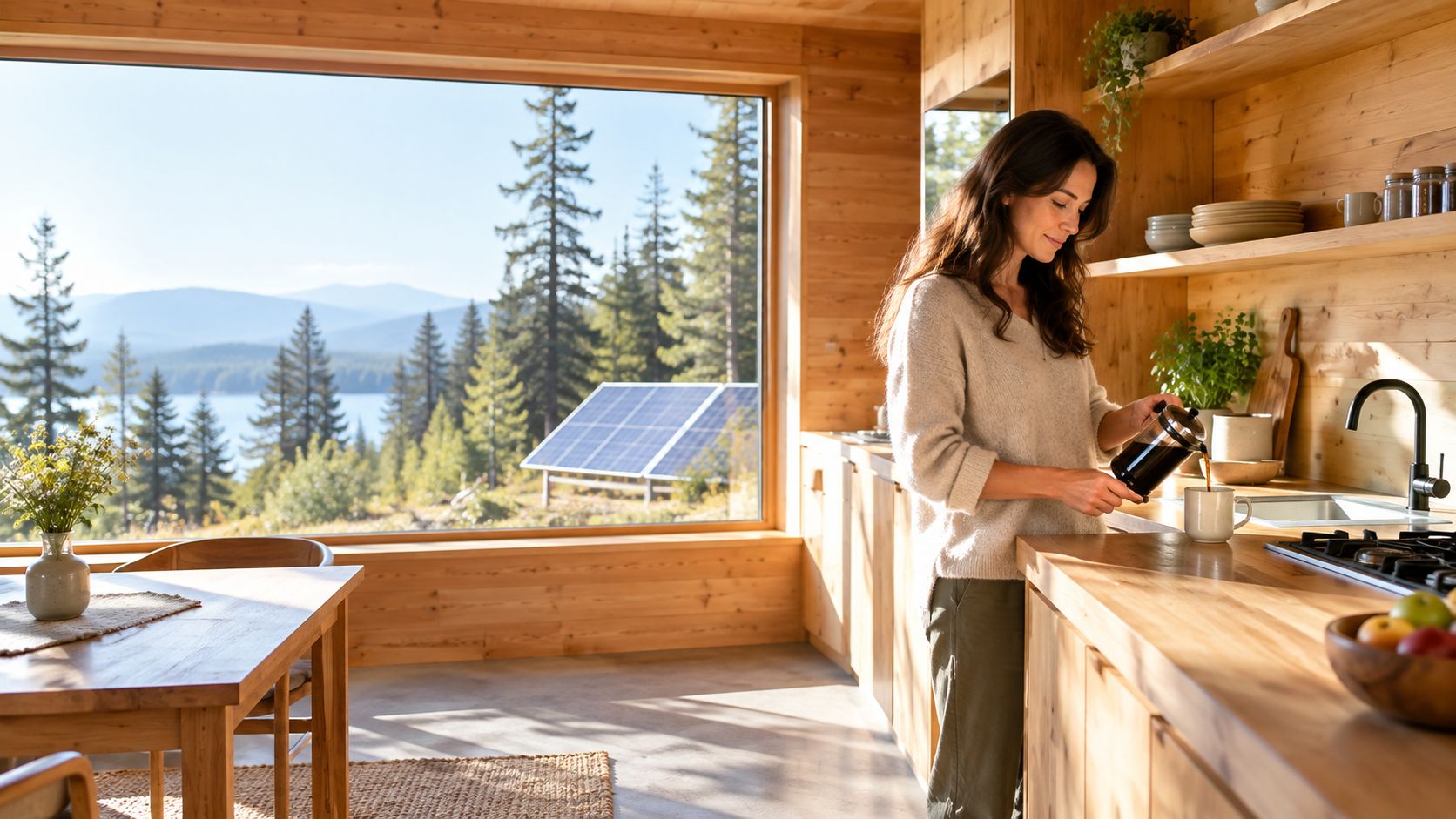
You wake before sunrise in a small cabin, reach for the coffee maker, and remember that nothing happens unless your own systems can make it happen. Solar panels are collecting energy, batteries are holding yesterday's surplus, a water tank or well supplies the kitchen, and wastewater has to move through an approved on-site system. The morning can feel ordinary, but the infrastructure behind it is yours to monitor.
That's the practical answer to what is off grid living. It isn't a cabin in the woods, a tiny house, or a home without a monthly electric bill. It's a way of operating a property without depending on public electricity, water, sewage, or gas services. You're replacing passive utility access with equipment, planning, maintenance, and legal approvals.
The idea attracts people seeking privacy, resilience, lower dependence on utilities, or a practical path to rural land ownership. It also describes a very different reality for communities that lack reliable access to centralized infrastructure. In 2023, about 666 million people lacked electricity, even though electricity access had reached roughly 92% of the world's population, and about 8 in 10 unelectrified people lived outside cities according to the Tracking SDG 7 electricity-access report.
For a first-time land buyer, the most important question isn't whether off-grid living sounds appealing. It's whether a specific parcel can legally and practically support independent power, water, waste handling, and communications. Understanding those systems before you buy can keep an inexpensive parcel from becoming an unusable one.
Table of Contents
- Introduction to Life Beyond Public Utilities
- What Off Grid Living Means in Practice
- The Four Core Systems That Make Off Grid Living Work
- Real Costs of Going Off Grid and How to Budget
- Legal Zoning and Land Suitability Checks Before You Buy
- Who Off Grid Living Suits Best and Common Misconceptions
- Your Next Steps Toward Off Grid Land Ownership
Introduction to Life Beyond Public Utilities
Grid-connected life hides most of its infrastructure. You flip a switch and the utility supplies electricity. You turn a faucet and a public system, well, or municipal provider delivers water. You flush a toilet and the waste disappears from view. Off-grid living makes each connection visible, because the homeowner is responsible for designing and maintaining the replacement.
A well-planned home can still feel comfortable. Lights, refrigeration, internet access, hot water, and ordinary kitchen appliances can all fit into an independent setup, but each one consumes resources that must be generated, stored, filtered, pumped, or disposed of. The difference is less about giving up modern life and more about managing the systems that make modern life possible.
Independence changes the daily rhythm
On a cloudy stretch of weather, you may postpone a high-energy task. A pump may need electricity from a battery bank, and a battery bank depends on earlier production and careful capacity planning. A water tank needs inspection, while a septic or composting system needs appropriate use and maintenance. These tasks aren't dramatic, but they become part of the household routine.
That responsibility creates the central trade-off. Public utilities offer convenience and shared infrastructure, while off-grid systems offer greater control over where and how a property operates. A remote parcel may make an independent system more practical than waiting for a utility extension, especially where roads, population density, or distance make centralized connections difficult.
Off-grid living works best when you treat the property as an operating system, not as a house with a few solar panels.
The timing also matters globally. Rural electrification has improved over time, rising from about 63% in 2000 to 73% in 2014 and around 80% in 2018, according to the World Bank rural electrification report. Yet rural access reached 83% in 2020, compared with 97% urban access, leaving decentralized systems relevant for remote settlements as well as voluntary lifestyle choices.
Before buying land, use that perspective to ask practical questions. Can local rules allow a dwelling without public utilities? Can the soil support septic treatment? Is water legally available, and can a vehicle reach the site year-round? The attractive view comes after those answers, not before them.
What Off Grid Living Means in Practice
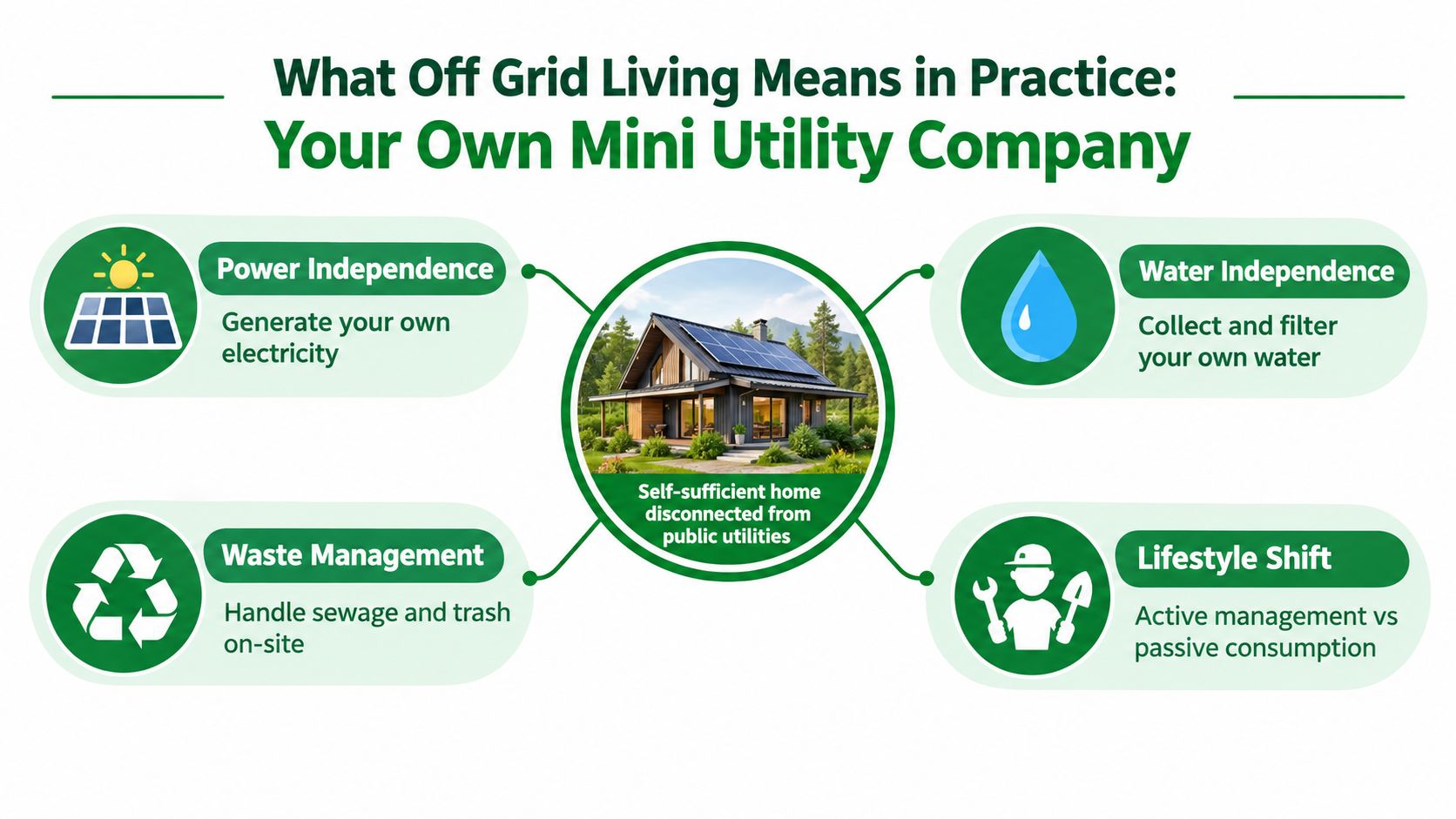
Think of an off-grid household as a mini utility company serving one property. Instead of paying a utility to generate and deliver electricity, you generate power with solar panels or another source, convert it through an inverter, store it in batteries, and decide how to use it. Instead of connecting to a municipal water line, you collect, pump, filter, or haul water. Instead of sending sewage into a public network, you process it on-site through a permitted system.
That analogy clarifies why off-grid living is more than a building style. A tiny home connected to public electricity and sewer services isn't fully off-grid. A large rural home with solar, batteries, a well, and septic can be off-grid if it operates independently. Homesteading may include food production and livestock, but those activities aren't required for a property to qualify as off-grid.
Independence comes in degrees
Some homes are fully disconnected from public utilities. Others use a hybrid arrangement, such as solar and batteries with a utility connection, or a private water source while remaining connected to the electric grid. A backup generator can support an independent power system, but it doesn't remove the need to plan fuel storage, maintenance, noise, and local compliance.
The defining feature is utility independence, not a particular architectural look. A modern cabin, manufactured home, workshop, or conventional house may use off-grid infrastructure if the systems are properly designed and approved.
Voluntary and involuntary off-grid situations differ
A buyer choosing an isolated parcel is making a lifestyle and investment decision. The household selects its equipment, budget, and level of independence. A family without electricity because infrastructure hasn't reached its community faces an access problem, not a lifestyle experiment. Both situations involve decentralized energy, but the financial resources, legal choices, and available alternatives can be very different.
That distinction matters when interpreting global energy figures. The remaining electricity-access deficit is concentrated in rural regions, where lower infrastructure density makes centralized extension harder. Off-grid solar reached about 141 million people in developing countries in one estimate, showing how decentralized systems became an important part of the broader electrification transition, as documented in the World Bank energy-access report.
For a land buyer, the mental model is simple. You aren't purchasing an absence of utilities. You're purchasing a site where you may need to create and manage the utility functions yourself. That makes parcel research as important as equipment research.
The Four Core Systems That Make Off Grid Living Work
An off-grid property operates as a connected loop. Power runs the well pump, water treatment, refrigeration, communications equipment, and sometimes heating or cooling. Water use affects waste handling, while access and communications affect how you monitor equipment and respond to problems.
Power begins with the loads
Start with the electricity you expect to use, not the number of panels you want to install. List lighting, refrigeration, pumps, cooking equipment, tools, heating, cooling, computers, and other appliances. Separate ordinary daily demand from short bursts of high demand, because an appliance may need a large starting surge even when its total daily consumption is modest.
Then estimate solar production for the actual site and account for seasonal variation. The system generally needs solar generation, an inverter, and battery storage, with each component sized to work with the others. The Briggs & Stratton off-grid living guide emphasizes the sequence of calculating energy demand, estimating peak sunlight, and determining panel and battery capacity.
Sizing principle: Installed panel wattage doesn't tell you whether the home will work. Daily loads, production conditions, inverter capacity, and storage autonomy determine that.
Water requires a legal source and a treatment plan
Possible sources include a permitted well, rain catchment, a spring where legally usable, or hauled water stored in tanks. Each option has different equipment and reliability concerns. A well needs suitable geology, drilling approval, pumping power, and water testing. Rain catchment depends on roof area, rainfall patterns, storage, filtration, and rules that may vary by location.
Water planning should include drinking, cooking, bathing, laundry, cleaning, and irrigation. Reducing consumption can lower equipment requirements, but conservation can't replace legal access or safe treatment.
Waste has to stay on the property safely
A septic system may be appropriate where soil, setbacks, and local regulations support it. A composting toilet may reduce water use, but it still may require approval and proper handling of solids. Greywater from sinks, showers, or laundry also needs a lawful disposal method. Never assume that a system marketed as simple or portable is automatically permitted for residential use.
Communications support safety and maintenance
Cell service may work near a road but fail at the building site. A booster can improve coverage where a usable signal exists, while satellite internet can offer another option in locations with clear sky access. Communications equipment also consumes power, so it belongs in the load inventory rather than being treated as an afterthought.
A practical design links all four systems. If the water source needs an electric pump, the battery system must support it. If remote monitoring relies on internet access, communications must remain powered. If winter access is difficult, maintenance and emergency planning become part of the property design.
Real Costs of Going Off Grid and How to Budget
The phrase “no utility bill” can create the wrong expectation. Off-grid living may reduce or remove some recurring utility charges, but it replaces them with equipment purchases, installation, permits, maintenance, fuel, testing, and eventual replacement. Land is only one part of the investment.
Independent estimates cited in the supplied market coverage place power-system costs around $20,000 to $60,000, while total off-grid setup costs often reach $45,000 to $65,000 or more, depending on the property and systems selected. Those figures come from the off-grid housing cost and market analysis, and they should be treated as planning ranges rather than a quote for a particular parcel.
A planning table for early comparisons
| System | Typical Cost Range | Key Cost Driver |
|---|---|---|
| Power | $20,000 to $60,000 | Battery storage, inverter capacity, solar production, installation |
| Water | Varies by site | Well conditions, drilling, tanks, pumps, filtration, hauling |
| Waste | Varies by site | Soil suitability, septic design, permits, toilet system, installation |
| Total setup | $45,000 to $65,000 or more | Land improvements, utility systems, permits, labor, and site access |
Power often receives the most attention because panels are visible, but batteries can drive a large share of the budget. Water and waste costs are harder to estimate before a site assessment, since soil, groundwater, terrain, setbacks, and local requirements determine the design. A parcel with difficult access can also make every delivery and installation more expensive.
Budget for replacement, not only installation
Batteries, pumps, filters, inverters, generators, and plumbing components all require maintenance or eventual replacement. A system that fits today's household may become inadequate after adding a freezer, workshop, electric vehicle, or larger home. Phasing construction can help, but only if the first installation leaves room for expansion.
Before making an offer, compare the parcel price with development costs, not with the price of a serviced lot alone. The LandZero guide to raw-land development costs can help frame that broader calculation. Ask for written estimates from local installers, well contractors, septic professionals, and permitting offices before treating a low land price as an affordable project.
Legal Zoning and Land Suitability Checks Before You Buy
A parcel can be beautiful, inexpensive, and unsuitable for an off-grid home. Local law may control whether you can build, occupy a structure, install a septic system, drill a well, collect rainwater, or use a composting toilet. These questions belong at the beginning of the buying process, not after closing.
Start with the county planning or building department. Ask whether the parcel's zoning permits a residence, what minimum dwelling standards apply, and which permits cover the building, electrical work, water source, sewage treatment, driveway, and any accessory structures. Rules differ by jurisdiction, so general online descriptions can't substitute for confirmation tied to the parcel's location.
Use a parcel-level checklist
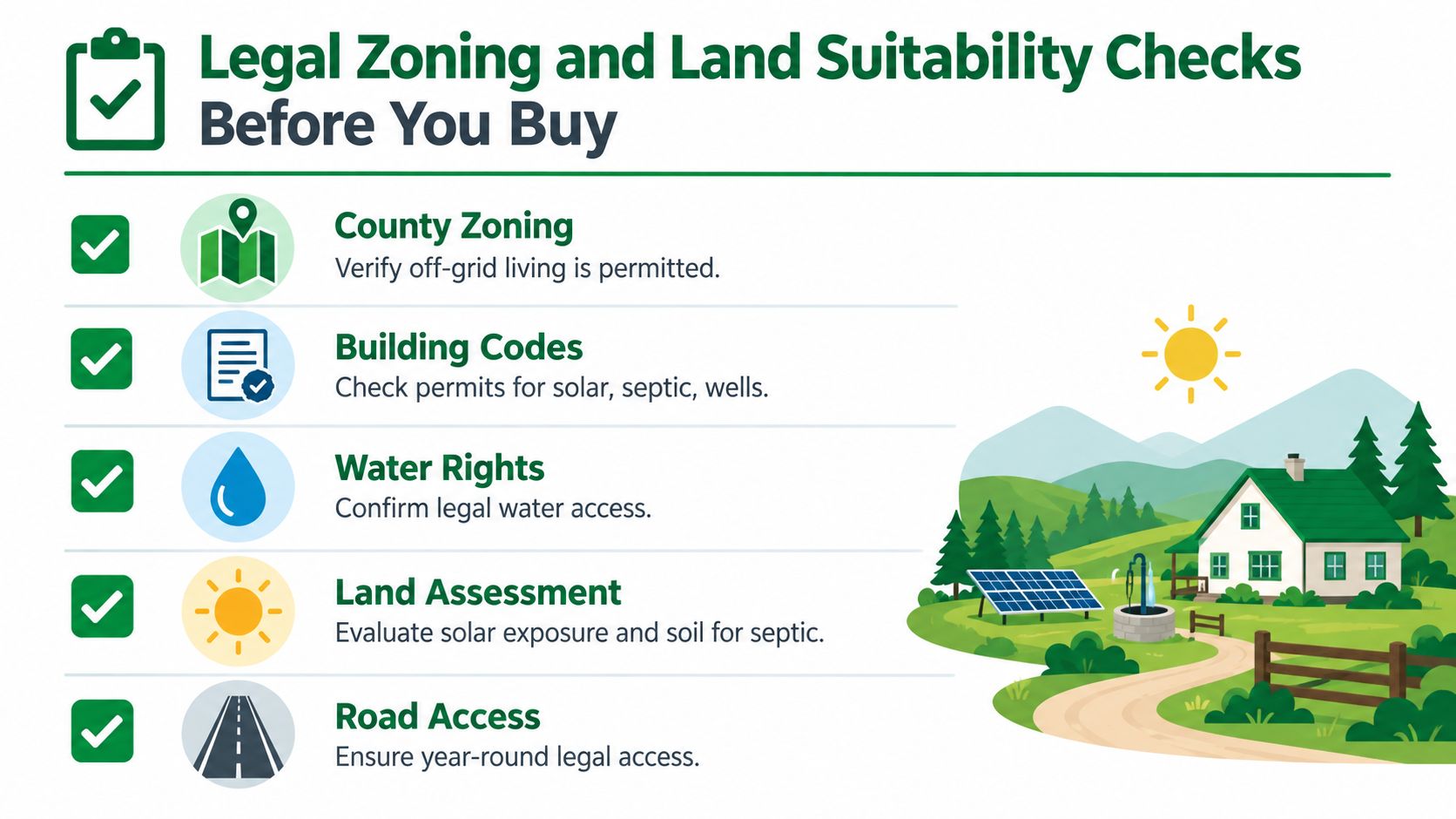
Check each of these before committing:
- Zoning: Confirm that residential or recreational occupancy is allowed and ask whether off-grid systems are recognized under local rules.
- Building codes: Identify permits and inspection requirements for the home, solar equipment, electrical work, septic, well, and accessory buildings.
- Water access: Verify whether a well is feasible, whether water rights apply, and whether rain catchment or hauling meets local requirements.
- Waste treatment: Request soil and septic information, then ask whether composting toilets and greywater systems are approved.
- Site conditions: Examine sunlight, slope, drainage, soil, flood exposure, and space for tanks, batteries, septic fields, and structures.
- Road access: Confirm recorded access and whether the route remains usable for construction vehicles, emergency responders, and residents throughout the year.
The guide to property zoning in the United States provides useful background, but the county remains the authority for parcel-specific decisions. Ask officials which documents they need before issuing a determination, and keep copies of their responses.
Treat utility feasibility as a purchase condition
A listing that says “off-grid” describes a property or intended use, not necessarily a legal approval. You may still need a permitted dwelling, approved sanitation, legal access, and an acceptable water plan. If an answer remains unclear, consult a local land-use professional, septic designer, or well contractor before buying.
The strongest due diligence combines paperwork with physical inspection. A shaded building site, steep access road, shallow soil, or drainage problem can make a legally buildable parcel costly to develop. Permission and practicality must agree before the land is a sound off-grid candidate.
Who Off Grid Living Suits Best and Common Misconceptions
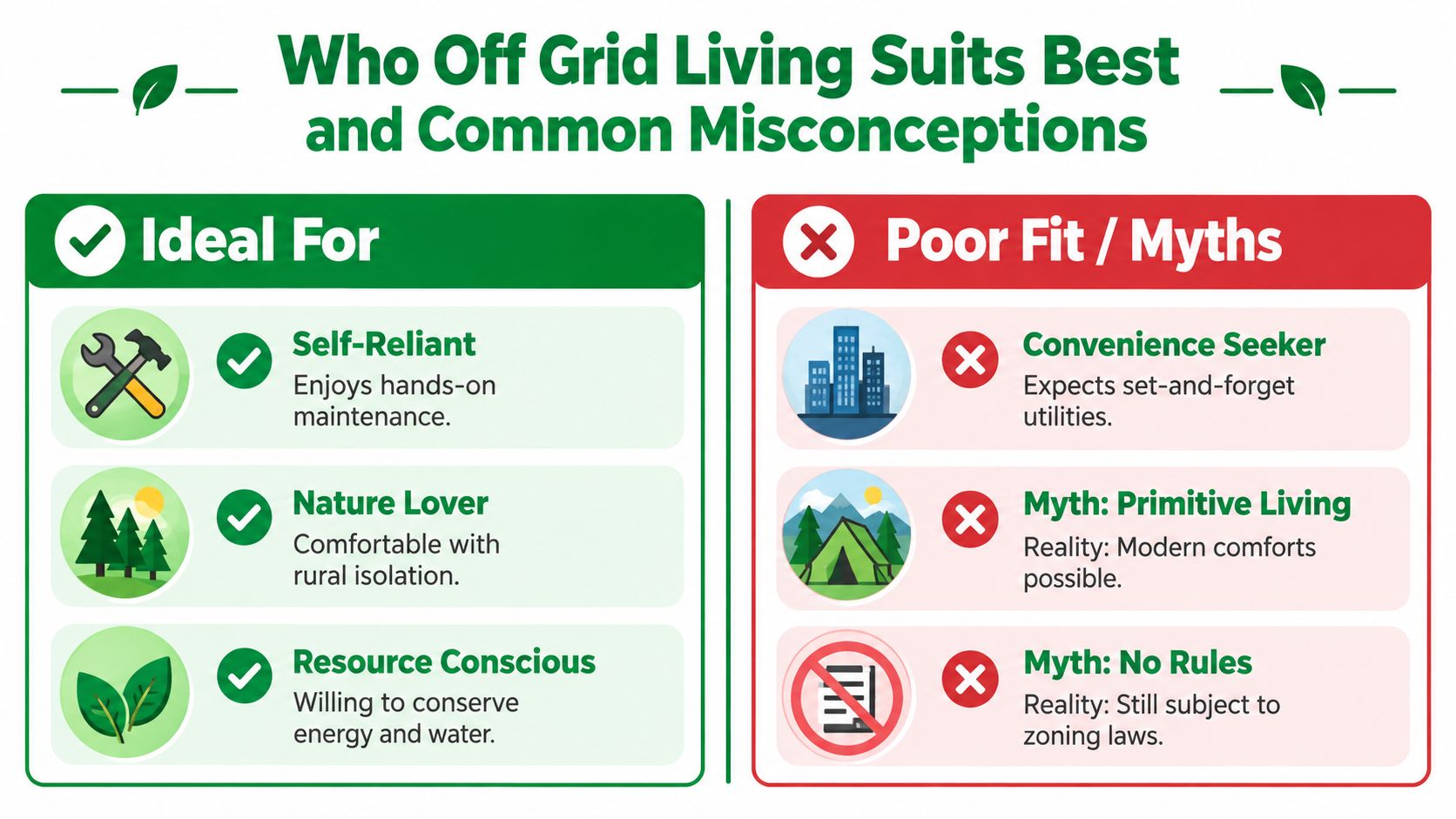
Off-grid living suits people who want more control and accept more responsibility. You'll need patience for maintenance, comfort with conservation, and willingness to learn how equipment behaves under changing weather and household demand. Rural quiet can be rewarding, but isolation also affects shopping, medical access, repairs, deliveries, and emergency planning.
The lifestyle frustrates buyers who expect a remote property to work like a serviced suburban home. A system can be modern and comfortable, but it won't be passive. Someone must inspect filters, monitor batteries, protect pipes, maintain waste systems, arrange fuel or water, and respond when equipment fails.
A simple fit comparison
| If you value or expect | Off-grid reality |
|---|---|
| Hands-on projects | Regular maintenance is part of normal ownership |
| Quiet and privacy | Services, stores, and skilled contractors may be farther away |
| Lower dependence on utilities | You take responsibility for generation, storage, water, and waste |
| A quick, inexpensive build | Permits, site work, and replacement costs can change the budget |
| Complete freedom from rules | Zoning, building, water, and sanitation requirements still apply |
Several common assumptions deserve correction. Off-grid doesn't mean primitive living, because properly designed systems can support ordinary comforts. It doesn't mean total isolation, because many households still use cellular networks, satellite internet, roads, and nearby communities. It also doesn't mean every do-it-yourself installation is lawful or safe.
The broader history adds context. Rural communities have made up most of the global electricity-access deficit for years, and decentralized systems emerged partly because extending centralized infrastructure across remote areas can be difficult. In 2018, rural populations represented about 85% of people without electricity, according to the World Bank energy-access report.
Before choosing a parcel, rate yourself. Do you want to manage systems, or do you mainly want a remote view? Are you comfortable hiring specialists and tracking maintenance? If convenience matters more than independence, a grid-connected or hybrid property may be a better fit.
For a practical list of errors to avoid during planning, review common off-grid land mistakes before you start comparing parcels.
Your Next Steps Toward Off Grid Land Ownership
Approach an off-grid purchase through three lenses. System design tells you whether the property can support daily life. Budgeting tells you whether you can build and maintain those systems. Legal and site due diligence tells you whether the plan is allowed and physically workable.
Use this sequence when reviewing a parcel:
- Define the intended use: Decide whether you want a full-time residence, seasonal cabin, workshop, recreational site, or future homestead.
- Estimate the loads and services: List power needs, water uses, waste requirements, internet expectations, and access needs.
- Check the jurisdiction: Contact planning, building, environmental health, and water offices with the parcel identification details.
- Inspect the site: Evaluate solar exposure, slope, drainage, soil, road access, and practical locations for equipment.
- Price the complete project: Include land, permits, site work, power, water, waste, communications, labor, maintenance, and replacements.
- Keep a fallback plan: Consider a hybrid system, phased construction, hauled water, or a different parcel if one constraint proves too costly.
For buyers comparing affordable undeveloped land, LandZero organizes vacant parcels by state and budget, including collections such as Land Under $5k, $5k to $10k, and $10k & Up. Its FlexPay owner-financing program offers zero-down purchases, no credit checks, and zero closing costs according to the publisher's stated policies, while the Land Guide provides educational material on zoning, development, taxes, and off-grid considerations.
Those features can simplify the search and payment process, but they don't replace county verification or professional site assessments. Evaluate each property with the same discipline you'd use for a major infrastructure project, then choose the parcel that matches both your ambitions and your ability to operate it.
If you're ready to compare affordable parcels for an off-grid plan, browse LandZero by state and budget, then use the property details and Land Guide resources to investigate zoning, access, water, waste, and development requirements before you purchase. Start with the parcel's legal and practical potential, not just its price or scenery.