
You've found a parcel that looks perfect online. The trees are attractive, the price is low, and the listing promises privacy. Then you call the county and learn that the road isn't maintained, the zoning doesn't allow a residence, and nobody can confirm the well yield. That isn't a minor inconvenience. It's how a dream property becomes an expensive storage lot.
The practical homesteading how to process starts before seeds, chickens, or a cabin. You need to prove that the land can legally, physically, and financially support the life you want to build. The Homestead Act offers a useful historical reminder. Between 1862 and 1934, about 1.6 million homestead entries were successfully patented, transferring roughly 270 million acres across 30 states, according to the National Park Service's historical summary. Land access mattered, but so did residence and improvement. Modern buyers face the same basic question, without the federal program: can this parcel support real use, not just ownership?
Table of Contents
- What Homesteading Actually Requires Before You Plant Anything
- Vetting Land So Your Homestead Can Survive Its First Year
- Buying a First Homestead Parcel Without Draining Your Savings
- Building Water, Power, and Waste as a Staged Project
- Shelter, Zoning, and Permits That Make a Homestead Legal
- Why a Micro Homestead Beats a Dream Acreage at the Start
- Your First Twelve Months on the Homestead
What Homesteading Actually Requires Before You Plant Anything
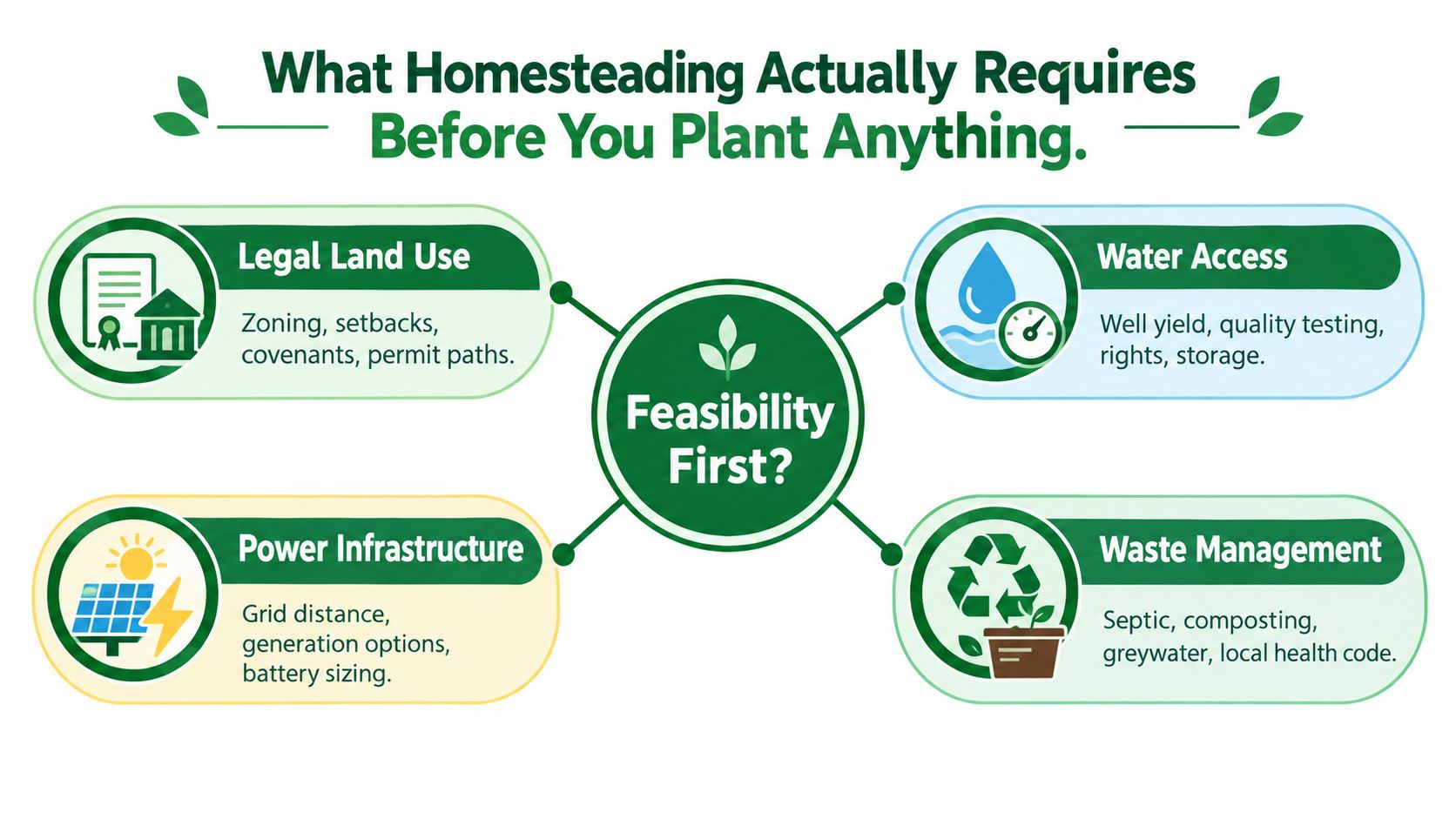
Most beginner advice starts with crops and livestock. That's backwards. Your first homesteading how to decision is whether the parcel can support legal land use, reliable water, workable power, and compliant waste management.
Start with legal land use
Call the county planning department before you make an offer. Ask whether the parcel allows a primary residence, manufactured home, tiny home, RV occupancy, agricultural buildings, workshops, poultry structures, livestock shelters, and commercial activity. Ask for the rules in writing, including setbacks, minimum dwelling standards, access requirements, and permit sequences.
A charming cabin doesn't help if the county classifies it as an unpermitted dwelling. A large barn doesn't solve the problem if residential use is prohibited. Covenants and homeowners association rules can impose restrictions even when county zoning appears favorable.
Prove water before you budget improvements
A parcel without validated water access isn't cheap land. It's an unresolved engineering problem. Check well records, neighboring well depths, water rights, seasonal reliability, surface-water restrictions, and testing requirements before you plan occupancy.
For zero-infrastructure sites, industry guidance places a hydrogeologist report at about $500 to $1,500, and estimates a fully installed off-grid water system for a family of four at about $15,000 to $30,000, as outlined in this off-grid water system planning guide. Those figures aren't a promise for your property. They show why water validation belongs in the purchase decision, not at the end of your budget.
Treat power and waste as site constraints
Check the distance to grid service, the location of utility easements, solar exposure, winter shading, and generator access. Then determine whether septic, greywater, composting toilets, or another waste system is legal under local health rules.
Soil fertility is useful, but it can't override a failed septic test. A flat building site is valuable, but it doesn't compensate for a road that becomes inaccessible during wet weather. Your first year will be won by boring infrastructure decisions made before planting begins.
Practical rule: Don't buy acreage because it looks rural. Buy it only after you understand how people, water, power, waste, and emergency vehicles will reach and use it.
Vetting Land So Your Homestead Can Survive Its First Year
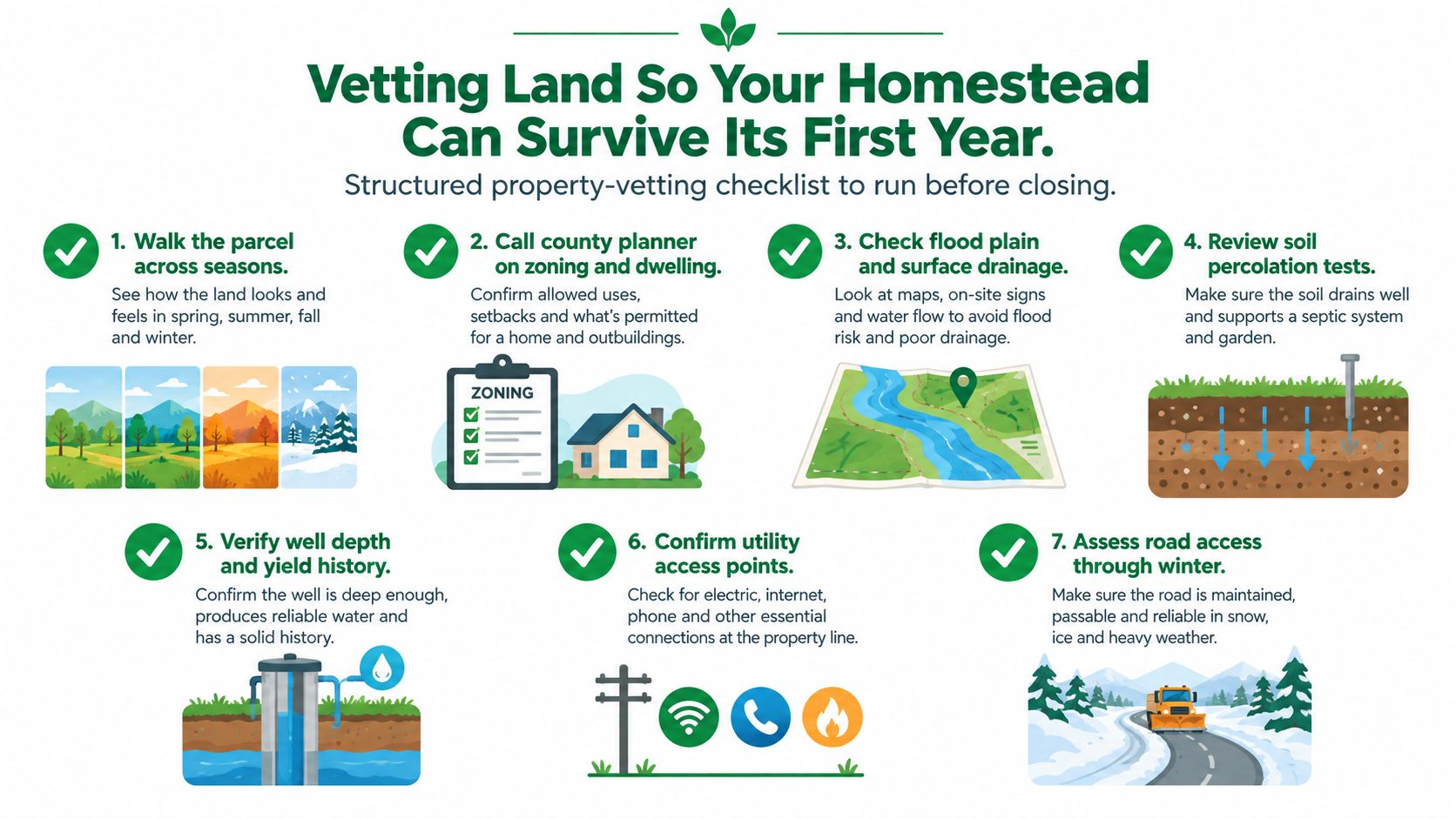
A property visit is not a casual walk. It's a field inspection. Bring the listing, parcel map, survey, notebook, phone camera, boots, and a list of questions that the seller may not think to answer.
Run the county check before the closing check
Start with the county planner. Ask about zoning, minimum dwelling size, manufactured homes, accessory buildings, animal limits, road standards, septic approval, well permits, and temporary occupancy. Don't rely on a listing description or a seller's interpretation of “agricultural.”
Check flood maps and surface drainage. Walk after rain if possible, inspect gullies and low points, and identify where runoff would travel through the building site. A parcel can look dry during a short visit and still require expensive grading or flood mitigation.
Review the survey line by line. Look for access easements, utility corridors, shared driveways, drainage easements, and restrictions on where you can build. If you don't have a current survey, use this land survey requirements guide to identify the documents and questions that need attention.
Verify water, soil, and access independently
Ask for well logs from the property and nearby parcels. Confirm depth, reported yield, construction details, and testing history. If the property has a shared well, read the maintenance agreement and confirm who pays for repairs, electricity, testing, and replacement.
Test soil rather than guessing from vegetation. You need to understand texture, drainage, compaction, contamination risk, and whether the proposed garden area is suitable. Review any percolation testing for a septic system, but remember that a test for one location doesn't automatically approve every building site.
Walk the road in the conditions that matter. Confirm whether access is public or private, who maintains it, whether the easement reaches the entire parcel, and whether a large delivery truck, fire engine, or septic installer can reach the intended building area.
Use a simple red-flag list before you fall in love with the property:
- Flood exposure: Low areas, drainage channels, and mapped flood zones can restrict construction.
- Restrictive covenants: Private rules may limit structures, animals, occupancy, or commercial activity.
- Agricultural-only zoning: Farming rights don't necessarily include residential rights.
- Unclear shared access: A recorded easement may be too narrow, poorly maintained, or poorly located.
- Unverified water: A seller's statement isn't a well test.
- Seasonal roads: A summer visit can hide winter access failures.
A property-vetting checklist is the cheapest protection you'll buy. Put inspection and feasibility contingencies in the purchase contract, and walk away when the answers remain vague.
Buying a First Homestead Parcel Without Draining Your Savings
Cheap land usually has a reason. It may lack utilities, have weak road access, offer limited financing options, or require improvements that cost more than the purchase price. A lower purchase price can help, but only if you preserve enough cash to make the parcel usable.
The right financing route depends on whether you're buying raw land, an improved property, or land with a residence that can qualify for a conventional mortgage. Owner financing can be flexible, while rural land loans may require stronger documentation and a larger upfront contribution. USDA Rural Development programs can be relevant for eligible rural homes, but they don't automatically solve financing for vacant recreational acreage. Conventional mortgages typically work better when the property includes a qualifying residence rather than only undeveloped land.
Compare the acquisition paths
| Financing Option | Typical Down Payment | Best For | Key Trade-Off |
|---|---|---|---|
| Owner financing | Varies by seller | Buyers who need flexible underwriting | Contract terms, interest, default provisions, and title structure require careful review |
| Rural land loan | Lender-specific | Buyers with documented income and a qualifying rural property | Underwriting can be stricter than a standard home purchase |
| USDA Rural Development loan | Program-specific | Eligible buyers purchasing a qualifying rural residence | Vacant land and intended use may not fit program rules |
| Conventional mortgage with acreage | Lender-specific | Improved parcels with a habitable home | The residence, appraisal, and property classification drive approval |
| Direct cash purchase | No lender contribution | Buyers with available funds and strong reserves | Cash tied up in land can't cover urgent infrastructure or repairs |
Regional pricing varies sharply, so don't treat a national idea of “cheap acreage” as a budget. A wooded parcel under $30,000 in the Ozarks may still need access, water, power, and waste infrastructure, while an improved small farm priced at $150,000 or more in the Northeast or West may include systems that reduce early uncertainty. These examples are planning benchmarks, not guarantees of current inventory.
Read this raw land development cost guide for 2026 before deciding how much land you can afford. Compare the purchase price with road work, surveys, permits, water, septic, power, fencing, tools, and carrying costs.
Negotiate for a closing-cost credit when inspections uncover a real defect. Ask whether the seller will finance part of the purchase, accept a structured down payment, or extend the inspection period while you verify water and zoning. Never spend your entire reserve on the deed. A homestead needs cash after closing, especially when the first failed pump or access repair appears at the worst possible time.
Building Water, Power, and Waste as a Staged Project
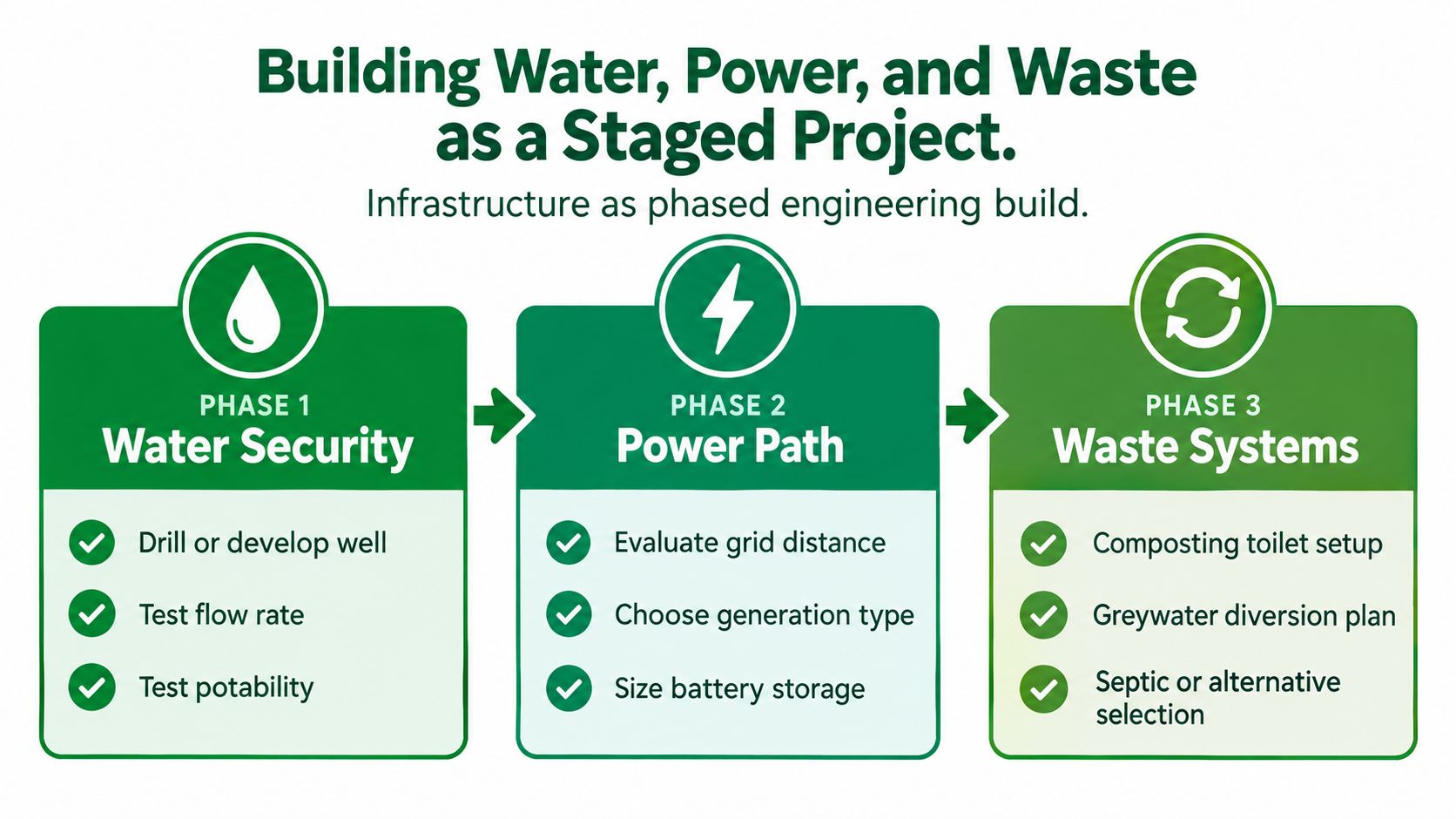
Build infrastructure in an order that protects occupancy and cash flow. Don't buy a complete off-grid package because a salesperson says it can run your imagined future lifestyle. Design each system around confirmed loads, tested sources, and local code.
Phase one establishes water security
Confirm the source before buying pumps. If there's an existing well, test flow, potability, pressure, and seasonal performance. If you need a new well, investigate local records and use qualified professionals to assess the site.
Install storage sized for actual household use, with a backup method such as a hand pump where practical. Protect tanks from freezing, contamination, sunlight, and wildlife. Potable taps shouldn't be used until testing and treatment are complete.
Water comes first because every other plan depends on it. You can delay a larger garden. You can't safely delay a verified drinking supply if you intend to live on the parcel.
Phase two matches power to real loads
List the equipment you'll use: refrigeration, well pump, lights, communications, tools, heating controls, and cooking appliances. Choose between grid connection, solar, battery storage, generator support, or a combination based on sun exposure, utility distance, winter conditions, and repair access.
Oversized solar systems waste money, while undersized batteries create daily frustration. Start with essential loads and leave room for expansion. A small generator may serve as a winter or emergency backup, but store fuel safely and confirm local rules.
The utilities guide for bringing services to vacant land can help you organize utility questions before excavation begins.
Phase three handles waste legally
A permitted septic system is often the default where soil and local rules allow it. Elsewhere, a composting or incinerating toilet may be possible, but only if the health department approves the design and use. Greywater isn't automatically harmless. It needs a legal discharge or diversion plan that protects wells, streams, and neighbors.
Build only what occupancy requires first. A safe water supply, approved waste system, dependable basic power, and weatherproof shelter deserve priority. Large workshops, expanded battery capacity, decorative outbuildings, and irrigation automation can wait until the core systems prove reliable.
Shelter, Zoning, and Permits That Make a Homestead Legal
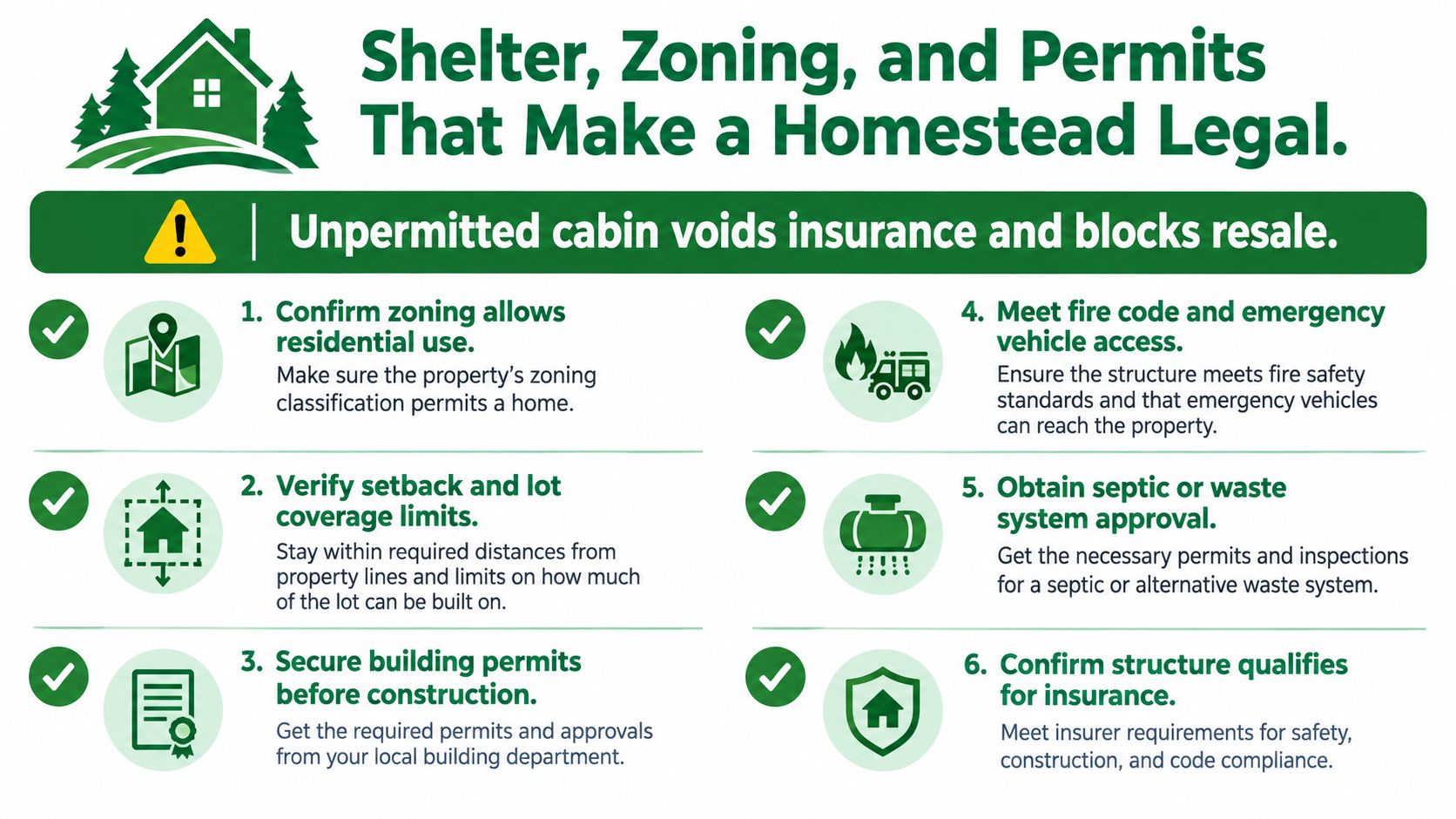
Shelter and legality are one problem, not two. An unpermitted cabin can create insurance problems, complicate financing, obstruct resale, and trigger enforcement after you've invested in the structure.
Confirm the dwelling path first
Ask the planning and building departments whether the parcel allows residential use and what qualifies as a primary dwelling. Confirm rules for tiny homes, yurts, RVs, manufactured homes, modular homes, and owner-built structures. A structure that feels like a home may not satisfy the county's definition of a legal residence.
Get the permit sequence for the well, septic system, electrical work, driveway, foundation, building shell, plumbing, and final inspection. Ask which inspections must happen before walls are closed and which approvals are required before occupancy.
Building codes still apply to owner-built work. Some jurisdictions require licensed contractors or engineered plans for specific systems, while others allow owner participation under defined conditions. Don't guess. The building official's written answer is more useful than advice from a social media group.
Protect the property after construction
Ask an insurance agent whether the planned structure qualifies for coverage before you build it. Standard homeowner policies may not cover detached workshops, livestock, farm equipment, solar batteries, generators, or animals without endorsements or separate policies.
Barn exemptions and agricultural structures can have narrow definitions. They may reduce certain requirements in one jurisdiction while creating different restrictions elsewhere. Keep permits, inspections, surveys, water tests, invoices, and construction photographs in a permanent property file.
Legal readiness is part of the homestead system. A garden can be moved. An illegal dwelling can become a permanent liability.
Plan emergency vehicle access as well. Fire code, address visibility, driveway width, turnarounds, and water access can affect both approval and safety. A remote lifestyle still depends on public responders reaching you when a stove, battery, or outbuilding creates an emergency.
Why a Micro Homestead Beats a Dream Acreage at the Start
Buying more land than you can manage is a common beginner error. Large acreage feels like freedom, but it also brings more fencing, roads, taxes, mowing, monitoring, water distribution, and unused space. Scale your skills before you scale your property.
A micro homestead can force better design. You'll have to place garden beds near water, keep animal areas downwind and accessible, protect compost from runoff, and store feed where pests and moisture can't reach it. Those decisions transfer directly to a larger property later.
| Factor | Micro Homestead (1-2 acres) | Dream Acreage (10-40 acres) |
|---|---|---|
| Land management | Concentrated and easier to inspect | More distance, boundaries, and neglected areas |
| Infrastructure | Shorter distribution routes | Longer roads, fences, lines, and utility runs |
| Learning speed | Mistakes stay contained | Mistakes affect more systems and more land |
| Livestock | Better suited to limited, carefully chosen animals | More room, but greater fencing and feed demands |
| Financing and insurance | Often simpler to evaluate | More complex use, access, and improvement questions |
| Exit risk | Easier to sell or change direction | Larger financial and operational commitment |
A small parcel can support meaningful production without pretending to provide total self-sufficiency. A well-planned acre can hold intensive beds, poultry, fruit, compost, storage, and water systems, but it won't support every animal or every ambition. Decide what you want to produce, then design around that constraint.
The strongest starter plan is deliberately incomplete. Grow food, preserve it, maintain a small animal system if legal, and document the labor and costs. If the work fits your household, expand later. If it doesn't, you'll discover that before a larger property magnifies the problem.
Your First Twelve Months on the Homestead
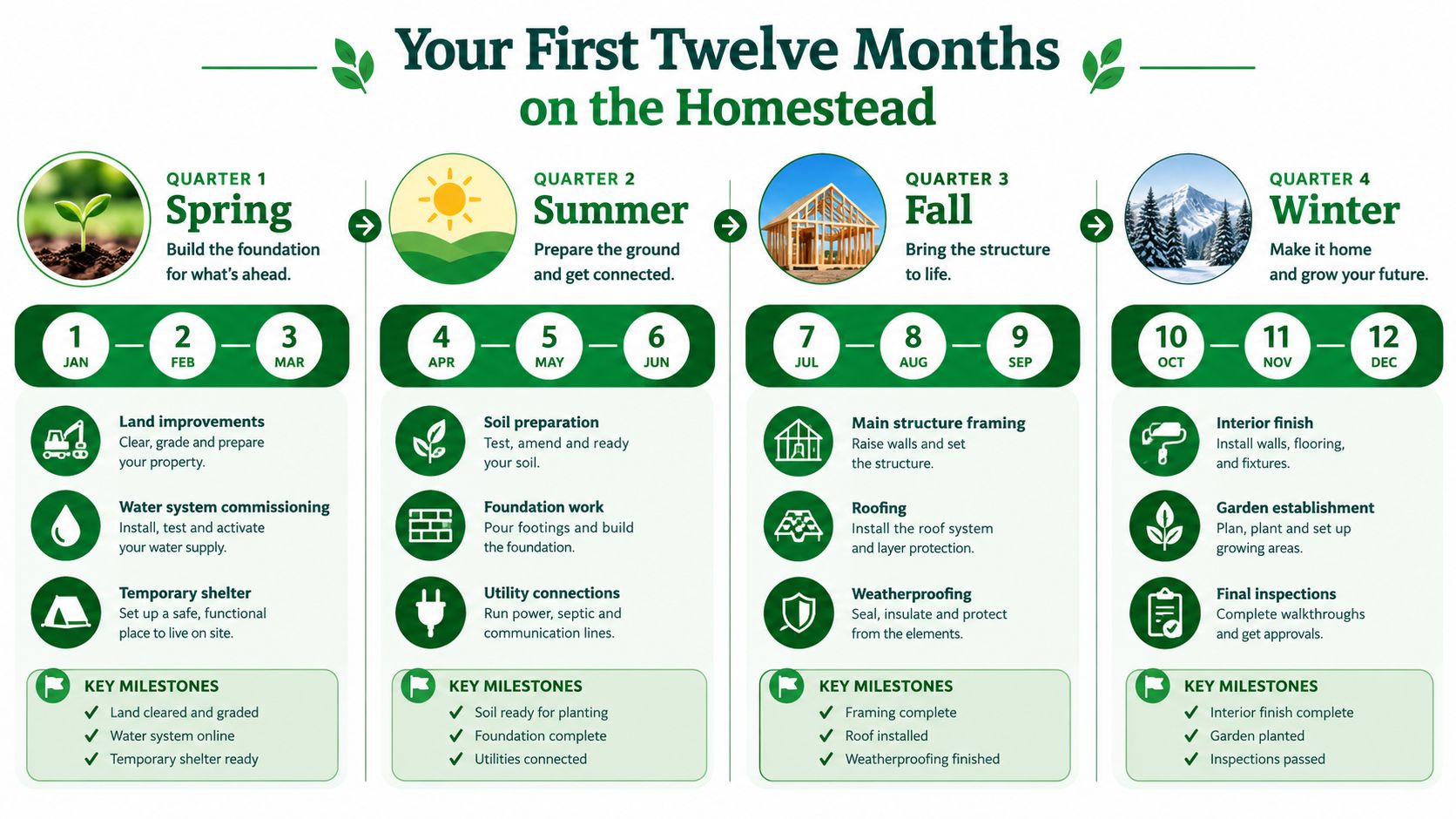
Your first year should produce working systems and reliable knowledge, not a crowded livestock roster. Use the calendar to control ambition.
Months one through three
Focus on access, drainage, water commissioning, temporary shelter, tool security, and basic fire safety. Finish required tests and approvals before you move into permanent construction. Create a site map showing the house, garden, well, septic area, access route, storage, animal zones, and future expansion areas.
Don't buy livestock yet. Spend this period observing sun, wind, runoff, wildlife, soil conditions, and the time required to maintain the property. Keep a written log of every repair, inspection, purchase, and delay.
Months four through six
Prepare a modest kitchen garden after soil testing and establish basic preservation habits. Start with crops your household already eats, not an ambitious catalog of plants. Build dry, secure tool and feed storage before adding anything that depends on daily care.
Use this phase to test your water distribution and power loads under normal routines. A system that works during a short installation visit may behave differently when pumps, refrigerators, lights, and tools operate together.
Months seven through nine
Add chickens or rabbits only after fencing, predator protection, feed storage, shade, water, and daily care routines are ready. Begin with a manageable number and learn the actual labor before expanding.
Review mortality risks, veterinary access, feed sourcing, manure handling, and local animal rules. If a fence isn't finished, the livestock purchase is premature.
Months ten through twelve
Plant orchard stock and expand garden beds only after you understand drainage, frost exposure, irrigation, and maintenance capacity. Audit winter readiness, including shelter insulation, backup power, water protection, firewood or other heating fuel, feed storage, snow or storm access, and emergency communications.
The most common first-year failures are predictable:
- Animals before infrastructure: New owners buy chickens or goats before fencing and shelters work.
- Permits after construction: Outbuildings become expensive to modify when inspectors reject them.
- Ignored soil tests: Poor drainage or contamination undermines an otherwise attractive garden.
- Thin cash reserves: Repairs and seasonal supplies arrive before the homestead produces anything.
- Unrecorded lessons: Without notes, you repeat the same mistakes next season.
By year's end, success means you know what the land can do, what your household can sustain, and which improvements deserve more money. Start with a parcel you can verify, build only the systems you can maintain, and choose expansion because the evidence supports it.
If you're evaluating affordable land for a homestead, use LandZero to review vacant parcels and owner-financing options, then apply the feasibility checklist before committing. Compare zoning, access, water, infrastructure, and development requirements first, so your next land purchase supports a workable plan rather than an expensive fantasy.