
You're scrolling through listings late at night when a five-acre parcel appears for far less than nearby rural tracts. The photos show pine trees, open sky, and a road that looks perfectly usable. The description says “off-grid potential,” and the price feels like an invitation to act before someone else takes it.
That's exactly when buyers get into trouble. Off grid land for sale isn't a lifestyle purchase first. It's a six-factor screening problem involving access, water, septic, power, zoning, and total setup cost. A low listing price may reflect missing infrastructure, a difficult road, restrictive covenants, or land that can't support the home you want.
The practical question isn't “How much does this acreage cost?” It's “Can this parcel legally and physically support the life I'm planning, and what will it cost to make that possible?”
Table of Contents
- The Off-Grid Land Trap Most Buyers Walk Into
- What Off-Grid Living Actually Means for a Parcel
- Verifying Access, Water, and Septic Before You Buy
- Solar and Wind Potential by Site and Region
- Zoning, Building Codes, and Use Restrictions
- Financing Options for Off-Grid Land Buyers
- Real Setup Costs Behind an Off-Grid Property
- A Final Checklist and Common Mistakes to Avoid
The Off-Grid Land Trap Most Buyers Walk Into
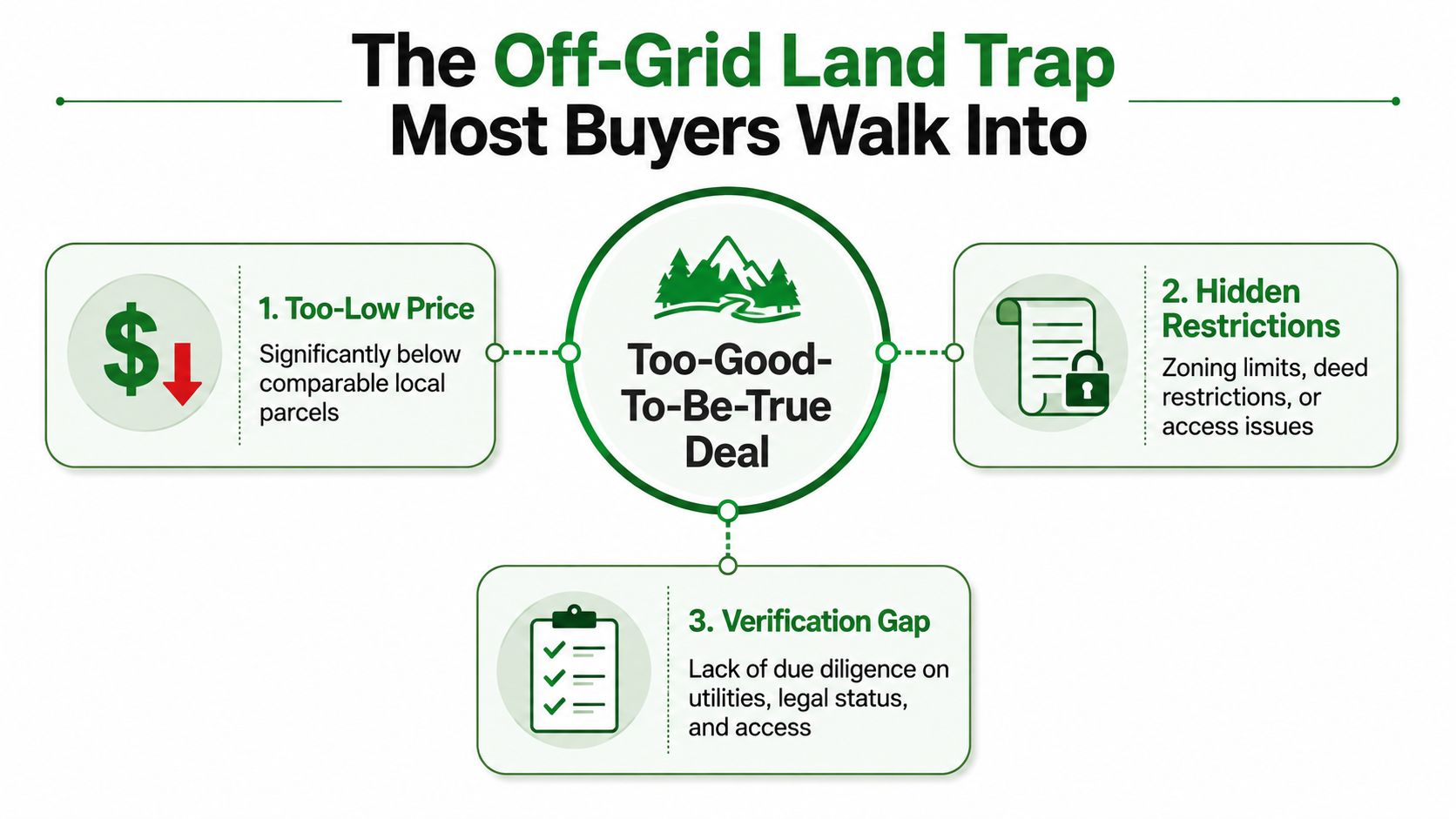
The buyer in that late-night example usually starts with price per acre. That's the wrong starting point. A cheap parcel can be a good purchase, but it can also be a piece of land with no recorded access, no viable well location, no septic approval, or a buildable area squeezed between setbacks and steep terrain.
Listing photos won't show a road after heavy rain. They won't reveal whether the access route crosses private land, whether the driveway becomes impassable in winter, or whether the nearest power pole sits much farther away than the listing suggests. They also won't tell you whether the county permits a full-time residence, a tiny home, an RV, or a seasonal cabin.
Treat the parcel like a screening exercise
Work through these questions before you make an offer:
- Access: Do you have a recorded easement or public road connection, and can a normal vehicle reach the site throughout the year?
- Water: Is there a workable well location, a documented spring, legal rainwater collection, or another permitted source?
- Septic: Has the soil passed a perc test or other required evaluation, and is there enough suitable ground for the system?
- Power: Can solar, wind, or a generator system meet the intended demand without excessive clearing or fuel dependence?
- Zoning: Can you build and occupy the structure you want under current county rules?
- Total setup cost: What will access improvements, water, waste treatment, shelter, permits, and labor add to the land price?
USDA's 2024 Tenure, Ownership, and Transition of Agricultural Land survey reported 2.1 million landlord ownership arrangements, with 87% classified as non-operating landlords who owned 79% of rented land. Landlords received $34.1 billion in rental income, while the value of land and buildings for owned acres rented out reached $1.7 trillion, according to the USDA agricultural land survey. Those figures describe agricultural ownership, not every off-grid listing, but they show why rural property ownership can be fragmented and held long term. A low-friction purchase structure may appeal to buyers, but financing convenience never replaces due diligence.
Practical rule: Screen the parcel before you screen the price. If one of the six factors fails, the bargain may be unusable.
What Off-Grid Living Actually Means for a Parcel
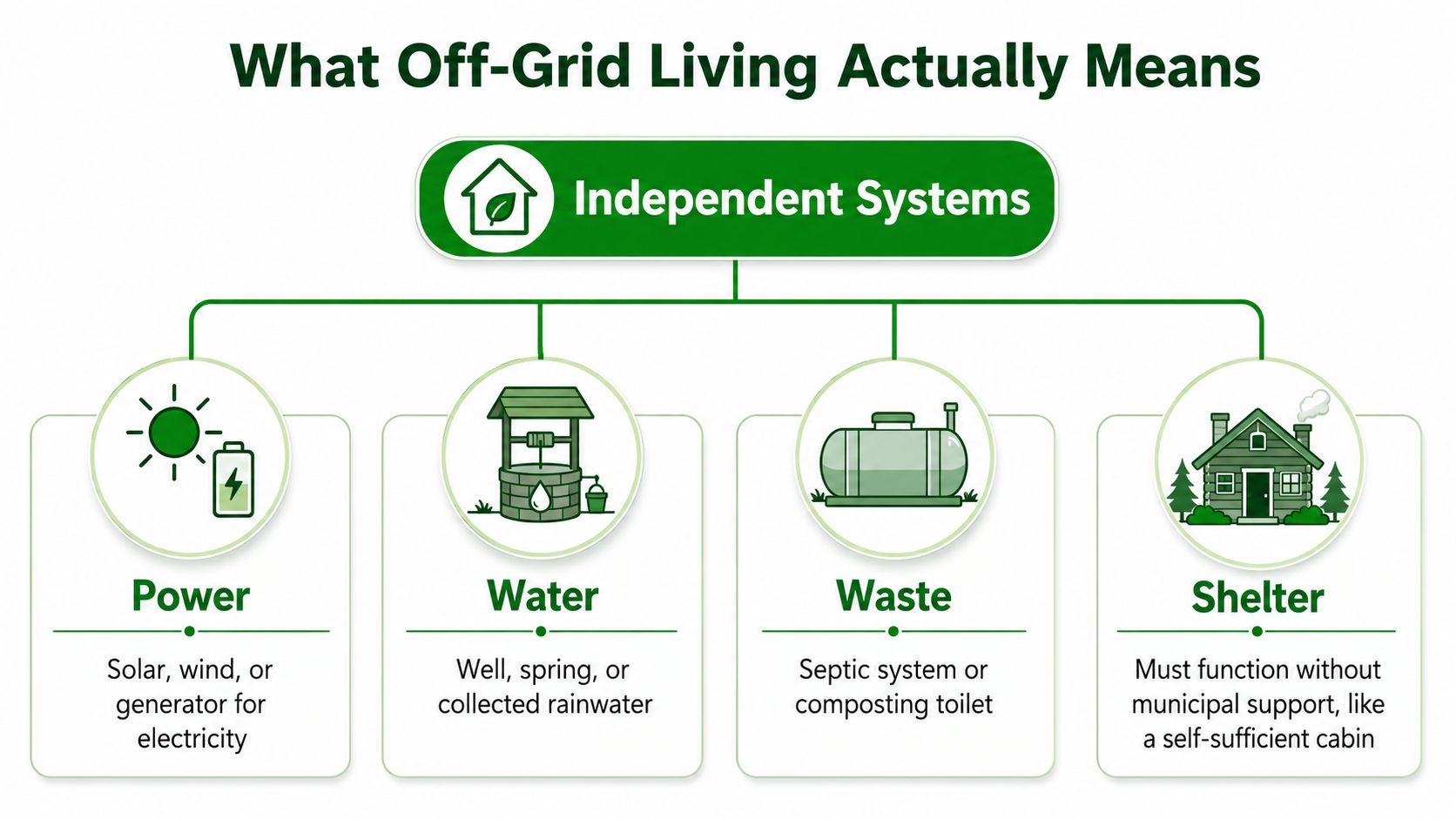
Off-grid living means your property must function without dependable municipal support. That requires more than a solar panel and a cabin. You need a coordinated system for power, water, waste, and shelter, with each layer sized for the site and the people using it.
Think about a remote cabin during a cold week. The cabin needs electricity for lights, refrigeration, communications, and pumps. It needs potable water from a well, spring, tank, or permitted collection system. It needs a way to handle wastewater and human waste. Finally, the shelter itself must satisfy applicable building and occupancy rules. If any one layer fails, the property may remain usable for recreation but not for the full-time homestead you had in mind.
Remote does not always mean off-grid
A parcel can be remote and still have nearby utility infrastructure. Another parcel can sit close to a maintained road but lack affordable hookups. The important distinction is whether the property has functioning connections or whether you must create independent systems.
Some buyers choose a hybrid arrangement. They might use grid electricity but install a private well and septic system, or use solar with a backup generator while relying on a permitted utility connection for water. Hybrid systems can reduce operational risk, but they still require verification of connection availability, fees, easements, and county approval.
The largest technical cost driver is usually distance from existing infrastructure. The utility installation cost guidance from HomeGuide places the overall cost of bringing utilities to raw rural land at about $9,000 to $34,500 or more, with electric service commonly priced at $5 to $25 per linear foot. Those figures vary by terrain, provider, and distance, but the lesson is straightforward. A parcel that looks inexpensive can become materially more expensive if every service must be extended from far away.
Don't design the dream system before identifying the actual need. List the shelter type, occupants, appliances, water demand, heating method, seasonal use, and permitted waste solution. Then evaluate whether the land can support that combination.
Verifying Access, Water, and Septic Before You Buy
These three checks decide whether many off-grid parcels are livable. Handle them before closing, not after you've paid for a survey, delivered materials, or started clearing a homesite.
Access must be both legal and physical
Start with the deed and title documents. Look for a recorded easement that describes the route, width, maintenance obligations, and permitted uses. A seller's statement that “everyone uses the road” isn't a substitute for legal access.
Then identify who maintains the route. A county-maintained road, a private road association, and an informal track create very different risks. Drive the entire route yourself, preferably after wet weather or during the season that causes the worst local conditions. Check steep grades, drainage, culverts, gates, narrow turns, and places where emergency or construction vehicles might struggle.
A land survey can clarify boundaries and access relationships, but it won't make an absent easement appear. Review the land survey requirements alongside the county's records and the title commitment.
Water needs evidence, not optimism
Ask the county or state water agency what type of source is allowed. If a well exists, request the well log, depth, construction details, pump information, and any available yield or quality records. If no well exists, obtain nearby well logs and speak with a qualified local driller about likely depth, drilling conditions, access for equipment, and failure risk.
A spring shown on a map isn't automatically a reliable household source. Seasonal flow, contamination, ownership rights, storage needs, and treatment requirements all matter. Rainwater may supplement supply, but whether it can serve as a primary source depends on local rules, climate, storage capacity, and system design.
Septic is a soil question
A basic septic tank doesn't guarantee approval. The county may require a perc test, soil evaluation, engineered design, minimum setbacks, reserve drainfield area, and separation from wells, streams, property lines, and structures. Rocky, shallow, saturated, or steep ground can force a more complex system or eliminate conventional septic altogether.
Request these documents before you close:
- Recorded deed and easements: Confirm ownership, access, and use rights.
- Well records: Review construction, depth, yield information, and water testing.
- Septic permits and reports: Verify prior approvals, test results, and system location.
- Land-use records: Request zoning correspondence, prior applications, violations, and development reports.
- Survey and plat: Compare legal boundaries, roads, setbacks, and easement corridors.
Skip any one of access, water, or septic, and a low-priced parcel can become an unusable one.
Solar and Wind Potential by Site and Region
Renewable energy starts with regional conditions, but parcel-level details decide whether the system performs. A sunny state doesn't guarantee a sunny homesite. A windy county doesn't guarantee enough sustained wind at your proposed tower location.
The Southwest can receive six or more peak sun hours per day, while the Northeast commonly receives four to five, according to the regional solar guidance in the brief. Trees, canyon walls, ridgelines, snow, panel orientation, and winter shading can reduce production at the exact place where you plan to build. Walk the homesite at different times of day and inspect the southern exposure rather than judging the entire parcel from a road.
Small wind turbines generally need sustained wind around four miles per hour or more to become worth evaluating, but average conditions alone aren't enough. Turbulence from trees and buildings, tower height, ridge and gap effects, noise rules, and setback requirements can make a turbine impractical.
| Region | Peak Sun Hours/Day | Avg Wind Speed (mph) | Best Primary Source |
|---|---|---|---|
| Southwest | 6+ | Site dependent | Solar |
| Northeast | 4 to 5 | Site dependent | Solar, with careful siting |
| Plains and open rural areas | Site dependent | Site dependent | Solar plus wind where sustained wind is verified |
| Mountain and forest parcels | Site dependent | Site dependent | Solar if shading is manageable |
A simple solar sizing check
Estimate daily electricity use for lighting, refrigeration, electronics, communications, water pumping, and any heating or cooling equipment. Divide the daily kilowatt-hour demand by expected peak sun hours, then apply a 1.5 derating factor for losses and imperfect conditions. This gives a starting array estimate, not a final engineering design.
Wind makes sense only where the site has consistently usable wind and enough room for a compliant tower. A solar-plus-wind system can provide complementary production, but adding equipment to a weak resource doesn't solve the underlying problem. Batteries often become the expensive part of an off-grid system because they must carry the household through nights, cloudy periods, and periods of low generation.
Before buying, ask for a solar site assessment and a wind resource evaluation if the parcel's economics depend on renewable generation. Don't pay for a wind turbine because the listing says “breezy.”
Zoning, Building Codes, and Use Restrictions
A parcel can be privately owned, attractive, and completely wrong for your intended use. County zoning determines whether you can build a dwelling, occupy an RV, place a tiny home, keep livestock, operate a business, or use the land only seasonally.
Agricultural, rural residential, forest, and timberland designations often carry different rules for dwelling types, minimum sizes, density, accessory structures, and environmental protections. The label alone isn't enough. Read the ordinance and ask the planning department how it applies to your parcel's legal description.
Verify the intended structure directly
RVs create frequent problems. Some counties allow temporary occupancy while construction is underway, while others restrict duration or prohibit using an RV as a permanent residence. Tiny homes on wheels may need RV classification, registration, utility connections, or compliance with local building standards. Yurts, shipping containers, and other unconventional structures can face separate requirements for foundations, fire safety, insulation, sanitation, and occupancy.
Do not rely on a seller's interpretation. Call the county code officer and describe the exact plan, including the structure, foundation, occupancy, utility systems, driveway, and intended use. Ask for the answer in writing.
Review the guide to property zoning in the United States before contacting the county so you know which questions to ask.
Search the records that survive the sale
Pull the zoning map, recorded plat, deed restrictions, covenants, HOA documents, easements, and building permit history. Restrictions can limit livestock, commercial activity, additional dwellings, short-term rentals, exterior materials, road changes, or camping. A covenant recorded years ago may still bind you after purchase.
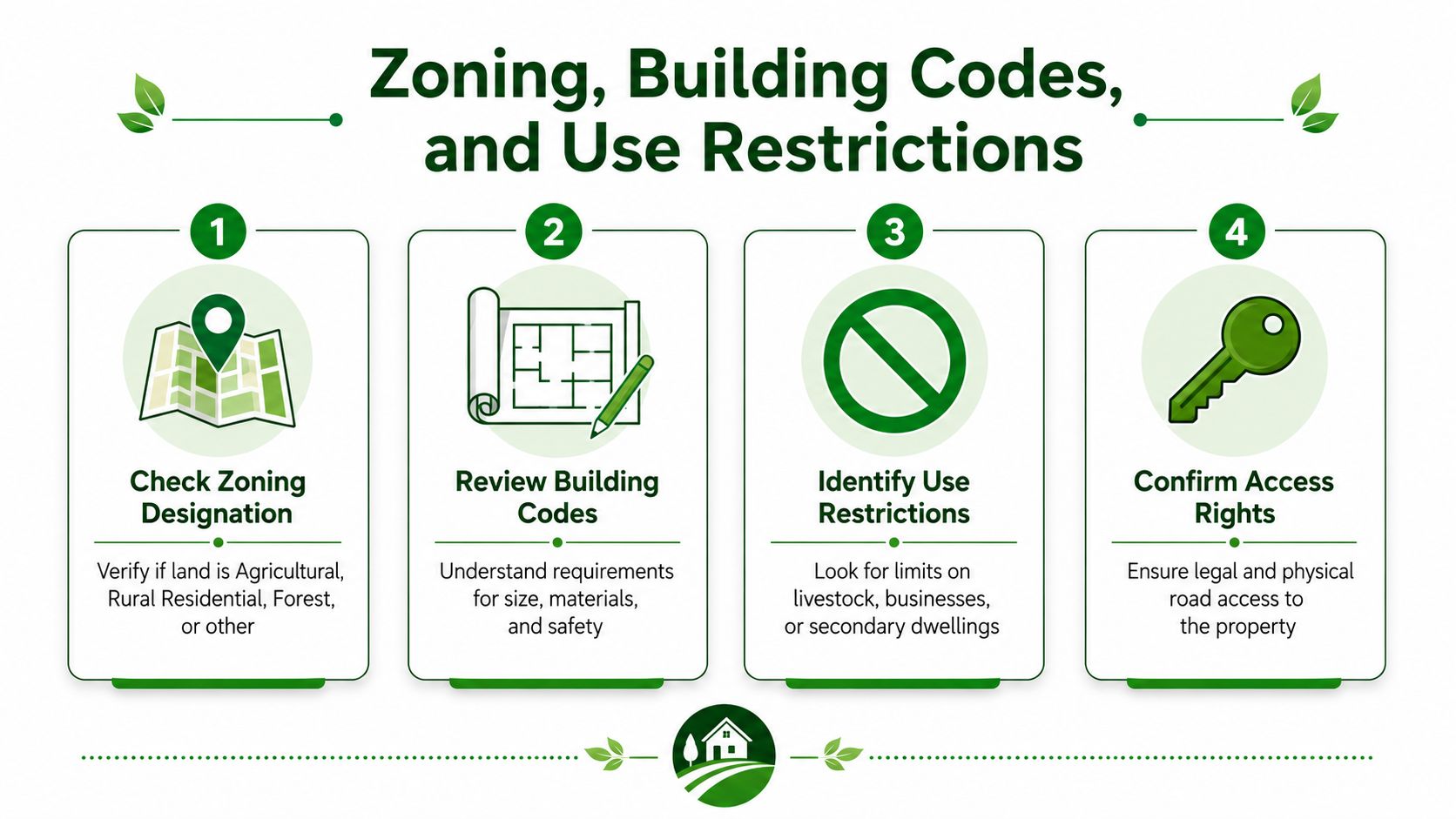
Use this approval sequence:
- Confirm the zoning designation: Match the parcel's classification to your intended residence and land use.
- Review building requirements: Check structure, foundation, sanitation, fire, driveway, and permit rules.
- Search private restrictions: Read covenants, HOA rules, easements, and recorded conditions.
- Get written confirmation: Ask the county whether your specific plan is permitted before closing.
A verbal “probably” from a listing agent is not approval. Treat the county's written response and recorded documents as the controlling evidence.
Financing Options for Off-Grid Land Buyers
Financing should match the parcel's risk, not just your monthly comfort level. Raw land can be harder to finance than a completed home because the lender has fewer improvements to value and may view remote access, zoning, and utility uncertainty as additional risk.
| Financing Option | Typical Down Payment | Term Length | Best-Fit Buyer |
|---|---|---|---|
| Cash | Full purchase price | Immediate ownership | Buyer who wants no loan balance or interest exposure |
| Traditional bank land loan | Often 20% to 35% | Commonly 5 to 15 years | Strong borrower prepared for appraisal and stricter underwriting |
| Credit union loan | Varies by lender | Varies by lender | Buyer with an established local banking relationship |
| USDA rural development financing | Program dependent | Program dependent | Buyer planning an eligible residence within the required timeframe |
| Seller or owner financing | Negotiated | Negotiated, sometimes with balloon terms | Buyer needing flexible underwriting or down payment terms |
| LandZero FlexPay | Structured by seller | Recurring payment schedule | Buyer seeking direct seller financing with smaller recurring payments and no balloon |
Cash removes interest and lender approval risk, but it can leave you without enough reserves for access work, water testing, septic engineering, or energy equipment. Keep a practical improvement reserve instead of putting every available dollar into the purchase.
Traditional lenders may suit buyers with strong credit, documented income, and patience for appraisal and underwriting. Credit unions can offer a more relationship-based process, but their land policies differ. USDA rural development programs are not a general solution for any vacant parcel, so confirm eligibility, intended residence rules, and timing requirements before relying on them.
Owner financing can help buyers with uneven income, self-employment, or limited credit, but read the contract closely. Confirm the interest rate, payment schedule, late terms, title structure, insurance obligations, taxes, default provisions, and whether a balloon payment exists.
LandZero offers vacant land listings with direct owner financing through FlexPay, including online checkout, zero-down initiation, no credit checks, and zero closing costs under its published process. Those features can reduce the upfront barrier, but they don't reduce the cost of making a marginal parcel livable. Compare the total amount paid, then add the setup budget.
Real Setup Costs Behind an Off-Grid Property
The land price is only the first line on the worksheet. The actual capital requirement includes the road, homesite, water source, wastewater system, power equipment, shelter, permits, professional services, and labor.
The verified utility guidance cited earlier places broad utility installation costs at about $9,000 to $34,500 or more, depending heavily on distance and terrain. Use that as a warning against assuming that nearby infrastructure automatically means affordable hookups.
The ranges below are planning figures from the brief for common system categories. They're not quotes, and local conditions can move the final cost outside them.
| System | Low Estimate | High Estimate | Main Cost Drivers |
|---|---|---|---|
| Solar and batteries | $8,000 | $30,000+ | Household demand, battery capacity, panels, inverter, installation |
| Well drilling or rainwater catchment | $5,000 | $15,000 | Ground conditions, depth, drilling access, storage, treatment |
| Septic or composting solution | $3,000 | $12,000 | Soil, setbacks, engineering, permits, system type |
| Driveway and access improvements | $2,000 | $20,000 | Distance, slope, drainage, rock, culverts, surfacing |
Price the parcel as a livable property
A $15,000 parcel in a remote county can become a $60,000 to $90,000 livable property after systems are installed, according to the planning example in the brief. That doesn't mean every property follows that path. It means the listing price tells you very little without a site-specific buildout estimate.
Add professional design, permits, equipment delivery, excavation, labor, and contingency to the worksheet. Weather delays, access problems, changing material availability, and contractor scheduling can push the total above the first estimate. Don't assign a precise contingency percentage unless a local contractor or engineer supports it.
The strongest value usually comes from buildability already present on the parcel. A usable road, nearby proven wells, favorable soils, and flexible zoning can matter more than extra acreage or dramatic scenery.
Before you commit, use the guide to bringing utilities to your land to map each required system, then request written estimates from local professionals. If you can't explain the first two years of spending, you're not ready to judge the land price.
A Final Checklist and Common Mistakes to Avoid
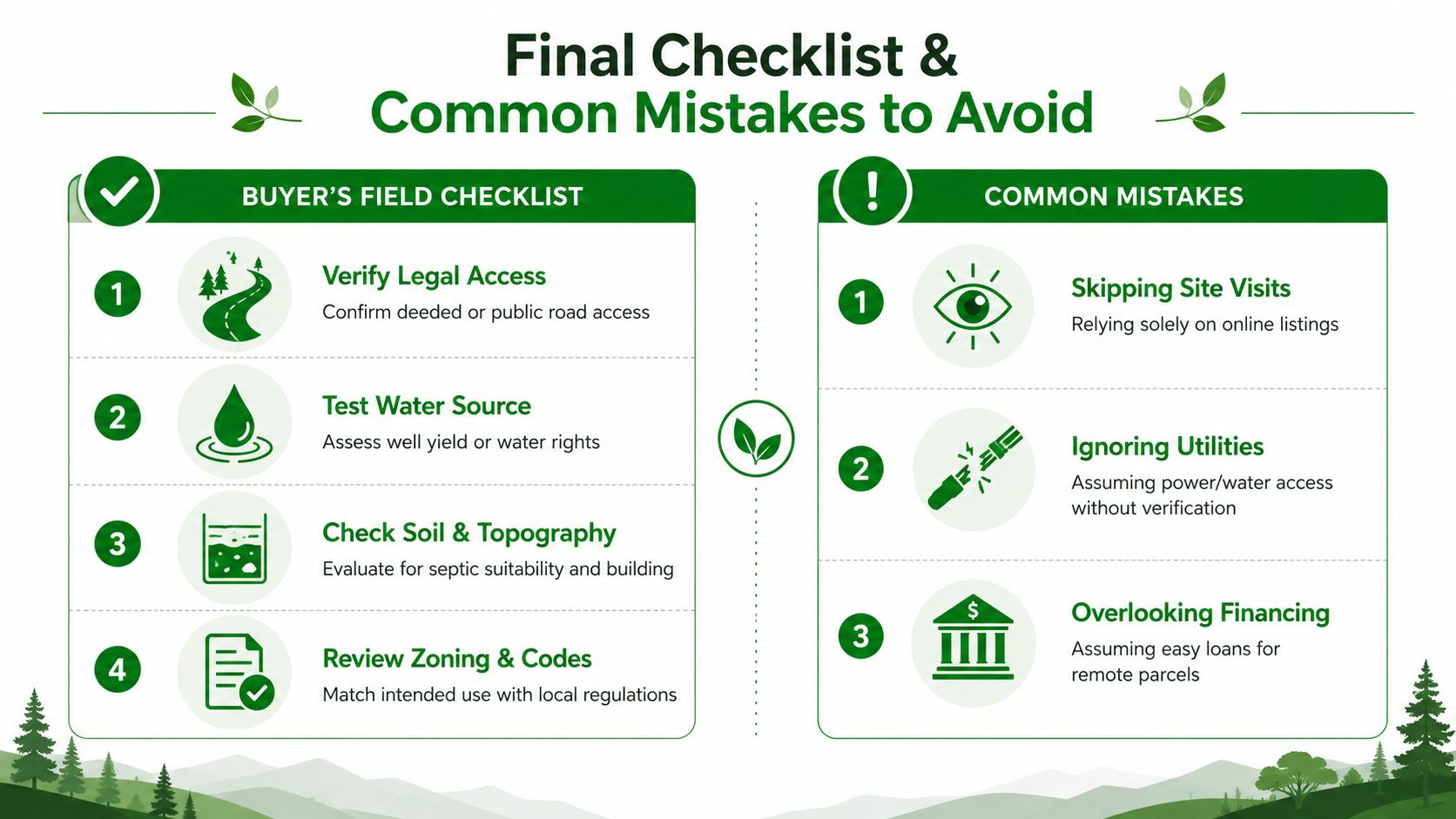
Take this checklist to the property, county office, lender, and closing table. Don't mark an item complete because a listing description sounds confident. Mark it complete only when you have inspected the site or reviewed reliable records.
- Verify physical and legal access: Follow the entire route, inspect seasonal conditions, and confirm recorded road rights.
- Validate the water source: Review well records, test existing water, investigate nearby wells, or obtain a professional drilling assessment.
- Clear septic or an alternative: Confirm soil suitability, permits, setbacks, reserve area, and the legality of any composting solution.
- Review renewable potential: Examine site-specific sun exposure, shading, wind conditions, tower rules, and battery requirements.
- Get zoning approval: Match the intended shelter and occupancy plan to county rules, building codes, covenants, and easements.
- Match financing to the budget: Calculate the purchase cost, financing cost, infrastructure, permits, labor, and operating reserve together.
Mistakes that turn bargains into burdens
Buyers trust listing photos instead of walking the land. They assume a visible track is legal access, treat a nearby well as proof their own well will work, or overlook the difference between summer access and year-round access. They also budget for panels and forget batteries, pumps, wiring, storage, maintenance, and backup power.
Another common error is assuming that an RV, tiny home, yurt, or shipping container is automatically permitted. Local rules control. So do recorded restrictions, and private covenants can be stricter than county zoning.
Recent land guidance emphasizes verifying water, legal access, energy, hazard, food, and buildability as separate screening factors, rather than treating scenery and acreage as proof of value. Coverage of Hawaii also shows how stricter permit enforcement can reduce unpermitted off-grid inventory and increase pressure on compliant properties, while broader market commentary points toward greater interest in parcels with documentation and functional improvements. Review the six-factor off-grid screening guidance for a due-diligence-oriented approach.
The smart buyer doesn't ask whether the parcel is the cheapest. They ask whether it's the most buildable parcel that fits the complete budget, then walk away when the evidence doesn't line up.
If you're comparing off-grid parcels, visit LandZero to browse vacant land by state and budget, including owner-financed options with online purchase setup. Use the listings and land guides as a starting point, then verify access, water, septic, zoning, and total setup costs before you commit.