
If you've ever found the right parcel and then watched a bank turn it into a paperwork maze, you already know why land buyers start looking for another path. Raw land often gets treated like a second-class loan, even when the buyer has a solid plan and the seller wants a clean sale. Owner financing land gives both sides a direct way to move forward, without waiting on a conventional lender to bless the deal.
That freedom comes with a catch. A flexible payment plan can make a parcel look more affordable than it really is, especially when the land has hidden problems like poor access, zoning limits, or utility gaps. The smart buyer learns the financing terms and the property realities at the same time, because the monthly payment only matters if the land can be used the way you want.
Table of Contents
- Why Owner Financing Opens Doors for Land Buyers
- How Owner Financing Land Actually Works
- Pros and Cons of Buying Land with Owner Financing
- Understanding Repayment Structures and Payment Terms
- Hidden Risks That Financing Guides Often Overlook
- Step-by-Step Process for Buying Owner-Financed Land
- Making the Right Decision for Your Land Purchase
Why Owner Financing Opens Doors for Land Buyers
A buyer gets approved for a house loan in town, then starts shopping for a vacant parcel and hits a wall. The bank wants more documentation, more equity, and a cleaner risk profile than the land can offer. That's where owner financing becomes the practical alternative, because the seller can step into the lender's role and let the deal move forward directly.
The market shows that this isn't a niche workaround anymore. NoteInvestor's recent reports say seller-financing note creation reached $30.3 billion in 2024 and $29.5 billion in 2025, with 89,890 owner-financed transactions in 2024 and 87,212 in 2025, which shows how durable this channel has become even when annual volume eased slightly. The five-year cumulative volume also expanded from $125 billion to $131.9 billion and then $137.8 billion across the reported windows, so the underlying market kept growing overall. NoteInvestor's 2024 and 2025 seller-financing report gives the clearest snapshot of that trend.
Who tends to benefit most
Owner financing usually helps buyers who have a real use case but don't fit a bank's template. That includes first-time land buyers, people with thin credit files, budget-conscious investors, and off-grid buyers who want a parcel that's affordable now and flexible later. It can also help sellers move parcels that are harder to finance conventionally, which is why this structure shows up often in rural and recreational markets.
Practical rule: if the bank is focused on your file, owner financing is focused on the property and the seller's willingness to carry the note.
LandZero's overview of buying land with no credit outlines one version of this path, where the transaction starts without a traditional bank approval process and can be completed online. Buy land with no credit through LandZero is useful context if you want to see how that model is presented to buyers.
The appeal is simple. Owner financing lowers the entry barrier, but it doesn't erase the need to understand what the land can and can't do. A buyer who only sees the payment plan is still missing half the picture.
How Owner Financing Land Actually Works
The easiest way to think about owner financing land is this. The seller becomes the lender, and the buyer pays the seller in installments until the debt is satisfied. The property sale and the private loan happen together, which is why the paperwork has to be clear from the start.
The two documents that control the deal
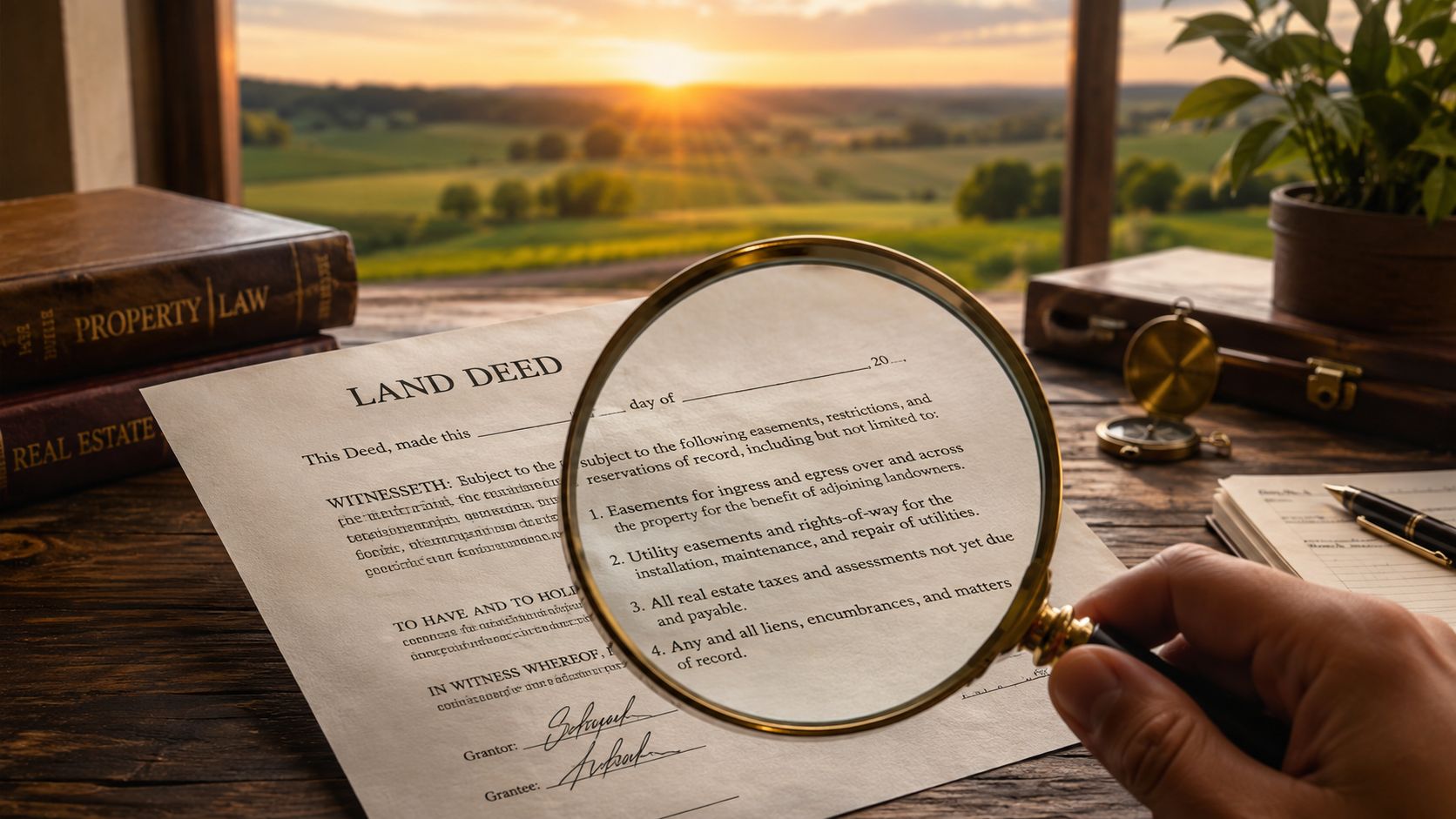
A proper owner-financed land transaction usually includes a promissory note and a security instrument. The note is the repayment promise, and it spells out the interest rate, payment schedule, amortization, late fees, and acceleration terms. The security instrument is what protects the seller if the buyer stops paying, and it may be a deed of trust, mortgage, or land contract depending on the state and structure. The Land Geek's explanation of owner-financing structures and paperwork lays out that document split clearly.
That distinction matters because the title position can change. In some structures, the buyer gets title immediately and the seller records a lien. In others, the buyer holds only equitable title until payoff, which means the seller keeps a stronger legal claim until the final balance is cleared. That's one reason buyers should read the recording language closely before they sign.
What the seller is really doing
Think of the seller as a private bank with one asset to protect. The buyer sends payments to the seller, and the note acts like the loan agreement that keeps the arrangement organized. If the contract is written well, both sides know what happens when a payment is late, when the balance comes due, and what rights exist if the buyer defaults.
The paper controls the relationship more than the handshake does.
That's why people get into trouble when they focus only on the monthly number. A low payment is meaningless if the note hides a large balloon balance or the security instrument leaves the buyer in a weak legal position.
Pros and Cons of Buying Land with Owner Financing
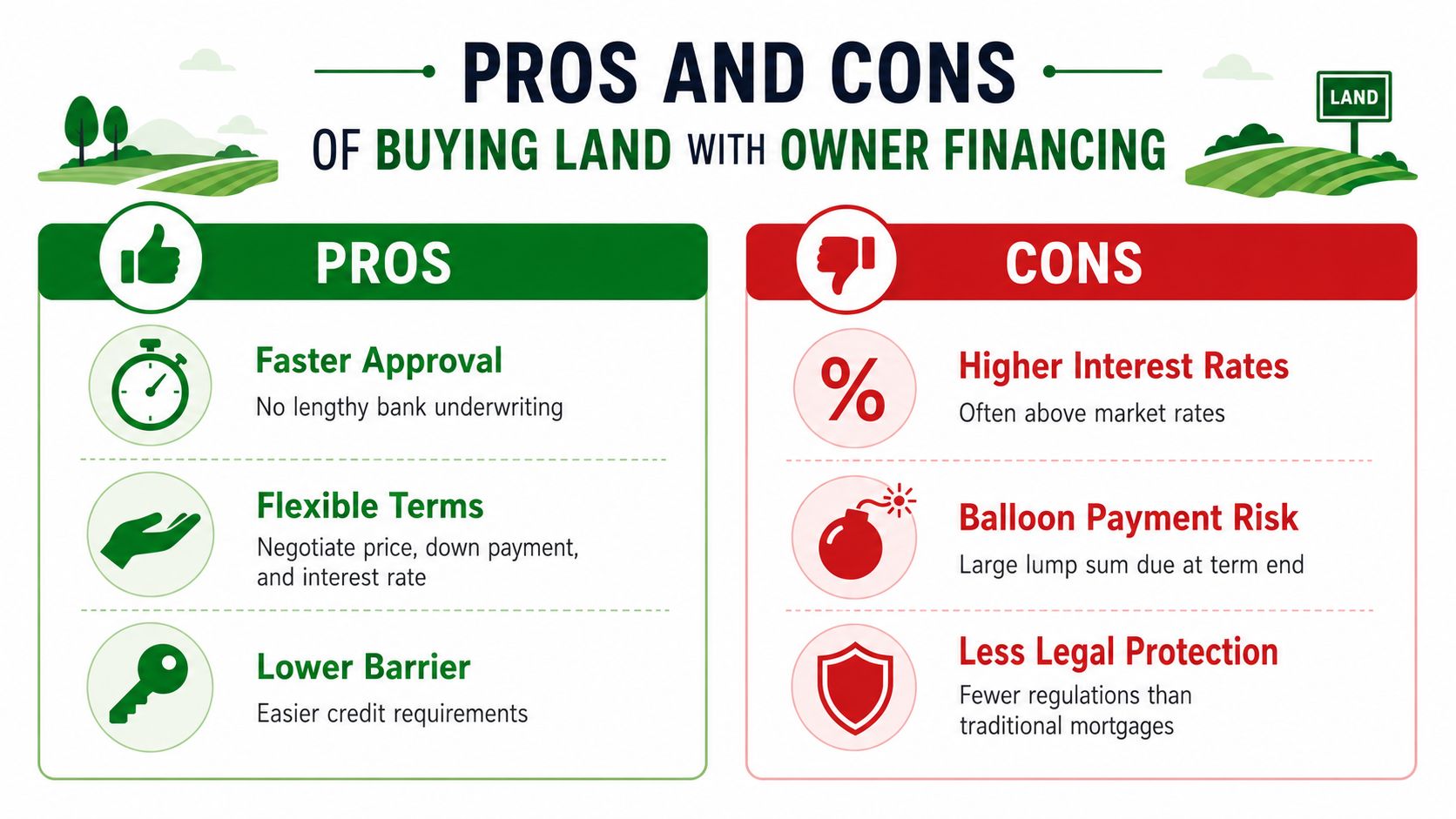
Owner financing is neither a magic shortcut nor a bad idea by default. It's a trade, and the trade is easy to see once you put the benefits and risks side by side. Buyers get faster access and more flexible terms, while sellers ask for more protection because they're taking on more credit risk.
On the upside, owner financing can remove a lot of friction. Many sellers don't use the same hard underwriting banks do, so buyers can sometimes move from interest to contract faster. It also gives both sides room to negotiate the deal shape, which is useful when a parcel is unique, rural, or awkward to finance conventionally.
On the downside, the seller usually wants something in return for that flexibility. Industry summaries place typical owner-financed land terms in the 6% to 12% interest-rate range and 10% to 30% down-payment range, with raw land often leaning toward the higher end because the parcel is viewed as riskier than improved property. NoteInvestor's 2025 land-note data also showed an average 73% LTV and an average land note size of $286,178, which suggests sellers were still financing a substantial share of the property value rather than the full price. NoteInvestor's owner-financing growth report ties those terms to broader market behavior.
The trade-offs buyers actually feel
A buyer who chooses owner financing usually gets one or more of these advantages:
- Faster access: fewer moving parts than a bank loan.
- Flexible negotiations: down payment, rate, and term can be adjusted.
- Lower entry barriers: the deal may be possible even when conventional financing is out of reach.
The cost of that flexibility can show up in the contract itself:
- Higher carrying cost: the seller may charge more than a conventional lender.
- Shorter runway: many terms are much shorter than a standard mortgage.
- Default sensitivity: missing payments can trigger serious consequences faster than buyers expect.
When the trade makes sense
Owner financing fits buyers who value access and speed, and who can tolerate more deal-specific risk. Traditional bank loans still make more sense when a buyer wants long-term stability, lower interest, and a standardized process.
If the parcel is a simple fit for your plans and a bank will lend on it, compare the full cost before you assume the seller-financed option is cheaper.
The right answer depends on the property, the payment structure, and how much uncertainty you can live with.
Understanding Repayment Structures and Payment Terms
The terms are where owner financing land becomes either manageable or expensive. Buyers often ask only about the monthly payment, but the full picture sits in the down payment, interest rate, term length, and whether a balloon balance is waiting at the end.
What the common structures look like
Mainstream land-financing practice often uses 10% to 30% down payments, 6% to 10% interest rates, and 3- to 10-year terms. Some sellers will accept less cash up front, and some deals can start with zero down, but those cases usually shift the risk elsewhere in the contract. The Land Geek's guide to buying land with owner financing is a helpful reference for how those terms are commonly framed.
Longer amortization usually means a lighter monthly payment, but many seller-financed land deals don't run for decades the way a house mortgage does. Instead, the payment schedule may be short, and the remaining balance may be due in a single balloon payment. That structure keeps the seller protected, but it can create pressure for the buyer if refinancing or resale doesn't go as planned.
Comparing payment structures
| Owner Financing Payment Structure Comparison | Down Payment | Interest Rate | Term Length | Monthly Payment Impact | Total Interest Paid |
|---|---|---|---|---|---|
| Zero-down or near zero-down | Very low or none | Often higher | Often shorter | Lower entry cash, but higher monthly strain | Usually higher because the seller carries more risk |
| Standard seller-financed deal | 10% to 30% | 6% to 10% | 3 to 10 years | More balanced monthly payment | Can still be meaningful because terms are shorter |
| Higher-equity structure | Larger upfront cash | Often more negotiable | Can be more flexible | Lower monthly pressure | Usually less costly over time |
The biggest mistake is assuming a low down payment means the deal is easier overall. Sometimes it just means the payment is stretched into a shorter window or paired with a balloon payoff later.
How to judge the term by your own timeline
If you're buying land you won't use right away, a short term can still work if you have a clear exit plan. If you're hoping to hold the parcel for years, build later, or refinance eventually, a balloon date becomes a serious planning item, not a footnote.
A payment plan is only good if it fits the way you actually intend to use the land.
That's why the right structure depends on more than what you can qualify for today. It depends on whether the repayment schedule matches your holding period, your cash reserves, and the parcel's resale prospects.
Hidden Risks That Financing Guides Often Overlook
The easiest mistake in owner-financed land is thinking the financing solved the hard part. It didn't. It only opened the door, and the parcel itself can still carry problems that make the land hard to use, hard to sell, or hard to hold over time.
A landlocked parcel with no legal road access can look cheap until you realize you can't reach it the way you thought. A lot that looks buildable can run into zoning limits, septic issues, or utility extension costs that change the economics entirely. Generic financing guides often skip those realities, but they're the difference between a usable asset and an expensive holding pattern. LandValues' owner-financing pros and cons discussion flags that access, boundaries, and use restrictions need real attention.
Why the payment plan can hide the property problem
A seller can make difficult land easier to buy by offering terms, but that flexibility can also attract buyers who aren't ready for the site-specific costs. That matters most in rural and off-grid settings, where road access, septic approval, utility extension, and local permitting can decide whether the parcel works at all. If those pieces are missing, the land's value isn't just lower, it may be tied to a use you never intended.
The practical question isn't just, “Can I afford the note?” It's, “Can I use this land the way I'm planning to use it?” Hidden usability constraints affect resale value, buildability, and default risk, because a parcel that's awkward to develop is harder to exit if your plans change.
The checks that matter before closing
- Access verification: confirm legal access, not just a path on a map.
- Zoning review: make sure the intended use is allowed by the county.
- Utility reality: check whether power, water, and septic are feasible.
- Boundary clarity: know where the parcel starts and ends before you sign.
- Exit potential: ask who would want the parcel if you had to resell it.
If you're looking into how utilities change raw land value, this guide on bringing utilities to your land is a practical place to start.
The hidden risk is simple. Financing flexibility can make a hard-to-sell parcel look accessible, but the land still has to work in the world. If it doesn't, the note is only the beginning of your problem.
Step-by-Step Process for Buying Owner-Financed Land
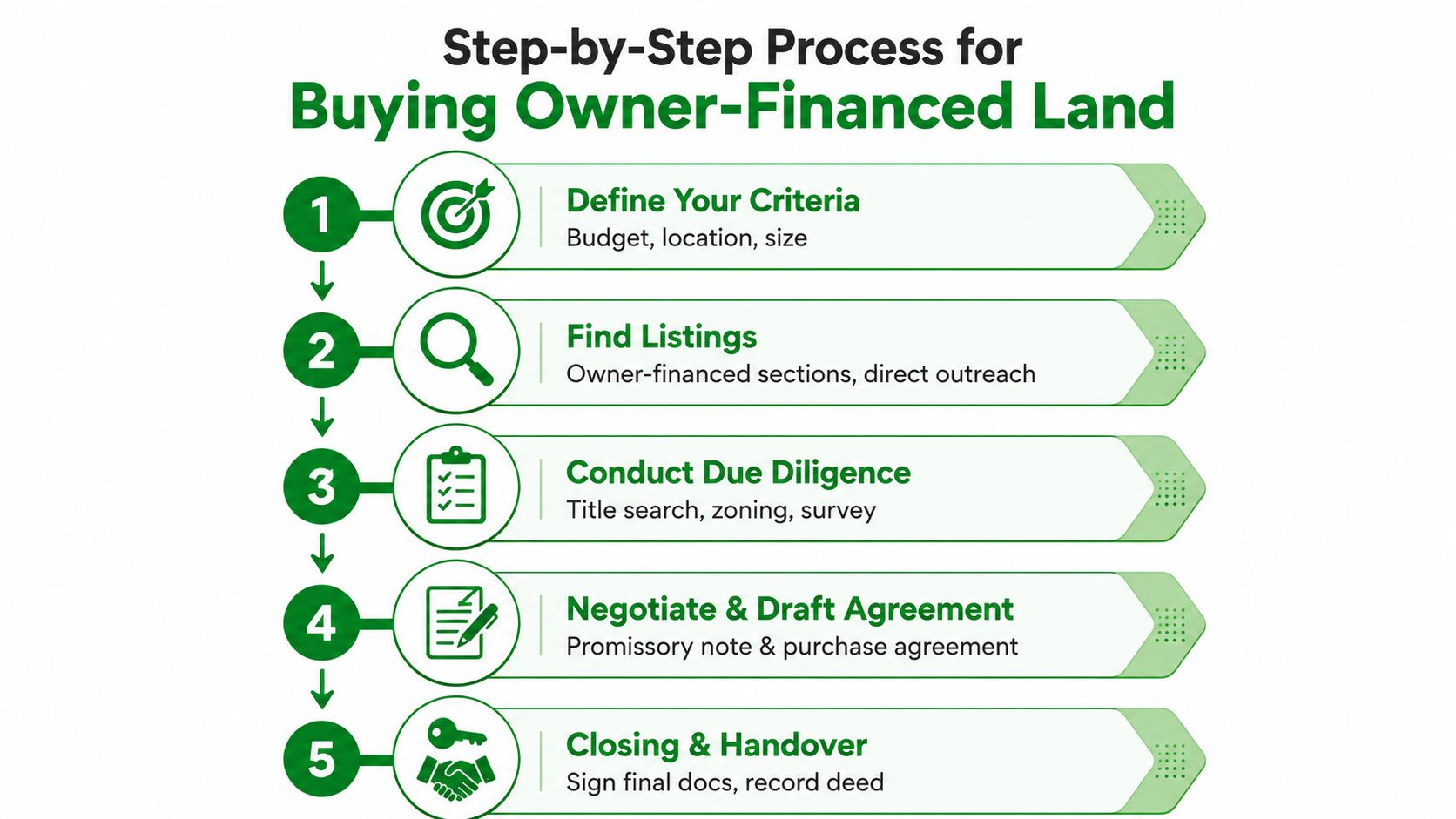
A clean owner-financed purchase follows a rhythm. First you narrow the parcel. Then you verify the land itself. Then you read the documents with enough care to know what you're signing. The process is simpler than a bank loan, but it shouldn't be casual.
Start with what the land has to do
Define the parcel by use first. A recreational lot, a future homesite, and an off-grid holding parcel all demand different checks. Size, budget, county rules, and access should shape the search before you look at monthly payment numbers.
Verify the parcel before you fall in love with the terms
The biggest due-diligence questions are basic, but they're easy to skip when the financing feels friendly. Confirm the boundaries, the access points, the zoning, and the utility situation before you sign anything. If a survey is needed, the land survey requirements guide is a good reference for why it matters.
Ask the seller direct questions
- What document secures the note: know whether you're dealing with a mortgage, deed of trust, or land contract.
- What happens if a payment is late: get the exact default language, not a summary.
- Is there a balloon payment: if so, know the date and the amount.
- What costs continue after closing: taxes, maintenance, and any association obligations still matter.
Once the structure is clear, the closing itself should feel orderly. A promissory note, purchase agreement, and recorded deed should line up with the actual deal terms. If anything looks rushed or inconsistent, stop and get clarity before money changes hands.
Making the Right Decision for Your Land Purchase
A buyer can feel good about owner financing and still end up with a parcel that is hard to use. The payment terms may look manageable, but the land still has to function as intended in practice. Access, zoning, utilities, and the intended holding period all need to line up with the way you plan to use the property.
A simple decision filter
Ask yourself these questions before you move ahead.
- Can I afford the down payment and recurring payments? If the answer only works on a good month, the deal is too tight.
- Have I verified the land title is clear? A clean contract does not fix a messy ownership record.
- Is the balloon payment feasible within my timeline? If not, the monthly number is misleading.
- Do I have an exit strategy if plans change? Resale and refinance are part of the cost.
- Have I consulted a real estate attorney? Contract terms vary by state, and the legal details matter.
- Does this match my long-term investment goals? A good parcel can still be the wrong parcel for your timeline.
Practical rule: buy the land for what it can do, not for what the payment plan makes it feel like it can do.
Owner financing can also hide property-level problems if the buyer focuses too much on flexibility. A low monthly payment does not improve poor road access, solve a zoning mismatch, or create utilities that are not there. The strongest buyers treat financing as one part of the deal and spend the same attention on the parcel itself.
That is why patience matters. The buyer who can tolerate more uncertainty and do deeper due diligence is in a much stronger position than the buyer who only wants the easiest path to closing. A parcel that fits the note but fails the usability test is still a weak purchase.
If you want to compare parcels, learn the financing mechanics, and shop directly from a platform built around vacant land, start with LandZero. It offers owner-financed land listings, budget filters, and an online purchase flow that can help you evaluate options while still doing the due diligence the land deserves.
If you are ready to look at actual parcels, use the LandZero listings as a starting point and compare the terms against the land's practical usability. Read the documents, verify access and zoning, and choose a property that fits both your budget and your long-term plan.