
The popular advice on land for sale in Colorado is backwards. Buyers are told to chase the lowest price, but in Colorado, cheap often means you're paying less because someone else already found the problem, access is weak, utilities are absent, or the parcel is hard to build on. If you want a smart purchase, stop asking whether the listing is cheap and start asking why it's cheap.
Colorado is a serious land market, not a side show. One statewide inventory lists 12,415 properties covering 991,171 acres, with a median lot size of 38.8 acres, a median list price of $734,900, and a median price per acre of $13,278 on Land.com's Colorado page. Another Colorado inventory shows 12,677 properties, 971,727 acres, a median list price of $735,000, and a median price per acre of $13,334, which tells you the state has broad supply, but not cheap supply.
That's the key mistake first-time buyers make. They see an off-grid listing at a low sticker price and assume they found a bargain, when in reality they may have bought a deferred-cost project. In Colorado, the question is simple: does the parcel have legal access, usable terrain, and a path to water, septic, power, and approval? If not, the headline price is just the first bill.
Table of Contents
- Why Cheap Colorado Land Is Not Always a Bargain
- Understanding the Colorado Land Market by the Numbers
- Regional Breakdown of Colorado Land Opportunities
- Essential Due Diligence Before You Buy
- The True Cost of Making Remote Land Livable
- Owner Financing Options for Colorado Land Buyers
- Your Action Plan for Buying Colorado Land
Why Cheap Colorado Land Is Not Always a Bargain
Cheap Colorado land usually isn't cheap because nobody noticed it. It's cheap because something structural is wrong, or expensive to fix. The usual culprits are bad access, absent utilities, difficult terrain, weak buildability, or county rules that shrink what you can realistically do with the parcel.
The price tag is not the project cost
If you're comparing listings, don't stop at acreage. A parcel that looks like a deal can be a headache if it's landlocked, requires a private road, or can't support a build without major site work. That's why buyers who focus only on price per acre often end up paying more in the long run.
A good filter is blunt, but effective. Ask whether the parcel is cheap because it's overlooked, or cheap because it's constrained. Overlooked land can be a value play. Constrained land can be a trap.
Practical rule: If the listing doesn't clearly show legal access, usable topography, and a realistic development path, treat the low price as a warning, not a win.
The difference matters most in remote or recreational purchases, where owners often expect the land to “work itself out” after closing. It won't. Counties don't waive access issues because the property is scenic, and utility companies don't extend service just because the land was inexpensive.
For buyers searching for low-entry options, this Colorado cheap land guide is useful only if you read it with a skeptical eye. Cheap is only useful when it's cheap for the right reason.
What makes a parcel overpriced, even when it looks affordable
A parcel can be priced low and still be overpriced for your use case. If you want to build a cabin, run a well, or use the land seasonally without constant hassle, then an isolated tract with no road, no utilities, and no clear permitting path may cost more than a better-located parcel with a higher asking price.
Buyers should think in terms of functional value, not just listing value. The question is whether the parcel supports the life or investment plan you have. If it doesn't, the “cheap” land is already expensive.
Understanding the Colorado Land Market by the Numbers
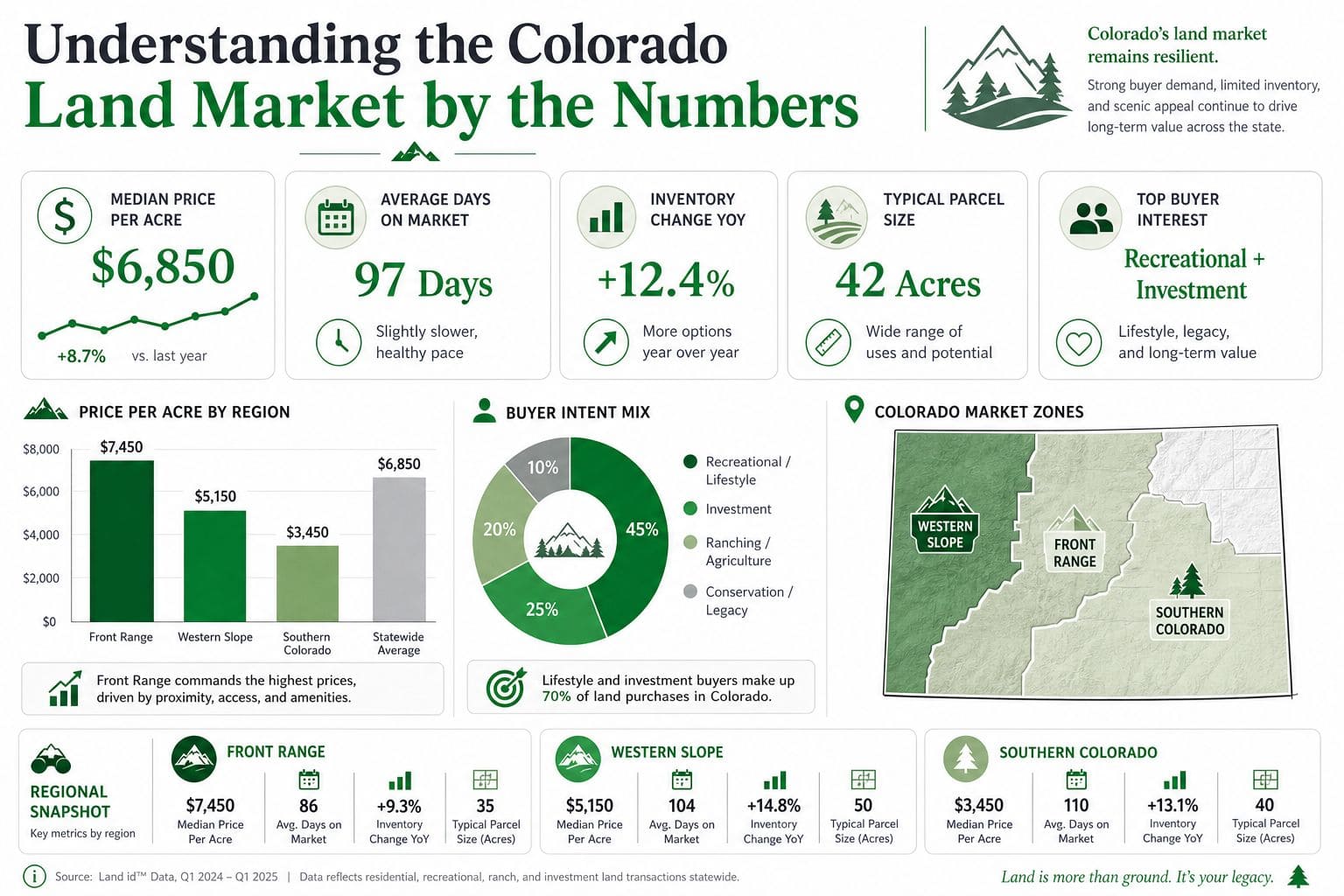
Colorado's land market is broad, active, and priced like a premium market. That matters because it resets your baseline before you make an offer. You are not shopping in a bargain state, you are shopping in a place where even raw land can carry serious per-acre pricing.
What the statewide inventory says
Colorado's statewide listings establish the floor, not the ceiling. The inventory is large enough to give buyers choices, but the pricing sits high enough that a low sticker price usually reflects a structural issue, not a hidden bargain. Any parcel priced well below $13,000 per acre deserves a hard look at access, utilities, and buildability before you write an offer.
Those baseline figures matter because they show how quickly a “cheap” listing can become expensive. If a parcel is far below the usual pricing, the discount usually comes from something buyers will pay for later, road work, utility installation, septic constraints, survey gaps, or a development path that is anything but simple. A low list price does not erase those costs.
How long land sits before it sells
Colorado land also moves at a pace that gives buyers room to evaluate, but not room to be careless. The market data shows a median days on market of 62 days to 67 days, which is long enough to do due diligence and short enough to punish indecision. Good parcels can go fast. Problem parcels can linger until a seller drops the price.
Colorado Association of REALTORS® market reporting points to the same pattern in transaction volume. In its 2025 recap and 2026 outlook, the group reported that land sales fell from 283 transactions in 2024 to 246 in 2025, a drop of 37 sales or about 13% year over year. That is a pickier market, not a dead one.
The same recap showed year-to-date dollar volume of $6.59 billion in 2025 versus $6.32 billion in 2024, which says Colorado real estate activity stayed strong even as land deals slowed. Buyers are still active, but they are more selective about what deserves a premium. For land investors, that means the price on the listing is only the starting point. The key question is what it will cost to make the parcel usable.
Practical rule: If a Colorado parcel is priced far below the market's usual range, assume there is a reason until you prove otherwise.
Regional Breakdown of Colorado Land Opportunities
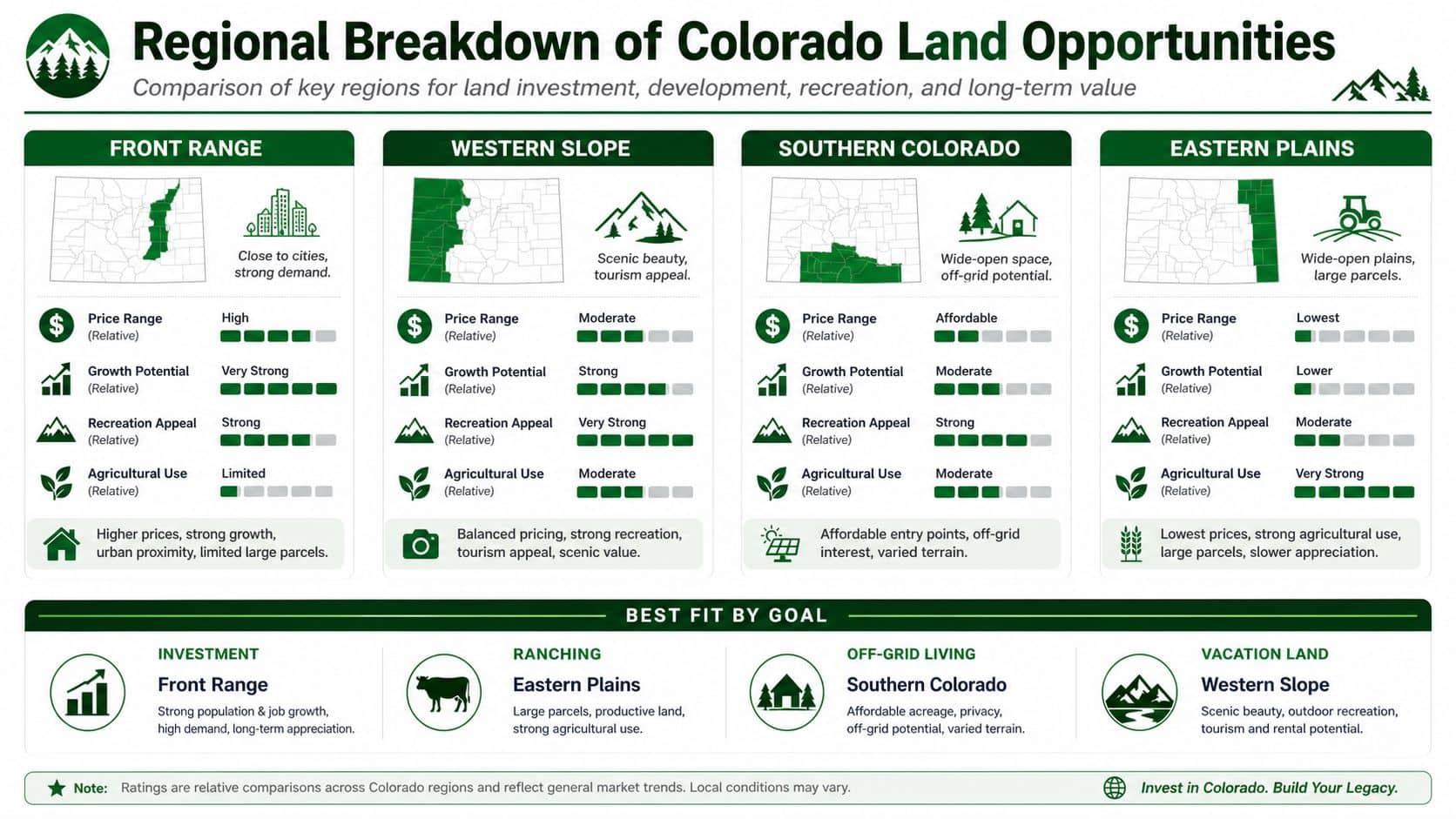
Colorado doesn't have one land market. It has several, and the difference between them is where most buyers either make money or make mistakes. If you're after cheap land, you need to compare regions on the same terms, because price, access, services, and buildability change fast from one corridor to another.
Southeast Colorado and the low-cost fringe
The Southeast is where a lot of low-cost and off-grid inventory tends to cluster. That doesn't make it bad. It does mean buyers should expect more distance from services, more dependence on private infrastructure, and more variability in road access. This region fits buyers who want privacy, recreational use, or a lower entry price, but it's usually not the place for someone who wants a simple, plug-and-play homesite.
If the parcel is in this kind of submarket, treat road status and utility absence as the default, not the exception. That's especially important for first-time owners who underestimate how quickly “just add a well and septic” turns into a multi-step development project.
San Luis Valley style parcels
The San Luis Valley appeals to off-grid buyers because it offers space, sky, and separation. It also tends to attract people who care more about independence than convenience. That can be a smart trade, but only if the parcel's legal and physical realities line up with your plans.
You need to think about seasonality, site conditions, and how much work you want to do before the land becomes usable. A lower asking price may be justified if the parcel is mostly meant for recreation or long-term hold. It's a mistake if you expected easy residential use.
Western Slope versus Front Range
The Western Slope offers stronger recreational appeal and often a more relaxed feel, but buyers still need to check access, winter conditions, and proximity to services. The Front Range, by contrast, is where you pay for convenience, growth pressure, and easier access to the state's busiest markets. You usually won't find the cheapest land there, but you may find land with fewer development headaches.
For investors, the trade-off is simple. The cheaper the parcel, the more carefully you should inspect access, terrain, and county rules. For buyers who want a future homesite, proximity to services matters more than bargain pricing. Don't buy a remote parcel and then complain that it behaves like a remote parcel.
Essential Due Diligence Before You Buy
Colorado gives buyers more public data than many land markets, and you should use it aggressively. County systems make it possible to confirm ownership, boundaries, and parcel details before you spend real money. That doesn't replace a survey or legal review when needed, but it does keep you from buying blind.
Start with access, boundaries, and legal description
Boulder County's assessor data is refreshed daily at 4 a.m. and includes parcel-related CSVs plus GIS parcel boundaries, while Weld County's property portal lets you search by account number, owner, address, subdivision, parcel number, or legal description, according to Boulder County's assessor data download page. That's not a small convenience. It means buyers can verify parcel geometry, ownership, and tax records before a purchase.
Use that data to answer a few hard questions. Does the legal description match the land you think you're buying? Do parcel boundaries line up with the listing? Does the route into the property exist on paper? If the answers are fuzzy, stop and investigate.
Don't treat a county map as proof of buildability. It's proof of location, not approval.
Check the issues that kill deals
A Colorado land buyer should confirm four things before closing. First, legal access. Second, zoning and setbacks. Third, water or well feasibility. Fourth, whether any easements or road obligations affect the usable area. If the parcel is for off-grid use, this is even more important because the property may look simple but carry hidden restrictions.
If you want a clean way to think about descriptions and parcel language, read this guide to legal land descriptions. The point isn't jargon. The point is making sure the contract, the map, and the world land all describe the same asset.
Use a stop-or-go checklist
- Verify access: Confirm the road, easement, or recorded route before you fall in love with the view.
- Match boundaries: Compare the listing, county parcel data, and any survey you can obtain.
- Read zoning carefully: Don't assume a rural parcel can support the use you want.
- Ask about water and septic paths: If those aren't viable, the land may never become practical for your plan.
- Look for red flags in the legal description: If the paperwork is vague, the risk is real.
If any one of these fails badly enough, walk away. There are too many parcels on the market to fight for one that can't support your goals.
The True Cost of Making Remote Land Livable
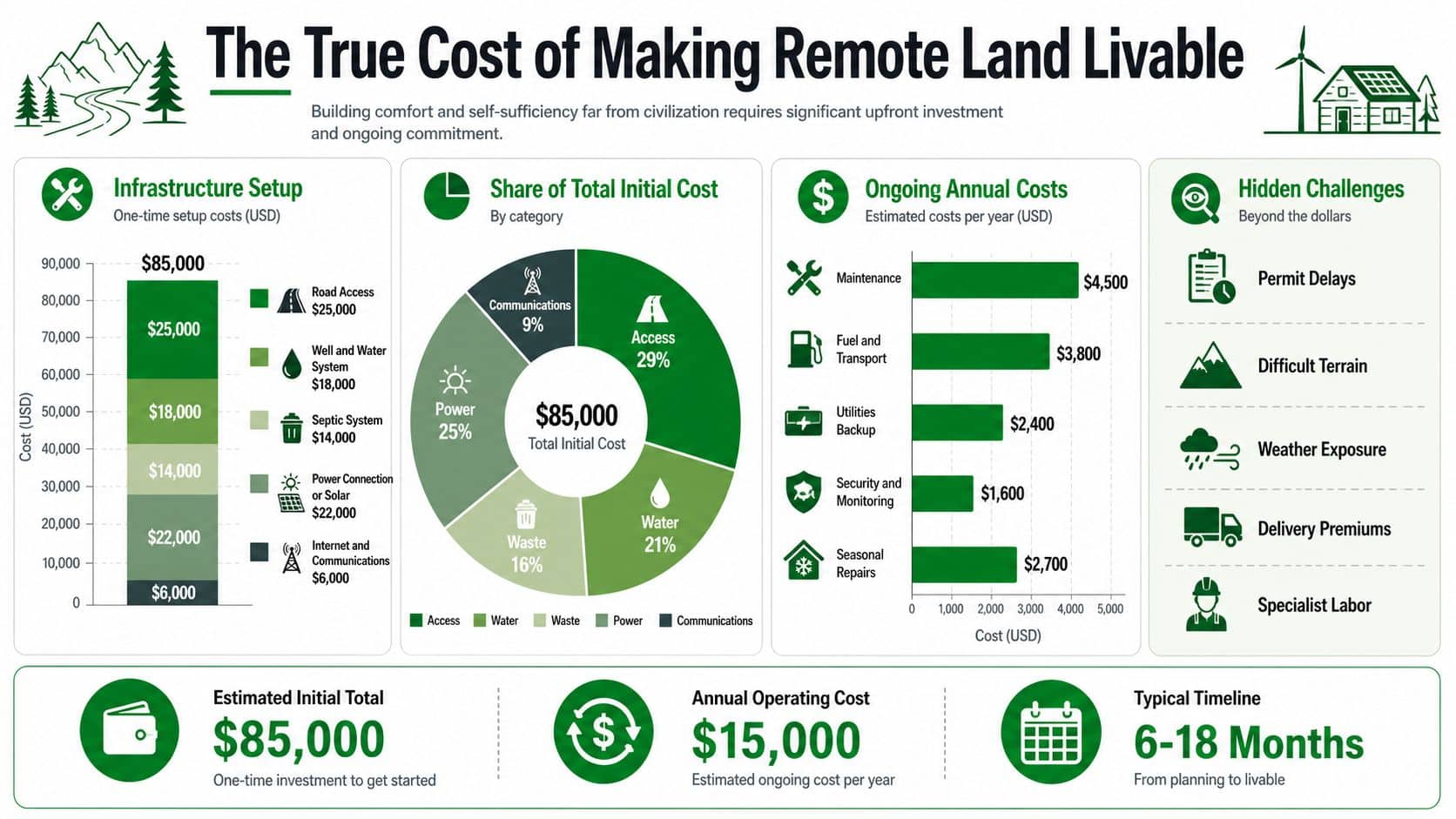
A low listing price can hide a large development bill. That's the brutal truth of remote Colorado land. The sticker price is the entry fee, not the full cost of ownership if you plan to live there, build on it, or use it comfortably year-round.
The infrastructure stack you're really buying
Remote land usually needs some mix of road work, water planning, septic approval, power solution, and internet workaround. That stack is where cheap becomes expensive. A parcel that looks affordable on a listing page can become a long project once you start pricing those pieces together.
The right question isn't, “Can I buy it?” It's, “Can I make it usable without blowing up my budget?” If the answer depends on several unverified assumptions, the parcel is still a speculation, not an investment.
What buyers overlook most
Road access is the most underestimated cost because it doesn't feel glamorous. But without a reliable way in and out, everything else becomes harder. Utility absence creates a similar problem, because every workaround adds cost, time, or both.
A lot of first-time buyers also underestimate the non-livable nature of raw land in its early stage. You can own a beautiful parcel and still have nowhere functional to park, sleep, store equipment, or keep systems running. That's why remote land should be priced as a project, not just as acreage.
For a more detailed framework on raw-land development, use this cost guide for raw land in 2026. The main lesson is simple, the market price of land and the usable value of land are not the same thing.
Investor rule: Never buy a remote parcel if you haven't mentally separated land price from development price.
Why some buyers should not buy remote land
If your budget is tight, remote land can punish you. The parcel may be affordable today and still impossible to finish on your timeline. That's especially true for buyers who need the land to become usable fast, or who don't have extra cash after closing.
In those cases, paying more for a better-located parcel is often the smarter move. Expensive land that already has access and a viable build path can be cheaper than “cheap” land that demands a second project after closing.
Owner Financing Options for Colorado Land Buyers
Bank financing for vacant land is hard, and that's a reality buyers need to accept early. Traditional lenders usually prefer improved properties and well-documented collateral, which leaves many first-time land buyers stuck. Owner financing fills that gap, especially for buyers who want flexibility and don't want to be derailed by underwriting.
Why owner financing works for land
Owner financing lets the seller, not a bank, structure the deal. That matters because land deals often move faster when the financing is simpler. It also helps buyers who have limited credit history, uneven income, or don't want a large upfront cash hit.
LandZero is one example of that model. It offers vacant land listings with zero-down initiation, no credit checks, zero closing costs, and structured monthly payments through its owner-financed checkout process. If you want to browse Colorado inventory under that model, LandZero fits the low-friction route better than a traditional land loan.
How to judge a financing offer
Do not focus only on the monthly payment. Compare the total payment obligation to the land's real utility and your development plan. A flexible structure is useful only if the parcel itself makes sense.
Use this simple filter:
- Can I afford the monthly payment without stretching my budget?
- Does the land still make sense after I factor in development costs?
- Am I getting flexibility, or am I just postponing a bad decision?
That last question matters more than it gets credit for. Easy financing can tempt buyers into overpaying for a parcel they wouldn't choose if they were paying cash.
When owner financing is the right move
Owner financing is strongest when the parcel is modest in price, the buyer wants to move quickly, and the land is being purchased for long-term hold, recreation, or gradual improvement. It's also useful when a buyer wants to preserve cash for surveys, permits, access work, or a future build.
It is not a magic fix for a bad parcel. Financing should solve the payment problem, not disguise a land problem. If the land doesn't fit your use case, no payment plan changes that.
Your Action Plan for Buying Colorado Land
A first-time buyer I'd trust with this market would start with use case, not acreage. If the goal is a future home, I'd push them toward better access and clearer buildability. If the goal is recreation or a long hold, I'd let them look farther out, but only after they've accepted the infrastructure trade-offs.
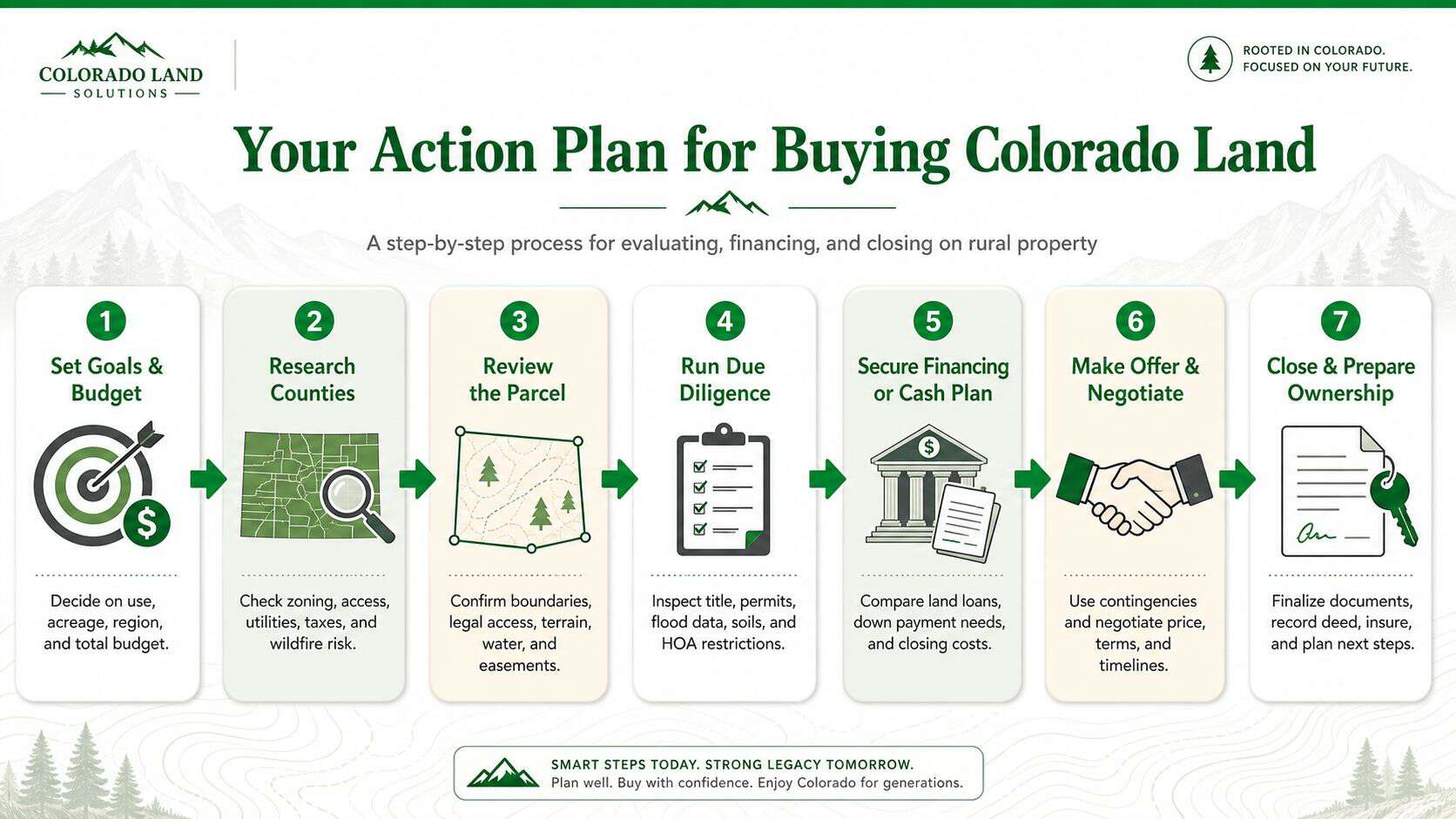
Buy in the order that avoids regret
The right sequence is blunt. Pick the region that matches your use, screen out parcels with access or boundary problems, verify zoning and utility feasibility, and only then compare prices. If you reverse that order, you'll get emotionally attached to the wrong land.
A good buyer also brings in help at the right moment. A surveyor or land attorney is worth the cost when the boundaries are unclear, the access is questionable, or the paperwork doesn't line up with the listing. Don't wait until after closing to discover the actual issue.
A realistic buyer path
A practical Colorado buyer often moves through four phases. First, narrow the region. Second, eliminate parcels that fail basic due diligence. Third, decide whether cash, traditional financing, or owner financing makes sense. Fourth, close only when the land fits the budget and the use case.
Bottom line: Buy the parcel that fits your plan, not the parcel that looks cheapest on the page.
If you're serious, keep the process simple. Use county data, ask hard questions, and price in the cost of making the land usable. That discipline is what separates a useful purchase from a regretful one.
If you want a simpler way to shop Colorado land without losing sight of the hidden costs, start with LandZero. It gives buyers a way to review low-cost parcels with owner financing and compare options without the usual bank-heavy process. For a Colorado purchase, that can make the difference between browsing and moving forward.