
The most common advice on this topic is to look up a single national average and call it a day. That shortcut creates more confusion than clarity, because an acre of land can mean a remote field, a buildable suburban lot, productive cropland, or a parcel with roads and utilities already in place. If you want a useful answer to how much does an acre of land cost, you have to start with use, location, and infrastructure, not just acreage.
A better way to think about land pricing is simple. First ask what the parcel is for. Then ask where it sits, what access it has, and how much work it still needs before it fits your plans. That framework gives first-time buyers a real buying lens instead of a misleading headline number.
Table of Contents
- The Answer to How Much Does an Acre of Land Cost
- What Raw Land Actually Is and Why It Matters
- USDA National Acreage Benchmarks and What They Miss
- State-by-State Land Price Ranges That Shape Your Search
- How to Evaluate Raw Land Before You Buy
- Navigating Raw Land Financing Options
- Common Raw Land Buying Mistakes and How to Avoid Them
The Answer to How Much Does an Acre of Land Cost
The answer is that there is no single acre price. An acre can mean very different things to different buyers, because the same piece of land may be raw, improved, agricultural, or positioned close enough to growth corridors that it starts to behave like development land.
Think in variables, not a sticker price
Location changes value first. A parcel near jobs, schools, paved roads, or future development pressure will usually draw a different pool of buyers than a similar-looking acre far from services. Zoning narrows the field after that, because what you can build, park, farm, or subdivide changes demand in a very direct way.
Infrastructure comes next. Land with roads, utilities, and approvals already in place often costs more than land that still needs access work, utility extension, or environmental review. Intended use matters too, since a hunting tract, homestead, commercial lot, and row-crop acre are all priced inside different markets, even if the acreage count is the same.
Practical rule: when a listing looks cheap, ask what the lower price is really buying you. Distance from services, missing utilities, difficult terrain, and legal restrictions can all reduce price, but each one also changes what you may have to spend later.
A helpful way to picture acre pricing is as a stack of filters. Start with the broad market, then narrow by county, zoning, road access, water and power availability, and whether the parcel already supports the use you have in mind. That is how buyers move from a broad search like how much does an acre of land cost to a budget that fits a real purchase.
For a quick benchmark, agricultural land gives a useful reference point, but only as a starting point. As the intended use becomes more specific, a national headline price tells you less about the parcel you are considering.
What Raw Land Actually Is and Why It Matters
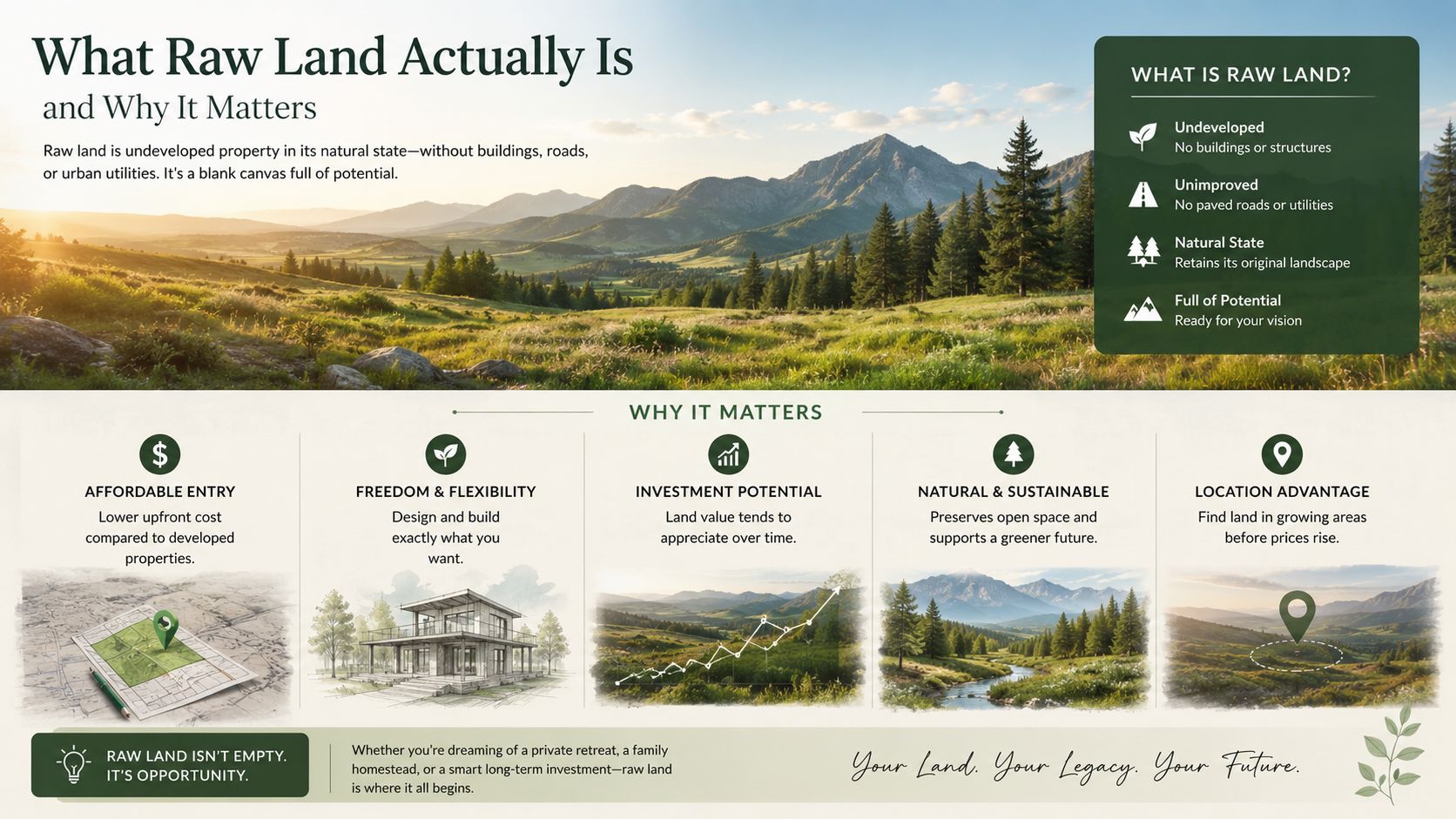
Raw land is undeveloped property with little or no infrastructure in place. In plain English, it's the blank canvas version of real estate. There may be no paved access, no utilities at the lot line, and no clearing, grading, or site prep that makes building easy.
Raw, improved, and developed land are not interchangeable
A parcel can look vacant and still carry hidden value from work that's already been done. Improved land may already have road access, a driveway, utilities, or basic site preparation. Developed land is even further along, often with approvals, infrastructure, and a use case that's easier for a buyer to step into.
That difference matters because buyers aren't only paying for dirt. They're paying for time saved, risk removed, and work already completed. A parcel that still needs a well, septic system, utility connection, and access improvements can seem affordable at first, then become expensive once the setup costs are added.
A simple way to separate the categories is to ask one question. If you bought the parcel tomorrow, could you use it the way you want without major extra work? If the answer is no, you're probably looking at raw land or something very close to it.
Why the label changes the number
The label helps explain why an acre with no services can trade very differently from one that already functions as a build site. Raw land often attracts buyers who want lower entry cost, privacy, flexibility, or a long-term hold. Improved parcels attract buyers who want convenience and certainty.
If you're comparing listings, use the seller's language carefully. “Vacant,” “undeveloped,” “off-grid,” and “buildable” are not the same thing. A parcel that looks raw from the road may still come with costs that change the final purchase price, so read the map, the disclosures, and the county records before you assume the sticker price tells the full story.
USDA National Acreage Benchmarks and What They Miss
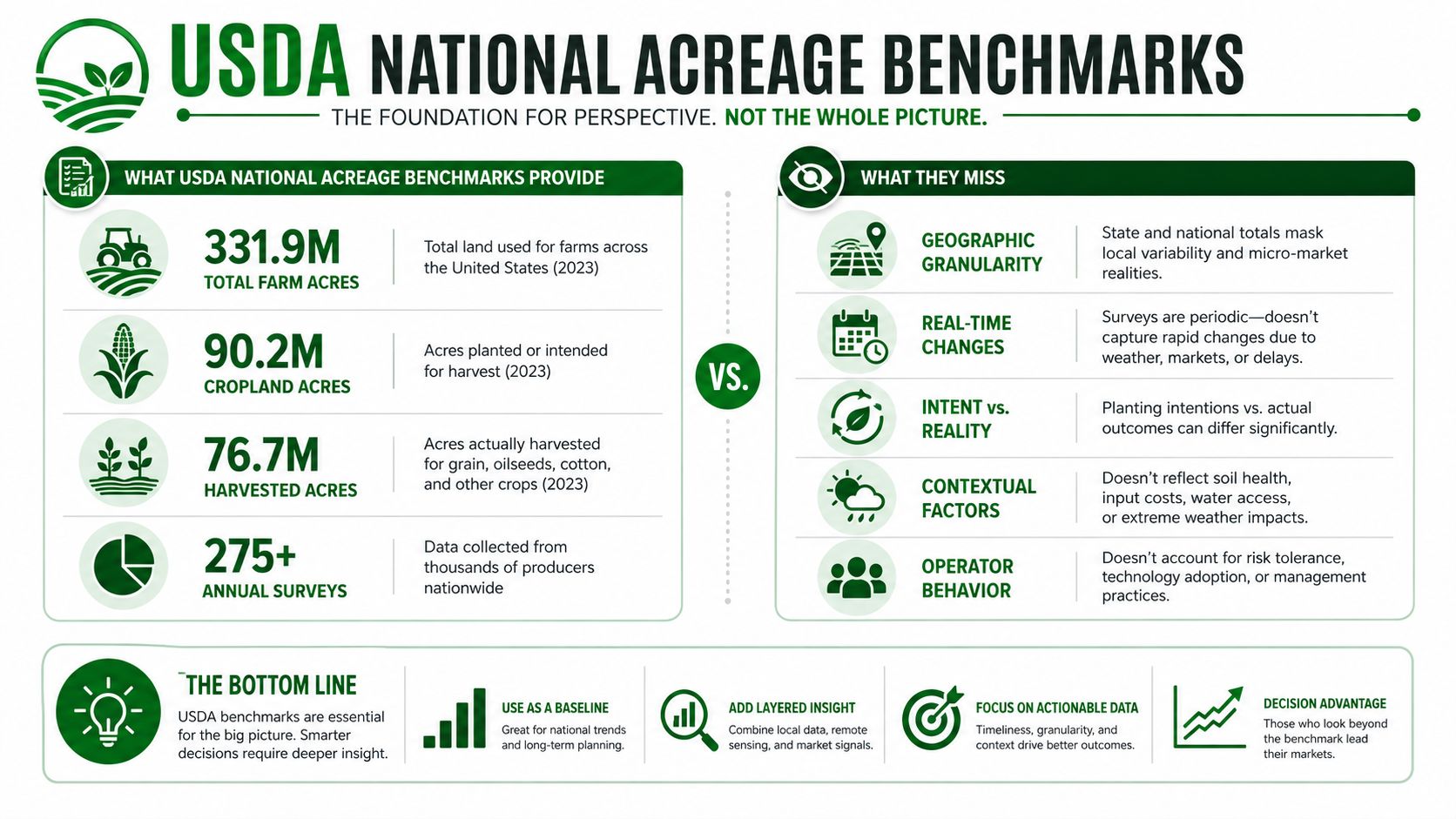
The best national benchmark for land pricing is agricultural land value, because it gives you a real per-acre reference point instead of a guess. USDA's 2025 Land Values Summary reported that U.S. farm real estate averaged $4,350 per acre, with cropland at $5,830 per acre and pastureland at $1,920 per acre. USDA also reported 2024 averages of $4,170 per acre for farm real estate and $5,570 per acre for cropland, which shows the market kept rising year over year. USDA's 2025 Land Values Summary is useful because it gives buyers a stable baseline, not because it solves every pricing question.
What those numbers tell you
The spread between cropland and pastureland shows how strongly use affects value. Cropland is about 3.0x the price of pasture on average, which makes sense when the land already supports more productive output. Farm real estate sits between the two, because it blends land value with the value of the improvements and productive potential already attached to it.
That benchmark helps a first-time buyer avoid the most common mistake, which is assuming every acre should cluster around one average number. It doesn't. A parcel that can support production, access, and predictable use commands a different price than land that is merely open.
What the USDA average leaves out
The USDA figures are strongest for agricultural land, but many buyers aren't shopping for a farm. They're looking for recreational ground, off-grid acreage, or a future homesite. Those categories can sit far outside the agricultural baseline because the buyer pool, zoning rules, and infrastructure needs are different.
That's why the national average should be treated as a starting point, not a ceiling or a floor. If you're comparing parcels in a county with heavy development pressure, your local market can move well beyond agricultural averages. If you're looking at rural ground with little access, the asking price may sit far below the USDA benchmark.
For practical budgeting, use USDA data to understand the broad market, then switch to county records and local comparable sales. That's the only way to know whether a parcel is priced like farmland, a raw lot, or a higher-value site with a better path to immediate use.
State-by-State Land Price Ranges That Shape Your Search
State averages show why the phrase an acre of land can't be priced from one national number. A 2026 state-by-state land analysis reported vacant-land averages from about $2,200 per acre in New Mexico to $65,000 per acre in Massachusetts, with Nevada at $3,500, Wyoming at $3,800, and Texas at about $10,200. The same broad market can also include land under $1,000 per acre in some places and commercial lots or farmland above $100,000 per acre. This 2026 state-by-state land analysis makes the core point clear, regional variation is huge.
Vacant Land Acreage Averages by State
| State | Average Price Per Acre |
|---|---|
| New Mexico | About $2,200 |
| Nevada | $3,500 |
| Wyoming | $3,800 |
| Texas | About $10,200 |
| Massachusetts | $65,000 |
Why this range matters before you browse listings
A buyer shifting from western rural acreage to the Northeast can face a major jump even before parcel quality changes. The same number of acres doesn't buy the same outcome in every state, because proximity to people, infrastructure, and constrained land supply affects the bid stack.
For example, a buyer focused on low-cost entry will usually find more realistic options in markets that are still priced like open land. A buyer chasing convenience, resale potential, or close-in buildability has to budget much higher, even if the parcel itself is small.
If you're looking at California specifically, this California land pricing guide is a useful internal reference point for how one state can sit well above the lower-cost national bands. That's the right way to use state-level research, as a filter for expectations before you get attached to a listing.
A good budget starts with the market you're actually buying in, not the national average you wish still applied.
How to use state ranges without getting misled
Start with the state, then move to the county. Within the same state, road access, zoning, and distance to services can separate one acre from another by a wide margin. That means state data is a compass, not a final valuation.
If your target state is expensive, you may need to adjust your strategy toward smaller acreage, less developed parcels, or a longer holding period. If your target state is more affordable, your bigger challenge may be sorting true bargains from land that's cheap because it still needs a lot of work.
How to Evaluate Raw Land Before You Buy
The right question isn't just whether an acre is cheap. It's whether the land can support the way you plan to use it without turning into an expensive fix-up project. A parcel that looks affordable on paper can become costly if zoning, access, or utility needs don't line up with your plans.
The checks that matter most
Zoning comes first. You need to know what the county allows right now, not what a seller hopes might happen later. If your goal is a cabin, RV use, animals, or a future home, those uses need to be allowed or realistically attainable.
Access comes next. A parcel with direct road frontage is easier to value than one that depends on a rough easement or a route that still needs legal clarification. If you can't reliably reach the site, the land's practical value drops fast.
Utilities are the next divider. Power, water, and septic availability can radically change what the parcel costs to make usable. If the land is remote, you may be deciding between on-grid setup and an off-grid plan, and that choice changes both budget and timeline.
What to look for in the field and on paper
Terrain matters because flat, build-friendly land is easier to prepare than steep, rocky, or flood-prone ground. Soil quality matters if you need a septic system or want to use the land productively. Flood risk matters because it can limit building options and raise carrying costs.
Don't let a low sticker price outrun a slow due diligence process. A cheap acre with a bad access problem is rarely a cheap acre for long.
A practical checklist is easy to keep in your head. Verify zoning, confirm legal access, ask about utility distance, inspect terrain, and review soil and flood information before you treat the listing as comparable to other parcels. If you want a deeper guide on setup costs, this internal resource on how much it costs to develop raw land in 2026 helps connect purchase price to real-world preparation.
The right parcel is the one that fits your use with the fewest surprises. That's what separates an attractive listing from a workable purchase.
Navigating Raw Land Financing Options
Price only matters if you can buy the parcel on terms that fit your situation. For raw land, financing often looks different from a home purchase because lenders tend to be more cautious when the property has no improvements and no immediate income stream.
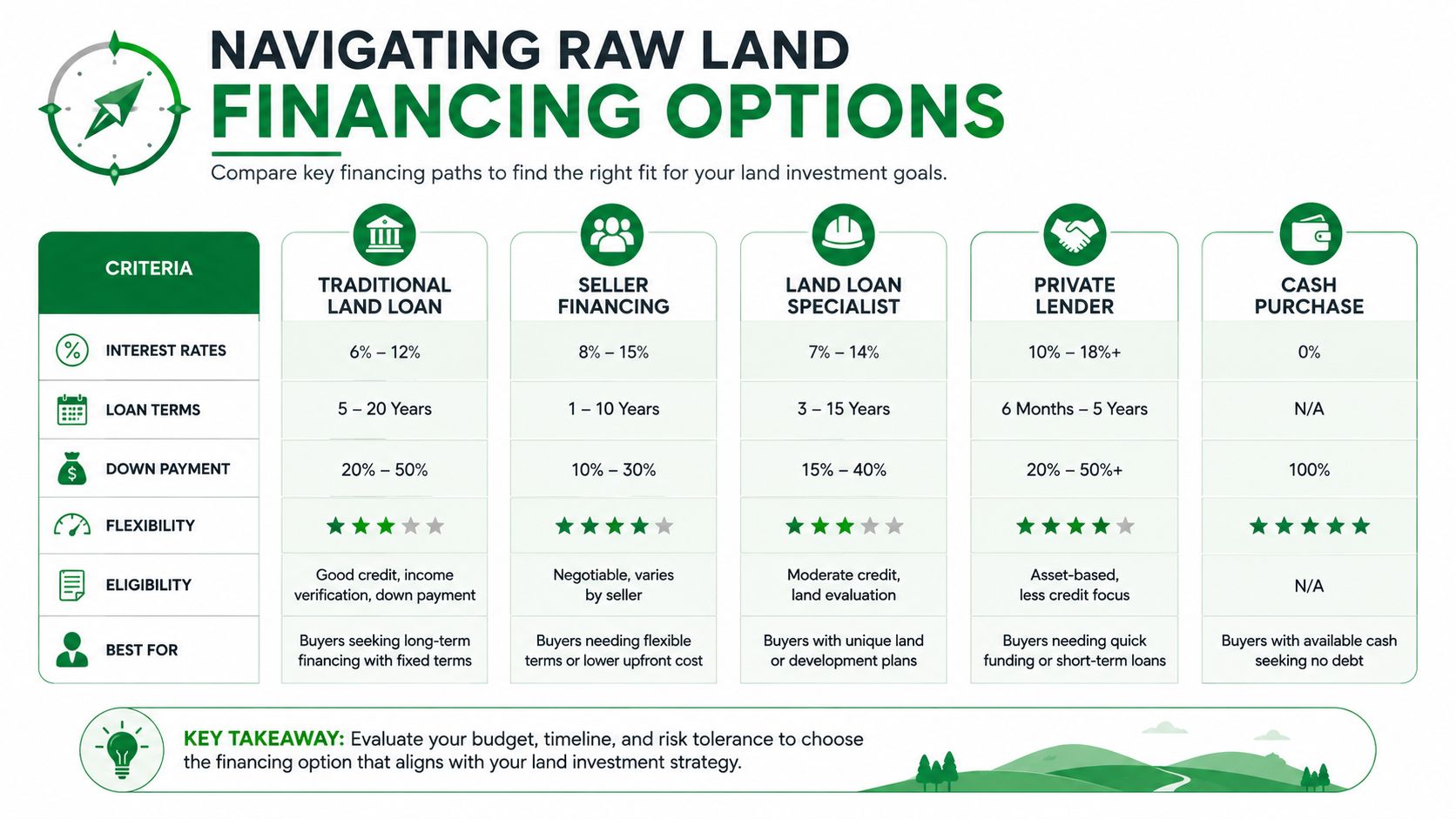
Three common paths buyers use
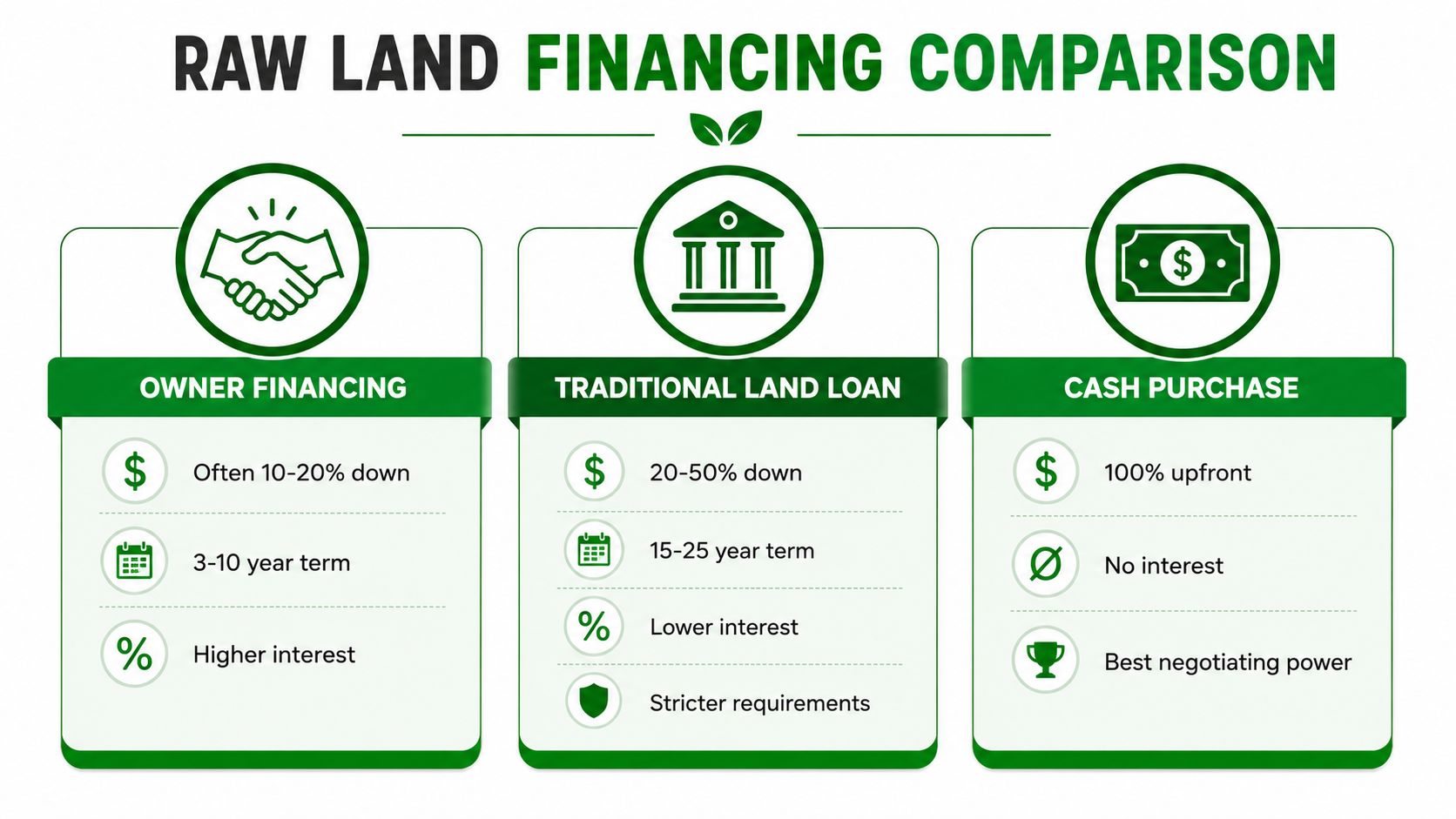
Owner financing is often the most flexible route for raw land. The seller sets the structure, and the buyer pays over time instead of depending entirely on bank underwriting. That can open the door for buyers who want a simpler approval process.
Traditional land loans can work well when the parcel is more bankable, but they usually come with stricter requirements. Lenders want more confidence in the parcel's value, access, and future use, so the process can feel closer to underwriting a project than buying a ready home.
Cash purchases are straightforward. They remove lender delays, eliminate interest, and usually give the buyer more negotiating power. Cash also tends to make the transaction cleaner, especially when the parcel is inexpensive enough that financing would add more friction than value.
Matching the financing route to the parcel
A remote raw lot and a near-town buildable acre do not belong in the same financing conversation. The more work a parcel still needs, the more likely a flexible owner-financed structure will feel practical. The more complete the parcel is, the more likely traditional financing becomes realistic.
For buyers who are comparing direct seller options, LandZero offers owner-financed vacant land listings with zero-down initiation, no credit checks, and zero closing costs. That matters most when the buyer wants a lower-friction purchase path rather than a conventional bank process.
If you're paying cash, use that advantage carefully. The strongest cash advantage is often not speed alone, but the ability to keep the transaction simple and sometimes negotiate more effectively because the seller doesn't have to wait on financing.
The right financing choice depends on your parcel and your budget, not just on what sounds easiest. A smart buyer compares the monthly obligation, the upfront cash need, and the amount of risk they're taking on before signing anything.
Common Raw Land Buying Mistakes and How to Avoid Them
The biggest land buying mistakes are usually simple. Buyers fall in love with the price, then discover the parcel doesn't fit the use they had in mind. That's avoidable if you slow the process down long enough to verify the basics.
Three mistakes that cause the most regret
Skipping the development math is the first one. A cheap acre can become much more expensive once you add clearing, access work, utility setup, and professional checks. Always compare the list price to the first-year cost of making the parcel usable.
Assuming remote means automatically affordable is the second. Distance can lower price, but it can also bring access issues, utility gaps, or legal complications. Remote land only counts as a bargain if the lower sticker price survives the due diligence process.
Ignoring surveys and boundary clarity is the third. A parcel that seems obvious on a map can still leave room for misunderstandings if the lines haven't been confirmed. This land survey requirements guide is a good reminder that property lines deserve the same attention as price.
The safest land buyers ask what might be missing before they ask how low the price can go.
A simple prevention mindset
Treat each listing like a decision tree. If the use works, the access is clear, the boundaries make sense, and the setup cost stays within budget, the parcel deserves a closer look. If one of those pieces is shaky, pause and confirm it before you move forward.
The fastest way to protect yourself is to slow down before you commit. Ask the county questions, read the disclosures, and compare the parcel against other sold land in the area rather than against a national average. That's how first-time buyers avoid paying for a cheap acre that turns into an expensive lesson.
If you're comparing raw land right now, LandZero gives buyers a place to browse low-cost parcels, review land education, and explore owner-financed options in one place. Visit LandZero to compare listings, check buying details, and see how different parcels line up with your budget and intended use.