
The popular advice is simple: find the state with the lowest price per acre, choose the largest parcel you can afford, and call it a bargain. That approach misses the part that determines whether the land will work for you. A cheap parcel can still be expensive to access, develop, finance, insure, or resell.
The best states to buy cheap land are better understood as starting points, not automatic answers. Price matters, but so do location, financing terms, water, legal access, zoning, utilities, taxes, and the condition of the title. Seller financing can make raw land easier to purchase, especially for buyers who don't fit a bank's lending model, but flexible payments don't remove property risks. They change how you pay for the parcel.
Table of Contents
- Why Cheap Land Is Not Automatically a Smart Buy
- Understanding Seller Financing in Plain English
- Key Contract Terms Every Buyer Should Know
- Comparing Affordable Land States
- How LandZero Owner Financing Works
- Benefits, Risks, and Legal Considerations
- Choosing the Right State and Parcel
- A Smarter Path to Affordable Land Ownership
Why Cheap Land Is Not Automatically a Smart Buy
A low listing price tells you what the seller wants for the land. It doesn't tell you what the property will cost to own or use. A remote desert lot may look affordable until you investigate the road, water, septic, survey, taxes, and restrictions attached to it.
The USDA's 2025 land-value data illustrates why state comparisons can be useful but incomplete. Cropland averaged $1,320 per acre in Montana at the low end and $32,900 per acre in Rhode Island at the high end, a gap of more than 24 times across states. U.S. cropland averaged $5,830 per acre in 2025, up 4.7% from the prior year, so low-price states remained well below the national benchmark (USDA 2025 Land Values).
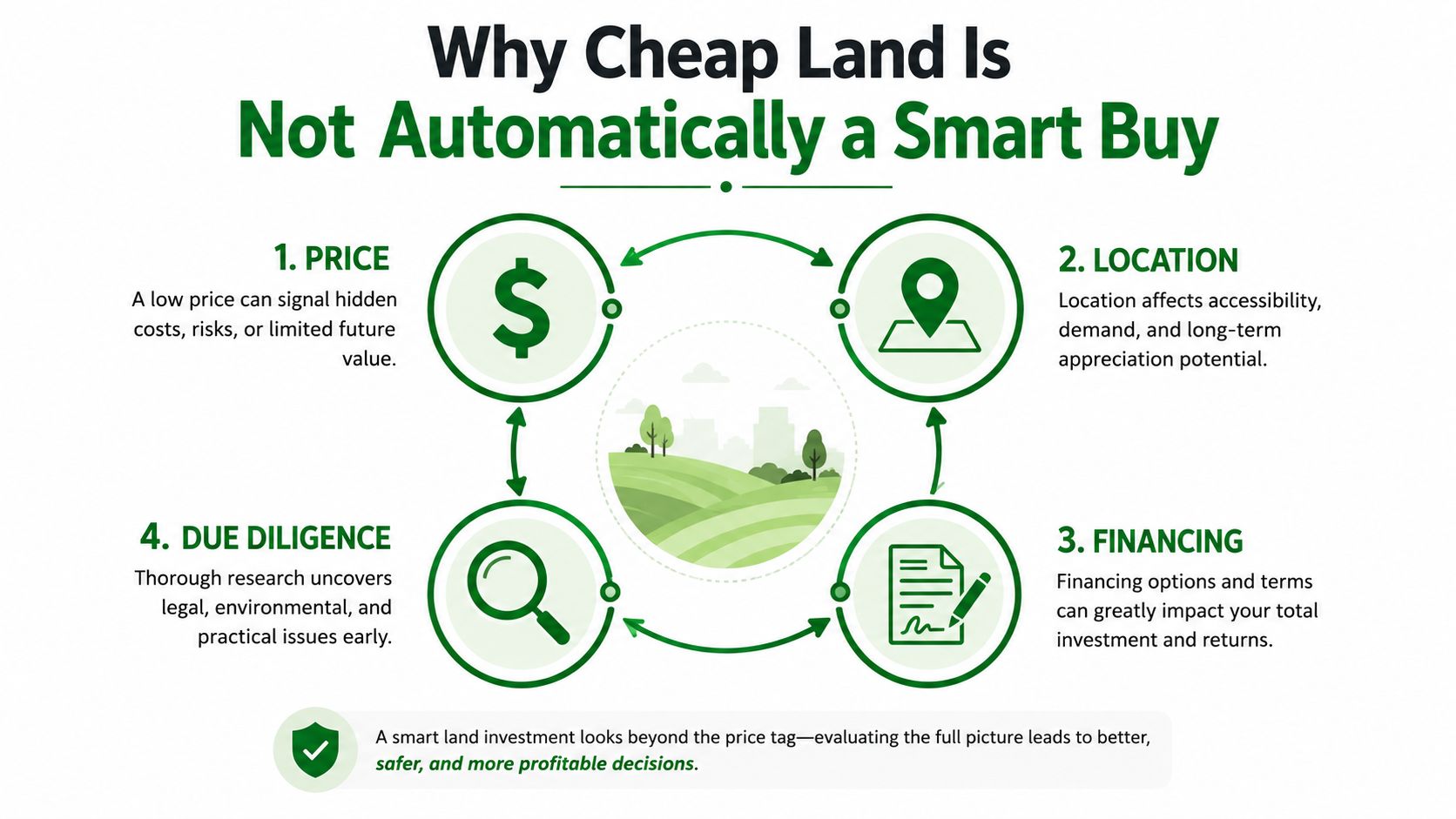
Separate the four decisions
Evaluate every parcel through four independent questions:
- Price: What is the purchase price, and what recurring costs come with ownership?
- Location: Can you reach the property, and does the surrounding area support your intended use?
- Financing: What will you pay upfront, monthly, and in total under the contract?
- Due diligence: Can you confirm title, access, zoning, taxes, restrictions, and physical conditions?
A parcel can pass one test and fail another. A $5,000 desert lot, for example, might need substantial spending on a road, well, septic system, survey, or power before it supports your plans. The land price is still $5,000, but the usable-property cost is much higher.
Common cheap-land traps
Look for landlocked parcels, flood exposure, unpaid liens, unclear easements, and zoning that limits building, camping, or recreational use. Deed restrictions or HOA-style covenants may prohibit RVs, manufactured homes, short-term occupancy, or certain structures even when county zoning appears permissive.
Practical rule: Never call land a bargain until you know what you can legally do with it, how you can reach it, and what you'll pay beyond the purchase price.
Seller financing makes this distinction more important. A lower monthly payment can feel manageable while the property remains unusable or the contract leaves you responsible for improvements you can't recover after default. Treat affordability as a complete ownership calculation, not a number on a listing page.
Understanding Seller Financing in Plain English
Seller financing means the property owner acts as the lender. Instead of borrowing from a bank, you agree to pay the seller directly under a written contract. The arrangement can be useful for vacant land because conventional lenders often view raw acreage as harder to value and harder to resell than a completed home.
The simplest analogy is a private installment sale. You and the seller agree on the purchase price and payment terms, you make scheduled payments, and the seller transfers the deed according to the structure of the agreement. Depending on the documents, the seller may keep legal title until the balance is paid.
The basic payment structure
Before signing, identify these terms:
- Down payment: The amount paid at the beginning. Some arrangements require a deposit, while others may begin with the first scheduled installment.
- Interest rate: The financing charge applied to the unpaid balance. Land contracts may carry a different rate from a conventional home loan.
- Amortization: The schedule used to calculate payments over time. A long amortization period doesn't necessarily mean the contract lasts that long.
- Balloon payment: A large balance due on a specific date before the regular payment schedule would otherwise finish.
- Promissory note: A written promise to repay the debt.
- Land contract or contract for deed: A document that sets out the purchase terms and may leave the deed with the seller until payoff.
A conventional mortgage usually involves bank underwriting, lender-required documentation, and a recorded security instrument. Seller financing can involve more direct negotiation and a faster closing, but the seller's rights and your remedies depend heavily on the contract and state law.
You may not need a traditional appraisal or bank approval, but that convenience shifts more responsibility to you. Review the property independently, understand the default language, and confirm who holds title during the payment period. Missing payments can result in forfeiture or termination rights that differ from a standard mortgage foreclosure process.
Buyers with limited or no credit history can review how buying land with no credit works before comparing specific financing options. The important point is simple: seller financing reduces dependence on a bank, not the need for careful evaluation.
Key Contract Terms Every Buyer Should Know
A seller-financing contract can make a parcel accessible while changing the total cost and risk. Read the agreement as a financial document, not just a promise to transfer land.
Start with the payment math. A smaller down payment preserves cash for surveys or improvements, but it may leave a larger balance. A higher down payment can reduce the financed amount, while a longer term may lower the monthly obligation but increase the time interest applies.
Clauses that deserve close attention
- Payment amount and due date: Confirm the exact installment, grace period, payment method, and date the first payment is due.
- Interest and amortization: Ask whether interest is calculated on the unpaid principal and request a complete payment schedule.
- Balloon provision: Find out whether a lump sum becomes due before the regular schedule ends and how you'll fund it.
- Late fees: Check the fee, when it applies, and whether repeated lateness triggers acceleration.
- Prepayment: Verify whether you can pay early without a penalty and whether extra payments reduce principal.
- Default and forfeiture: Understand the cure period, seller remedies, and what happens to previous payments and improvements.
- Taxes and insurance: Identify who pays property taxes, required coverage, recording costs, and association charges.
- Assignment: Determine whether the seller can transfer or sell the note to another party.
A contract for deed may leave the deed with the seller until final payment. A recorded deed of trust or similar instrument can create a different ownership and enforcement structure. Don't assume two contracts offer the same protection because both advertise monthly payments.
For legal-description issues, buyers can review LandZero's guide to legal land descriptions. The description should match the county record and the parcel you inspected.
| Contract Feature | Contract A: Low Down, Balloon | Contract B: Higher Down, No Balloon |
|---|---|---|
| Upfront cash | Lower initial payment | Higher initial payment |
| Monthly structure | May appear easier to manage | Often more predictable |
| Large future balance | Required under the contract | Not expected under the stated structure |
| Cash-flow risk | Higher if refinancing or payoff funds aren't available | Lower, assuming payments remain affordable |
| Improvement planning | Riskier if default remedies are strict | More predictable, subject to the contract |
| Best fit | Buyers with a clear payoff plan | Buyers prioritizing payment certainty |
Have the seller explain acceleration rights, cure periods, and the treatment of improvements in plain language. If an answer isn't written into the contract, don't rely on a verbal promise.
Comparing Affordable Land States
Regional data provides a helpful first screen. It can't tell you whether a particular parcel has a usable road, dependable water, buildable terrain, or clean title.
USDA 2025 farm real estate values were $1,660 per acre in the Mountain region, $2,880 in the Southern Plains, $3,200 in the Northern Plains, and $3,930 in the Delta States, compared with a U.S. average of $4,350 per acre. The Corn Belt and Pacific regions were both above $8,200 per acre (USDA farmland value data).
New Mexico stands out in the supplied market data. A 2025 USDA-based ranking placed it at about $725 per acre, the lowest among the ten cheapest states, while independent market data identified it as the cheapest state by median land price at about $6,000 per acre. Those figures measure different things, so they shouldn't be treated as interchangeable. Arid land, low population density, and limited development pressure help explain why broad averages can remain low (2025 cheap-state ranking).
Arizona offers another useful example. Independent data placed its median land price at about $4,164 per acre, while some western counties averaged under $1,000 per acre. Remote parcels far from roads, water, and utilities can sell at steep discounts, even when the statewide picture looks less inexpensive (state land-price analysis).
| State | Typical Price Range | Common Parcel Size | Land Use Notes | Owner-Financing Availability |
|---|---|---|---|---|
| New Mexico | Very low in many remote markets, with differing measures across datasets | Varies by county and listing | Arid land, off-grid and recreational possibilities | Available on some vacant-land listings |
| Arizona | State and county prices vary widely | Varies by county and access | Desert parcels may have limited competing uses | Available on some vacant-land listings |
| Nevada | Often associated with remote, low-density land markets | Varies by location | Arid terrain and distance from services matter | May appear in owner-financed inventory |
| Texas | Broad variation across rural and higher-demand areas | Varies substantially | Rural, recreational, agricultural, and development uses differ by county | Common on some private-land listings |
| Arkansas | Regional affordability varies | Varies by county | Terrain, roads, timber, and water conditions need parcel-level review | May be available through individual sellers |
| Oklahoma | Interior Plains pricing patterns can be favorable | Varies by county | Rural and agricultural uses depend on local rules | May be available through owner-financed listings |
These states aren't universally best. Use LandZero's state-focused cheap-land guide as a starting point for comparison, then verify the parcel itself. Lower median prices often correlate with remote locations, fewer services, and a greater need to confirm access, utilities, terrain, and permitted use.
How LandZero Owner Financing Works
LandZero's process starts with finding a parcel, then checking whether its payment terms and property conditions fit your plans. Buyers can browse vacant-land listings by state and budget, review parcel details, and assess the purchase before completing checkout.
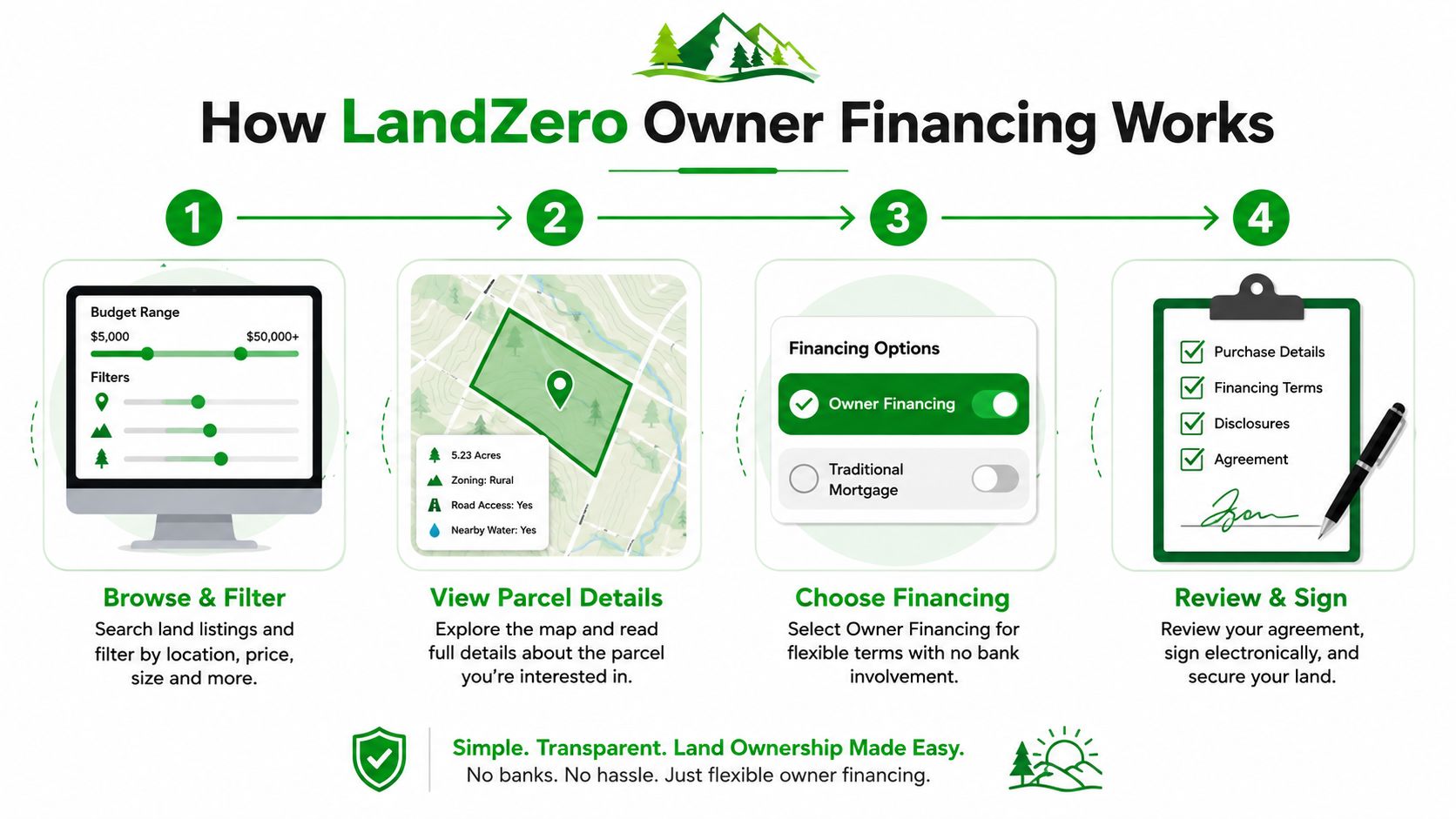
Start with the budget filter
Collections such as Land Under $5k, $5k to $10k, and $10k & Up narrow the search before a low price creates an emotional commitment. State-level browsing supports location comparisons, while parcel details provide starting points for checking acreage, legal description, access information, and intended use.
The filter is a screening tool, not a property inspection. A parcel within your price ceiling may still lack reliable road access, water, suitable zoning, or workable terrain.
Review the payment choice
LandZero offers FlexPay, an owner-financing structure with zero down, no credit check, and no closing costs, as stated by the publisher. LandZero offers zero-down initiation on owner-financed purchases, subject to contract terms and state-specific regulations. Review all conditions before signing. The buyer starts with the first month's installment, with payments handled directly by the seller rather than a conventional bank.
Check the disclosed monthly payment, total term, total purchase price, default provisions, and other contract conditions. A no-credit-check process may simplify qualification, but it does not replace title research, county records, or parcel-level due diligence.
Complete the online transaction
The process includes online checkout, account access, and a customer portal for managing payments. The agreement should explain how and when ownership transfers after the buyer satisfies the required terms. LandZero's stated process provides deed transfer upon completion of the agreement, so keep the signed contract, payment records, and closing documents.
The useful comparison is between known payment terms and unknown property costs. Financing can be easy to arrange while development remains difficult or expensive. Use the platform's educational guides and FAQ resources to examine zoning, taxes, off-grid questions, and improvement costs before committing.
Benefits, Risks, and Legal Considerations
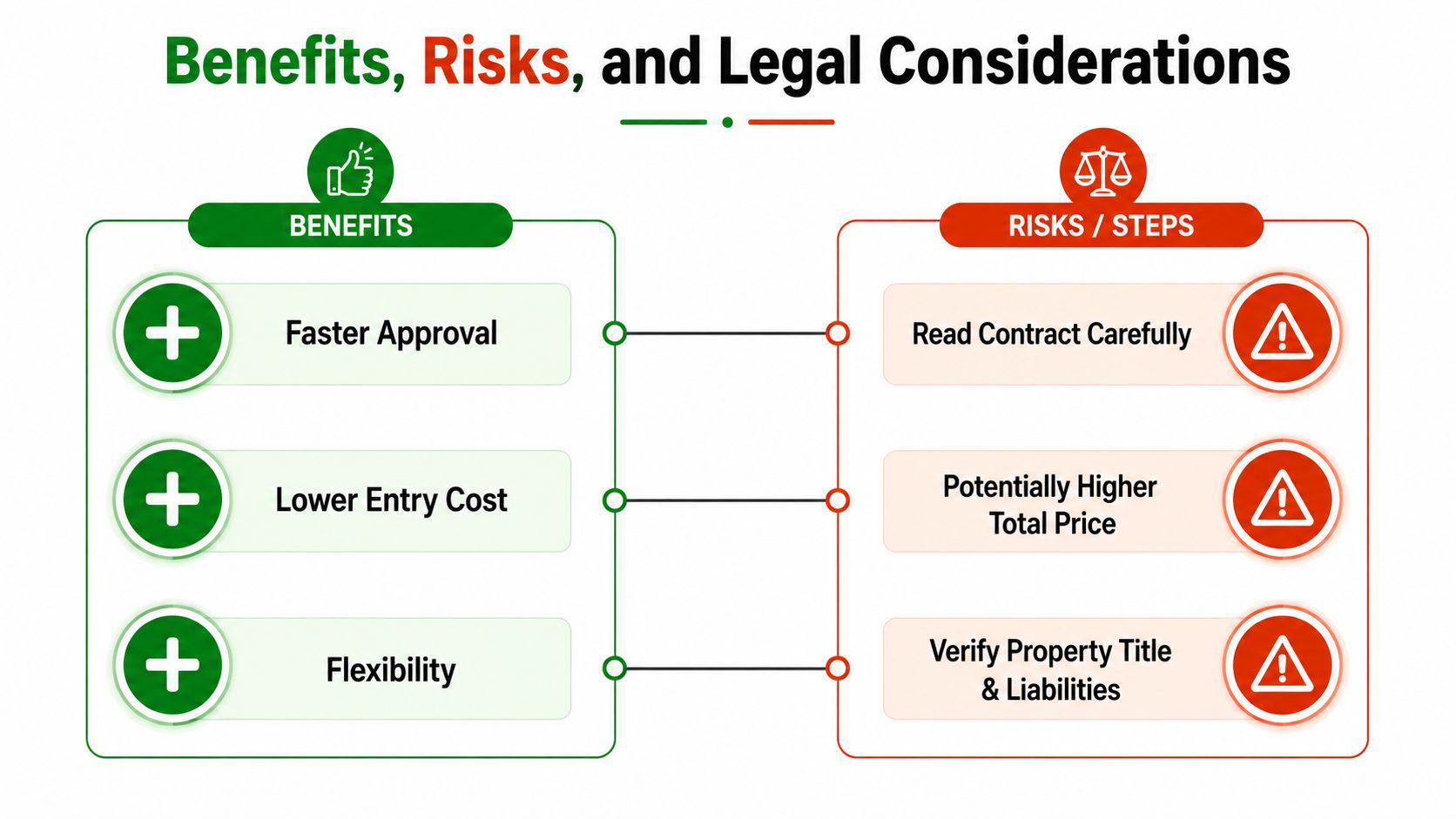
Owner financing solves one problem, access to payment terms, but it doesn't solve every land-buying problem. The strongest approach pairs each benefit with a verification step.
| Potential benefit | Corresponding risk or check |
|---|---|
| Faster approval | Read the contract and confirm default remedies |
| Lower entry cost | Calculate the full amount paid, not only the first installment |
| Flexible underwriting | Verify title, access, zoning, taxes, and liabilities independently |
A direct arrangement can feel less intimidating than a bank loan. That speed becomes a liability if it discourages careful review. Ask who owns the land, whether liens are recorded, whether taxes are current, and whether the seller has authority to finance the parcel.
Verify the property, not just the payment
Before paying, investigate:
- Title: Order or review a title search for ownership, liens, easements, covenants, and unpaid obligations.
- Access: Confirm a recorded right to reach the parcel from a public road. A visible track isn't always legal access.
- Survey: Determine whether a recent survey exists and whether boundaries are clear.
- Utilities: Ask the relevant providers or county offices about power, water, septic approval, and communications access.
- Zoning: Confirm that the county permits your intended building, camping, agricultural, or recreational use.
- Taxes: Identify the current annual property-tax responsibility and any delinquency.
- Physical condition: Check flood exposure, drainage, slope, vegetation, and road conditions through records and an in-person visit where possible.
Owner-financed contracts vary by state and seller. Clauses covering late fees, acceleration, forfeiture, balloon payments, and prepayment can change the practical risk dramatically.
A simple checkout process doesn't make a complex property simple.
Have a qualified real estate attorney review the agreement before signing, especially if the seller keeps the deed or the contract limits your rights after default. Independent legal and property review is money spent to reduce uncertainty, not an unnecessary obstacle.
Choosing the Right State and Parcel
Build your shortlist from the parcel outward. Start with a state that matches your budget and intended use, then narrow by county and property characteristics instead of treating a statewide average as a prediction.
Use a practical sequence:
- Set a price ceiling: Decide what you can pay monthly and what cash you can reserve for due diligence, taxes, travel, and improvements.
- Choose a use: Separate recreational land, off-grid living, future building, hunting, agriculture, and investment goals.
- Filter inventory: Search by state, budget tier, acreage, and location.
- Check county records: Review ownership history, tax balances, zoning, liens, and recorded access.
- Inspect the setting: Use satellite imagery, maps, public-road information, and an in-person visit when possible.
- Ask direct questions: Request details about prior use, easements, back taxes, restrictions, water, and utilities.
- Compare financing: Place the monthly payment, total price, term, and default terms beside the property's expected ownership costs.
Terrain and distance deserve special attention in low-cost western markets. A parcel far from water or roads may suit a patient recreational buyer but fail a homesteading plan. The same listing can be attractive to one buyer and unusable to another.
Don't let acreage substitute for access. Confirm that the route is legally available, physically passable, and maintainable for the use you have in mind.
A Smarter Path to Affordable Land Ownership
A suitable state is only the entry point. A smart purchase happens when price, financing, location, legal status, and intended use align at the parcel level.
Use this order:
- Define the use and total budget.
- Compare low-cost states and counties.
- Verify access, utilities, zoning, taxes, liens, and survey status.
- Read the complete financing contract.
- Clarify balloon dates, prepayment rules, cure periods, and improvement rights.
- Record every promise in writing.
- Keep copies of the agreement, deed documents, payment history, and county confirmations.
That sequence turns cheap land from a tempting listing into a considered ownership decision. The right parcel may not be the lowest-priced one, but it should be one you can reach, use, finance, and carry without unpleasant surprises.
LandZero offers state and budget-based vacant-land listings alongside FlexPay owner financing, with stated zero-down initiation, no credit checks, and no closing costs. Visit LandZero to filter available parcels by location and budget, then review the property and payment terms before deciding whether a listing fits your plan.