
Most advice about a land payment calculator stops at the monthly number. That's convenient, but it's incomplete for raw land, because the calculator usually prices a parcel like a small mortgage, not like a development-ready asset with access questions, utility gaps, zoning limits, and financing terms that often look nothing like a standard home loan. The monthly figure matters, but it's only useful if you know what it leaves out.
Table of Contents
- Why a Land Payment Calculator Is Only Half the Story
- The Inputs Every Land Payment Calculator Needs
- How to Calculate Your Monthly Payment Step by Step
- Comparing Amortization, Interest Only, and Balloon Structures
- What Most Land Payment Calculators Quietly Leave Out
- Three Realistic Scenarios Run Through the Calculator
- Smarter Workflow and Common Calculator Questions
Why a Land Payment Calculator Is Only Half the Story
A land payment calculator is useful because it gives buyers a fast starting point. The problem is that most widely used calculators estimate only principal and interest from the purchase price, down payment, rate, and term, with a few adding tax, insurance, or balloon-payment fields. They still do not consistently model raw-land realities like utility installation, road access, zoning limits, or the higher-risk pricing that often applies to raw parcels, and that gap can make the monthly figure look safer than it really is. MortgageCalculator.org's land calculator is a good example of the standard approach, while the more land-specific concern is the gap between the payment number and the parcel's true readiness.
The real decision is not just payment, it's readiness
Land-specific guides note that raw land typically carries higher down payments, higher rates, and shorter terms than improved land, so a simple monthly payment can materially understate the cash a buyer needs to close and carry the property. That's why the best calculator for land is often the one that forces a buyer to ask hard questions early, not the one that gives the prettiest output. If you're evaluating a parcel, the right output isn't “Can I make this monthly payment?” It's “What has to be true for this tract to become usable without blowing up my budget?”
Practical rule: treat the calculator as a screening tool, not a verdict.
That mindset changes how you shop. Instead of entering a parcel and hoping the number fits, test the deal for development-readiness and all-in ownership cost before you get attached. Buyers who skip that step often confuse affordability with feasibility, then discover the land needs more cash, more time, or more risk tolerance than the calculator suggested. For utility and site-prep research, LandZero's utility guide is a practical reference point.
The Inputs Every Land Payment Calculator Needs
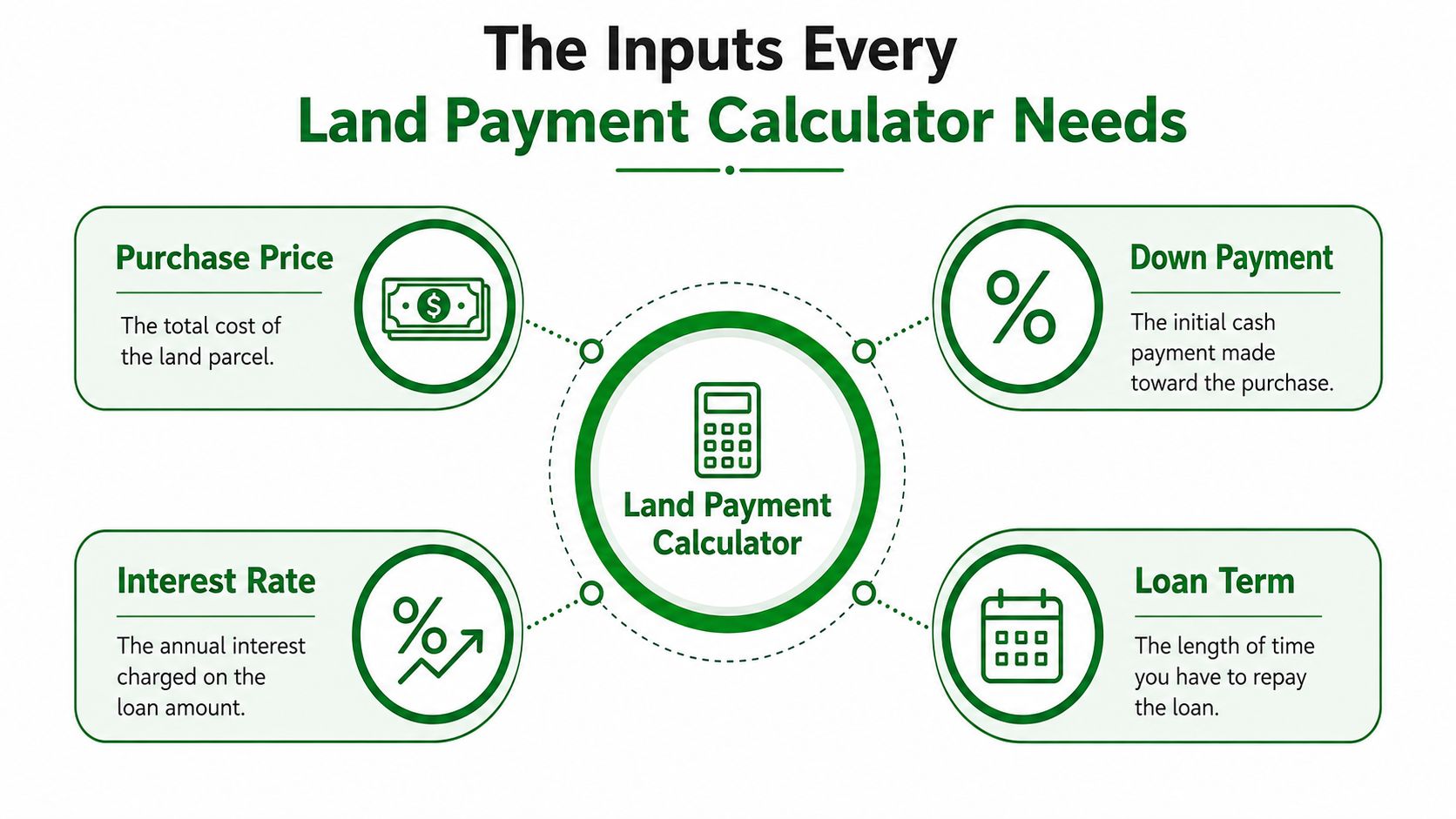
Every land payment calculator starts with the same four inputs, even when the site dresses them up differently: purchase price, down payment, interest rate, and loan term. If you know those four pieces, you can usually reverse-engineer the monthly payment, even on a seller-financed deal. The trick is knowing which of those inputs are hiding behind a listing headline and which ones the seller hasn't stated clearly.
How each input works in plain English
Purchase price is the base number, but it's not the full cost of ownership. Down payment is the cash paid upfront, and on land it's often larger than buyers expect. Interest rate is the cost of borrowing, and loan term is the length of time you'll make payments. Together they determine the monthly amount, but they don't tell you whether the parcel is ready for use.
Raw land usually pushes those inputs in an uncomfortable direction. The financing structure often asks for more money down, charges a higher rate, and shortens the repayment window compared with a standard mortgage. That's why the same purchase price can feel manageable on paper and tight in practice.
How to read a seller-financed listing
Look for whether the ad quotes a monthly payment, a rate, or just a total price. If the seller gives only the monthly number, ask for the full amortization schedule so you can see how much of each payment goes to interest and how much reduces principal. If the listing includes a payment that seems unusually low, confirm whether it's a teaser figure, an interest-only period, or a balloon structure with a large balance later.
If the quote doesn't clearly say what's included, assume it's only part of the story.
If you're comparing listings, check whether the quoted payment is principal and interest only or whether it also includes a tax, insurance, or escrow-style buffer. That one distinction can change how you compare parcels side by side.
How to Calculate Your Monthly Payment Step by Step
The basic amortization formula is the engine behind most land payment calculators. It turns the borrowed amount, interest rate, and term into a fixed monthly payment, then splits each payment between interest and principal over time. The payment stays constant in a fully amortizing loan, but the mix inside that payment changes every month.
A worked example you can repeat
Use this scenario: a $7,500 parcel, zero down, 9% interest, 60-month term. First, convert the annual rate to a monthly rate, then identify the number of payments, then plug those values into the amortization formula. A fixed-rate payment on a deal like this comes out to a steady monthly installment, but the exact figure depends on the formula input, not on any guesswork.
The useful part is the structure of the payment, not just the final number. In the early months, most of the payment goes to interest because the remaining balance is still high. As the balance falls, more of each payment starts going to principal. That's why early payoff decisions matter more than many buyers realize.
Practical rule: on an amortizing land note, early payments are usually doing the slowest work.
A simple way to think about the math is this.
- Start with the amount financed.
- Convert the annual rate to a monthly rate.
- Match the term to the total number of payments.
- Use the amortization formula to get the payment.
- Break the first payment into interest and principal to confirm the schedule makes sense.
Sample Amortization Snapshot for a $7,500 Land Parcel
| Month | Payment | Interest | Principal | Remaining Balance |
|---|---|---|---|---|
| 1 | Fixed monthly payment | Highest portion | Smallest portion | Highest balance |
| 2 | Fixed monthly payment | Slightly lower | Slightly higher | Lower than month 1 |
| 3 | Fixed monthly payment | Lower again | Higher again | Lower again |
That snapshot is intentionally simple, because the goal is to show direction, not invent a fake spreadsheet result. If you want the exact month-by-month numbers for a deal, ask the seller or lender for the amortization table and verify that the balance falls the way a fixed-rate note should. If a quoted payment looks odd, compare it against the structure before you compare it against your budget.
Comparing Amortization, Interest Only, and Balloon Structures
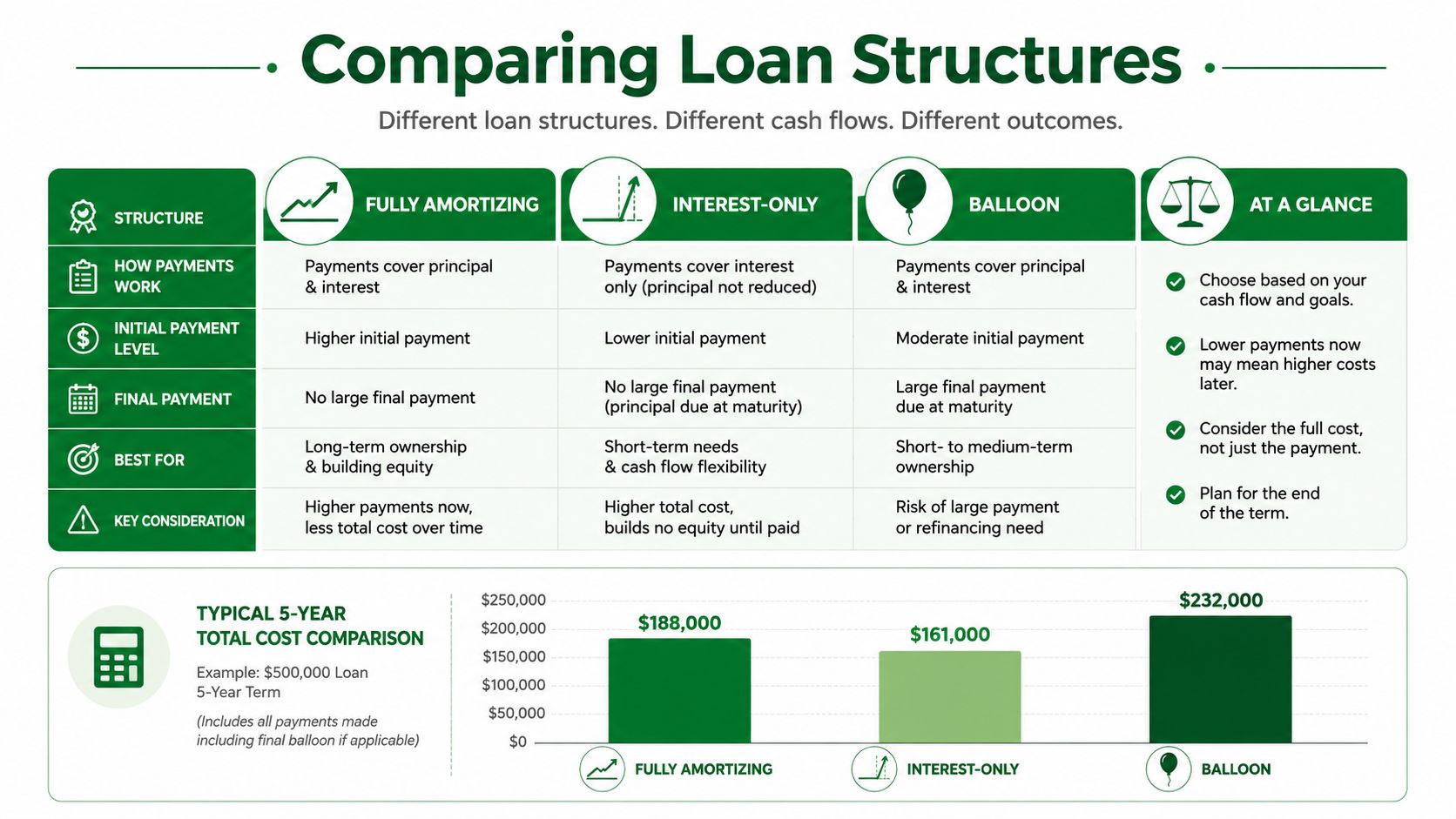
Most calculators assume a standard amortizing loan, but land deals often come wrapped in very different payment structures. That matters because the same parcel can feel cheap or expensive depending on whether the note is fully amortizing, interest-only, ballooned, or built around irregular seasonal payments. The monthly figure changes, but so does the risk profile.
Why the structure matters as much as the price
A fully amortizing note is the cleanest structure for most buyers because each payment chips away at principal. An interest-only deal lowers the monthly payment, but it also leaves the principal untouched during the interest-only period. A balloon note can look manageable month to month, then force a refinance or payoff later. Irregular seasonal schedules can fit land that generates income at certain times, but they can be awkward for buyers who budget on a normal household paycheck.
The key trade-off is simple. A lower monthly payment does not automatically mean a better deal. It may just mean the obligation is being pushed into the future.
How to compare the options on the same parcel
If you're evaluating a parcel, ask the seller or lender which payment structure they're using, then compare the deal under at least two alternative assumptions. One version should be the actual quoted structure. Another should be the structure you would prefer if you had more control. The gap between those two numbers shows where the risk sits.
For buyer types that rely on land income, scenario-based tools can help. Some calculators now support balloon-payment modeling, quarterly or annual payment schedules, fixed-principal structures, or land-affordability checks based on income from the land itself, which is useful for grazing or leased acreage. That's the reason the most useful calculator is often the one that tests the financing structure, not just the purchase price.
A low payment can be a feature, but it can also be a trap if the note expects a large payoff later.
What Most Land Payment Calculators Quietly Leave Out
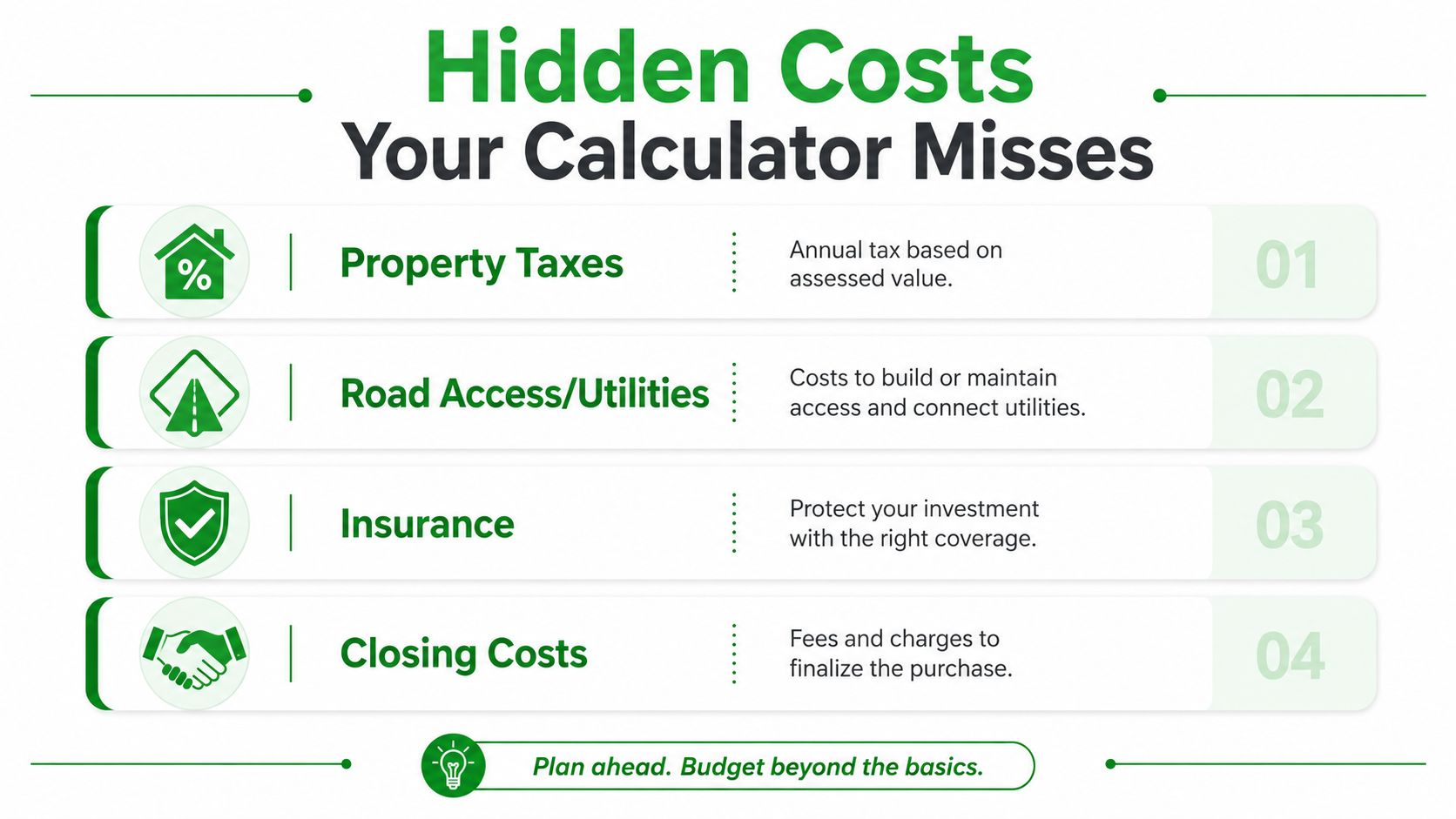
The biggest blind spot is that most calculators focus on the note and ignore the parcel. Raw land can look affordable until you layer in the costs that make it usable. A buyer can win the financing and still lose the deal if the land needs access work, utility buildout, or time-consuming approvals before it can serve the intended purpose.
The costs that usually disappear from the form
The first omission is property taxes. A land payment calculator rarely knows your county's bill, even though taxes still have to be carried every year. The second is road access and easements, which can determine whether you can reach the property legally and practically. The third is utility installation, including well, septic, power, and propane. The fourth is any carrying cost from holding land that sits unused while you wait to build or resell.
Those omissions matter because the land itself may be cheap while the work around it is not. A parcel with a low sticker price and a long list of site requirements is not the same thing as a ready-to-use tract.
How to stress-test a parcel before you commit
Start by running the payment at the quoted rate, then test the same deal at a higher assumed rate to see how much margin you really have. Shorten the term and see whether the payment still fits. Then ask what happens if one payment is missed and the note has late-fee language or acceleration language. That is not pessimism, it's basic deal discipline.
For buyers with little or no credit, LandZero's no-credit guide is useful because it keeps the focus on structure and affordability rather than on bank underwriting. The same caution applies whether you're buying from a seller, a private noteholder, or an online land platform. If the land needs major development work, a calculator that only models the note is missing the most important part of the transaction.
Three Realistic Scenarios Run Through the Calculator
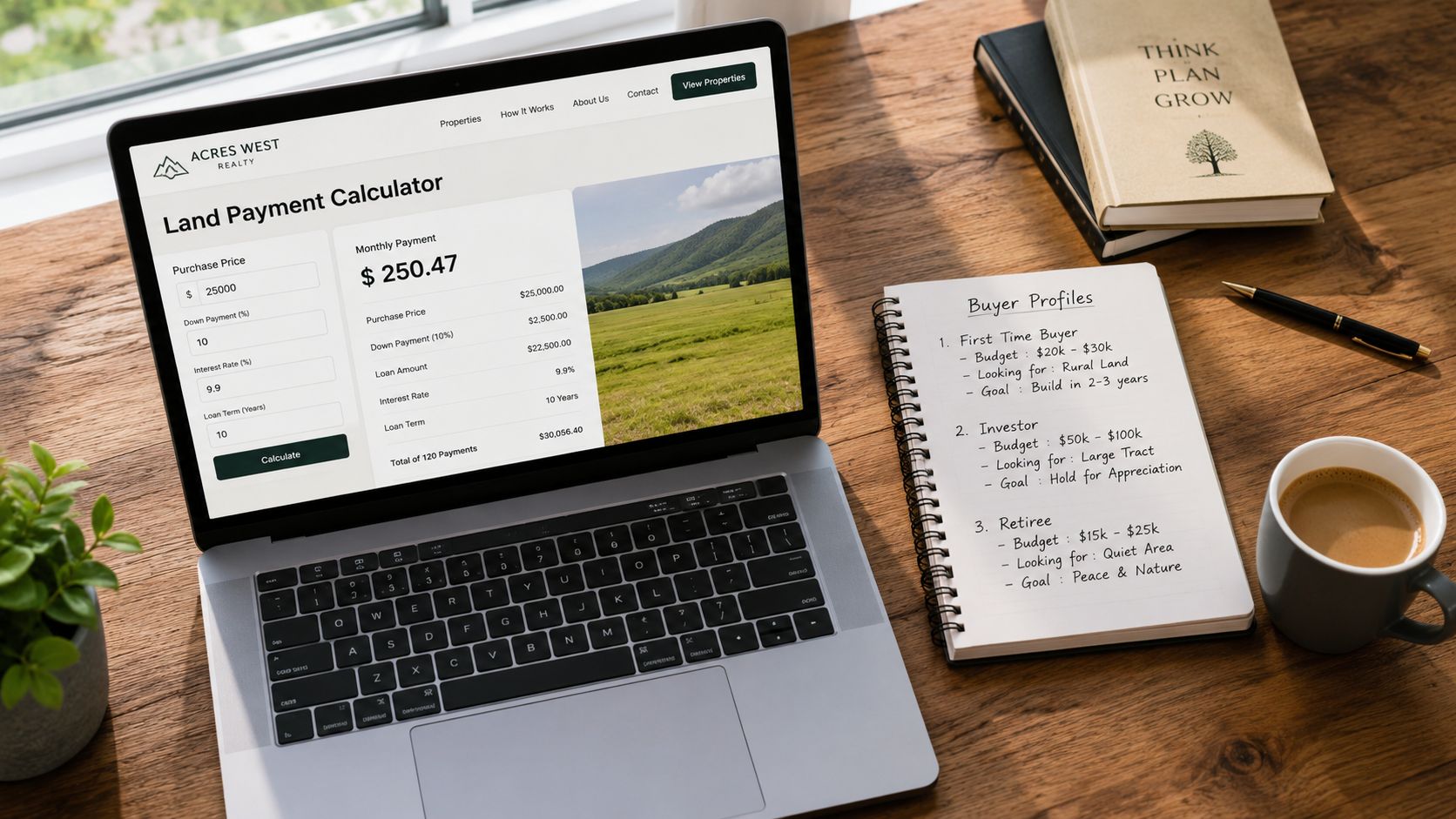
A recreational buyer, a homestead buyer, and an investor all use the same calculator differently. That's why the monthly result has to be read in context. A payment that feels easy for a weekend parcel can be the wrong fit for a long-term build site, and a number that looks fine for a hold-and-flip deal may be too rigid for someone planning to improve the land slowly.
Recreational buyer
A buyer looking at a $3,500 parcel for weekend use usually cares about keeping the monthly obligation light and predictable. The calculator helps answer whether the note is small enough to carry alongside travel, fuel, and maintenance. The trade-off is that a low monthly payment doesn't mean the parcel is ready for recreation if access, camping restrictions, or utility limitations still need to be solved.
Homestead buyer
A $9,500 parcel with a longer-term plan needs a different lens. The monthly payment is only part of the decision, because the buyer is also thinking about development sequence, utility hookups, and the timing of future build costs. In that setting, LandZero's raw-land development cost guide belongs in the same decision stack as the calculator itself.
Investor
A $15,000 parcel being evaluated as a hold-and-flip asset should be tested for resale flexibility, not just affordability. The payment might be acceptable, but the question is whether the note leaves enough room for market timing and carrying costs. If the financing structure is too rigid, the investor can end up owning a property that looks inexpensive but is slow to move.
A rough rule holds across all three profiles. If the monthly number only works when everything goes right, the deal is too thin. If it still works after you add the hidden costs and a less-friendly financing structure, you're looking at something more durable.
Smarter Workflow and Common Calculator Questions
A better workflow beats a better guess. Start with the listing, confirm the four inputs, test the financing structure, and then add the hidden ownership costs. That sequence keeps you from falling in love with a monthly number that doesn't survive contact with the actual parcel.
A repeatable workflow for any listing
- Verify inputs. Confirm price, down payment, rate, and term before you trust any monthly figure.
- Test three structures. Compare fully amortizing, interest-only, and balloon terms if the seller will provide them.
- Stress-test the rate. Re-run the deal at a less friendly assumption to see how much cushion exists.
- Add hidden costs. Layer in taxes, access, utilities, and any development work the calculator skipped.
FAQ
Does owner financing show on credit? Not always in the same way a bank loan does. The answer depends on who is servicing the note and how the transaction is reported, so buyers should ask before they sign.
What happens if a payment is missed? That depends on the contract. Some notes allow a short cure period, while others give the seller more power after default.
How do I find the interest rate? Ask the seller directly and request the written terms. If the listing only shows a payment, have the seller spell out the rate, term, and whether the note amortizes.
The best negotiation tool is a clean scenario, not a vague objection.
If you can show the seller a calculator-backed version of the deal that still works for both sides, you have a stronger conversation. If you want inventory, financing, and practical land-buying tools in one place, visit LandZero and use it to compare parcels with the monthly structure in mind.