
You've probably already felt the frustration. You found a parcel you like, ran the numbers in your head, and then a bank asked for more paperwork, more time, and more cash upfront than the land itself seemed to justify. For many buyers, that's the moment the dream of owning a piece of ground starts feeling distant, even when the land looks affordable on paper.
Owner financed land changes that conversation because the seller, not a bank, can provide the purchase money and set the terms directly. That doesn't make it casual or risk-free, but it does make land ownership possible for buyers who need a different path.
Table of Contents
- Why Traditional Land Loans Feel Impossible
- How Owner Financing Works
- Owner Financing vs Bank Loans
- The Real Risks and How to Protect Yourself
- How LandZero FlexPay Makes It Simple
- Can You Build on Owner Financed Land
- Is Owner Financing Right for Your Situation
Why Traditional Land Loans Feel Impossible
A buyer can have decent income, steady work, and a clear plan for the parcel, then still hear no from a lender because vacant land is treated as higher risk than improved property. That's especially discouraging when the buyer is looking at a simple rural lot, not a complicated commercial project. The land may be affordable, but the loan process can make it feel out of reach.
The usual sticking points are familiar. Lenders often want more cash down, tighter credit, and cleaner documentation because raw land has fewer built-in protections than a house already connected to utilities. The result is a gap between what a buyer can responsibly afford and what the bank is willing to finance.
That gap is exactly why owner financed land keeps showing up in the marketplace. It gives the seller room to negotiate directly with the buyer instead of forcing the deal through a bank's underwriting template. For buyers with thin credit, limited savings, or a timeline that doesn't fit a slow approval process, that flexibility can be the difference between buying and waiting indefinitely. This guide on buying land with no credit is a useful companion if your main obstacle is lender approval rather than the land itself.
Practical rule: if the lender is judging the parcel more harshly than the buyer's actual plan for it, owner financing can become the more realistic path.
That's why many first-time buyers start looking beyond traditional land loans. They're not trying to avoid responsibility. They're trying to find a structure that matches how land is bought, held, and improved in the world.
How Owner Financing Works
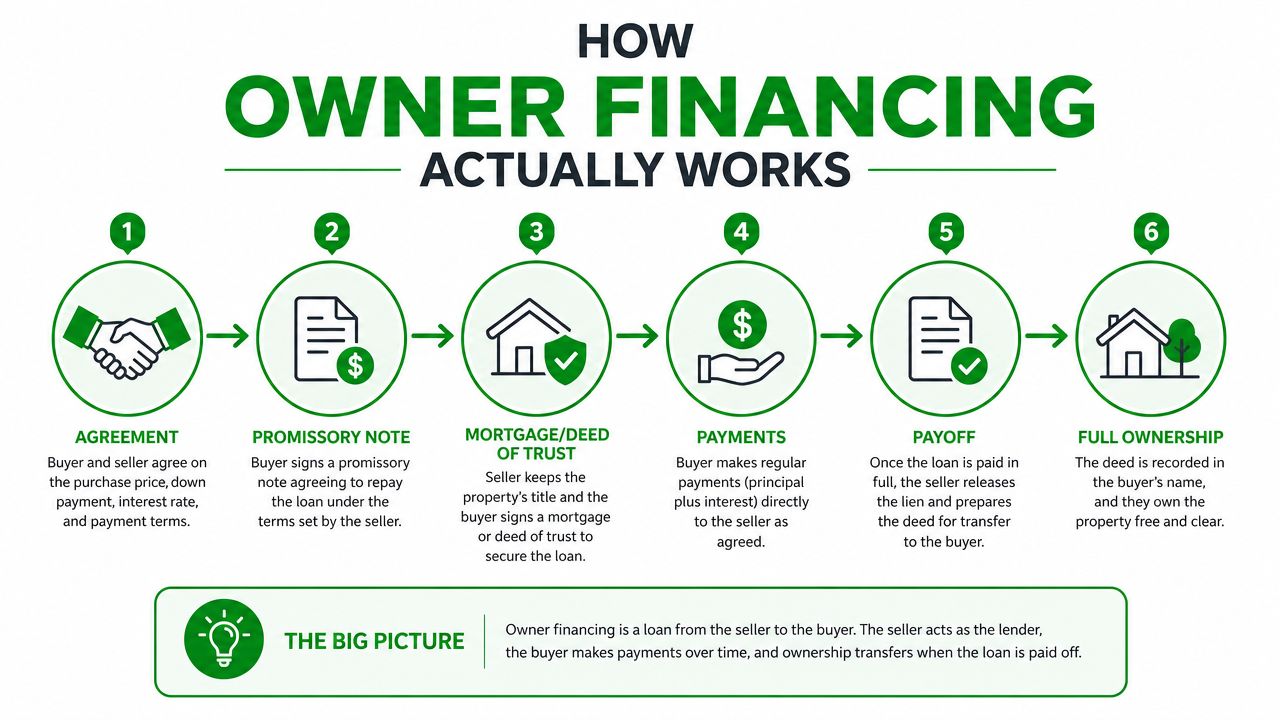
At its simplest, owner financing means the seller acts like the lender. Instead of borrowing from a bank, the buyer agrees to repay the seller over time under terms both sides negotiate. Those terms usually cover the down payment, the interest rate, the monthly installment, the length of the deal, and what happens at the end if there's a balloon payment.
The basic moving parts
A seller-financed land deal usually starts with a few negotiated terms that shape the whole arrangement. The down payment shows how much the buyer brings up front, the interest rate sets the cost of carrying the balance, and the payment schedule determines how quickly the principal is reduced. In many land transactions, the structure also includes a balloon payment, which means a larger balance comes due at the end of the term.
The paperwork typically starts with a promissory note, which spells out the payment obligation. Then the deal is secured by either a deed of trust or mortgage, or by a land contract. Under a deed of trust or mortgage structure, the buyer can receive title with the seller keeping a lien position. Under a land contract, the seller commonly keeps legal title until the buyer pays in full (The Land Geek).
That title detail is the part many buyers miss. In some deals, the buyer is using the land and making payments, but does not fully hold title yet. In others, title transfers at closing and the seller keeps a security interest. The legal structure changes who bears what risk, so the document type matters just as much as the monthly payment.
Practical rule: don't ask only, “Can I afford the payment?” Ask, “What exactly do I own during the payment period?”
Why the title question matters
A land contract can be useful, but it can also leave a buyer with less control than expected if the seller keeps title until payoff. A deed of trust or mortgage structure can offer stronger title mechanics for the buyer while still protecting the seller's interest. That is why the ownership question deserves a direct answer before signing anything.
The easiest way to think about it is this. Owner financing is not just a payment plan. It is a legal structure that decides whether you are building equity under your name now, or waiting for full title until the obligation is finished.
Owner Financing vs Bank Loans
A buyer can close on the same parcel in two very different ways, and the ownership mechanics change just as much as the payment terms. A bank loan follows lender rules and a formal underwriting process. Owner financing lets the seller set the terms directly, which can make the deal possible when a bank says no.
| Factor | Bank Loan | Owner Financing |
|---|---|---|
| Down payment | Often set by lender rules and tied to qualification standards | Negotiated between buyer and seller |
| Credit requirements | Usually strict | Often more flexible |
| Approval speed | Slower, with more documentation | Faster, because the parties negotiate directly |
| Interest rate | Usually lower | Often higher |
| Flexibility | Limited by underwriting templates | Highly customizable |
| Total cost | Can be lower if you qualify | Can be higher if the rate, term, or balloon structure is less favorable |
The table only tells part of the story. With a bank loan, the lender usually wants a clean package, stable income, and a property that fits its checklist. With owner financing, the seller may care more about getting the sale done, but the buyer needs to read the actual contract, because the document controls who holds title, who records the lien, and when the seller's interest ends.
That timing matters more than many first-time buyers expect. In a bank deal, title usually transfers at closing and the lender keeps a security interest. In owner financing, the buyer may get title right away, or the seller may keep title until the balance is paid, depending on the structure. That is why a survey and recording review should not be treated as paperwork in the background, and a land survey requirements checklist can help buyers catch boundary and access issues before they become ownership problems.
The practical tradeoff is simple. Bank financing can cost less over time if you qualify and can wait through underwriting. Owner financing can open the door faster and with less pressure on credit, but the buyer may carry more risk if the paperwork is vague or the exit plan is weak.
That is also why the monthly payment is only one part of the comparison. Two deals with the same payment can lead to very different outcomes if one gives you recorded title and the other leaves title with the seller until payoff. Buyers often focus on affordability first, then discover that control over the land, the lien, and the transfer date shapes their rights just as much as the payment amount.
A good rule is to ask how the deal behaves during the payment period. If you need the parcel closed quickly and the terms are straightforward, owner financing may fit. If you qualify for a bank loan and want the structure that lenders already know how to process, conventional financing may give you more predictability and lower long-term cost.
The Real Risks and How to Protect Yourself
Owner financing solves access problems, but it doesn't erase legal and financial risk. The biggest one is simple. If the rate is higher or the term is shorter, the buyer can end up paying more over time than they would with institutional debt. That's the cost of flexibility, and it should be part of the decision from the start.
The title and lien problem
The more serious risk is ownership confusion. If the seller doesn't own the property free and clear, or if there are hidden liens, the buyer can inherit a mess that wasn't obvious at signing. That's why title verification is not optional.
A land contract can also create vulnerability if the seller has problems with their own mortgage or other obligations. In that setup, the buyer may be making payments faithfully while the seller's separate financial issue threatens the deal structure. The ownership timing matters because the buyer's rights are tied to the instrument used, not just to the fact that payments are being made.
The safest protection starts before closing. A title company or title insurer can help uncover ownership problems, unpaid liens, or recording issues. The buyer should also review the exact balloon terms, because a balloon due date without a realistic exit plan can create pressure to refinance or pay in full on a deadline.
For a practical checklist on a related due diligence item, see these land survey requirements. Boundaries and legal access are part of the same risk picture.
What to verify before you sign
- Who owns the property now. Confirm the seller's legal ownership and check for liens or other claims.
- Which document controls title. A land contract, deed of trust, and mortgage do not give you the same rights.
- What happens at balloon time. Know whether you're expected to refinance, pay off the balance, or negotiate again.
- What the default terms are. Missed-payment rules should be clear before you commit.
- Whether title insurance is available. If it is, use it.
Practical rule: if the answer to “who holds title during the payment period?” is vague, slow down and get the document reviewed.
Buyer protection is mostly about refusing assumptions. The price may look friendly, but the legal structure is what determines how safe the deal is.
How LandZero FlexPay Makes It Simple
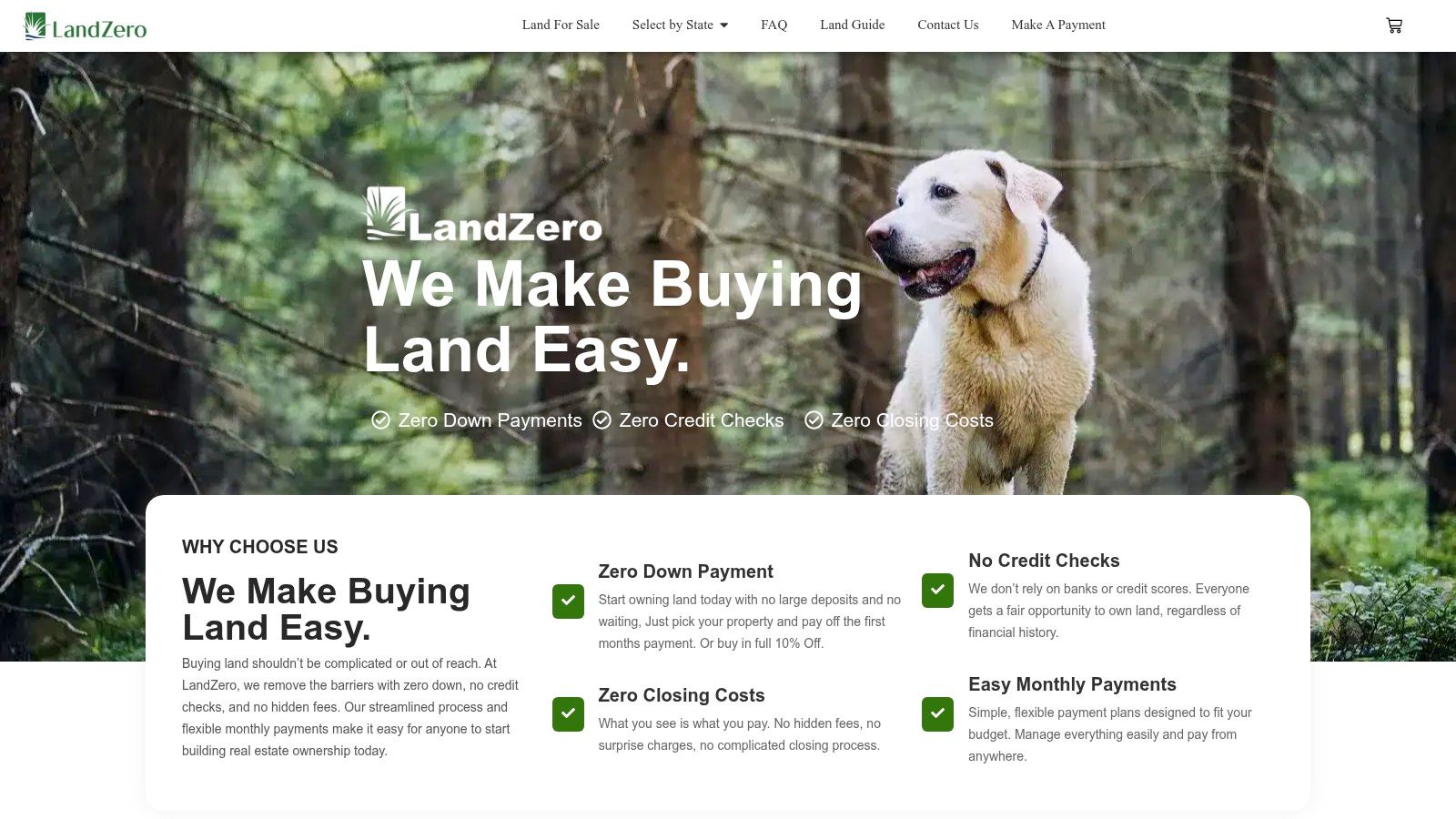
LandZero's FlexPay model shows what modern owner financing can look like when it's packaged for convenience. The company says buyers can start with zero down, pay the first month's installment to begin, and avoid credit checks and closing costs. That setup removes three of the biggest friction points that usually stop first-time land buyers.
How the process is organized
The buying flow is straightforward. A shopper browses by state and by budget tier, including Under $5k, $5k to $10k, and $10k & Up, then selects a parcel and moves through online checkout. That matters because it turns a usually fragmented land search into something more structured and easier to compare.
LandZero also provides a customer portal for managing payments, which helps buyers stay organized after closing. The company says buyers can also pay in full with a 10% discount, which gives a clear off-ramp for anyone who wants to eliminate the payment plan later.
Why this model matters
The big advantage here is predictability. Buyers don't have to worry about a bank approval cycle, surprise lender conditions, or a closing stack that gets more expensive at the last minute. The pricing is presented as transparent, and the process is designed to be completed online.
Practical rule: if a seller-financed purchase feels simpler, that's only useful if the terms are still clear. Simplicity should reduce confusion, not replace due diligence.
LandZero is one example of how owner financing can be modernized for remote buyers, budget-conscious purchasers, and people who want to buy without a conventional loan file. It's still owner financing, so the title and payment terms still matter, but the purchase path is much easier to understand than a traditional land transaction.
Can You Build on Owner Financed Land
A buyer can close on owner financed land and still discover that building there will take far more work than expected. That gap between ownership and buildability is where many first-time buyers get tripped up. A parcel can be affordable because it is undeveloped, or because it carries limits that show up only after the purchase.
The hidden constraints buyers miss
Zoning can stop the use you had in mind before you ever submit a building plan. A parcel may be zoned for agriculture, recreational use, or limited residential activity, which means a cabin, full-time home, or accessory structure may not be allowed without a variance or a zoning change. Even if the land is yours, local rules still decide what can rise on it.
Access is another filter buyers often overlook. A parcel can sit on a map, look reachable from a road, and still lack recorded legal access that a lender, county office, or contractor will accept. That can slow construction, complicate emergency access, and make future resale harder.
Utilities create their own set of costs. Power may need a line extension, water may require a well, and sewer may mean a septic system instead of a public connection. If you want a rough framework for those steps, how to bring utilities to your land is a useful place to start before you buy.
That is why a cheap owner financed parcel can be misleading. A small payment does not tell you whether the land can support a homesite, a driveway, a septic permit, or the permits needed for a structure you can legally occupy. The primary question is whether the parcel can support the project you have in mind without turning into a long list of surprises.
Due diligence that keeps the deal usable
Start with zoning, not wishful thinking. Ask the county whether the parcel allows the exact use you want, then check whether special overlays, setback rules, minimum lot sizes, or HOA-style deed restrictions narrow that use further. A lot that looks suitable for a house may still be limited to seasonal use or a single small dwelling.
Then verify access in writing. A shared path, a dirt track, or a road that has been used for years is not the same as documented legal access. If access is uncertain, you may need an easement before you can build, and that can affect both cost and timing.
After that, confirm the utility plan and the price tag attached to it. A parcel without nearby service may need trenching, meter fees, a well drill, a septic install, or a costly power extension, and those costs can change the budget fast. The land may be affordable, while the infrastructure needed to make it livable is not.
Review environmental and site conditions before you get attached to the parcel. Wetlands, flood zones, steep slopes, poor soil, or drainage issues can limit where a structure can go or whether a permit is even possible. If the land needs grading or fill work before construction, that should be part of the decision, not a later surprise.
Owner financing can get the deed into your hands, but it does not override local building rules. During the payment period, ownership and buildability are separate questions, and buyers need both answers before they commit.
Is Owner Financing Right for Your Situation
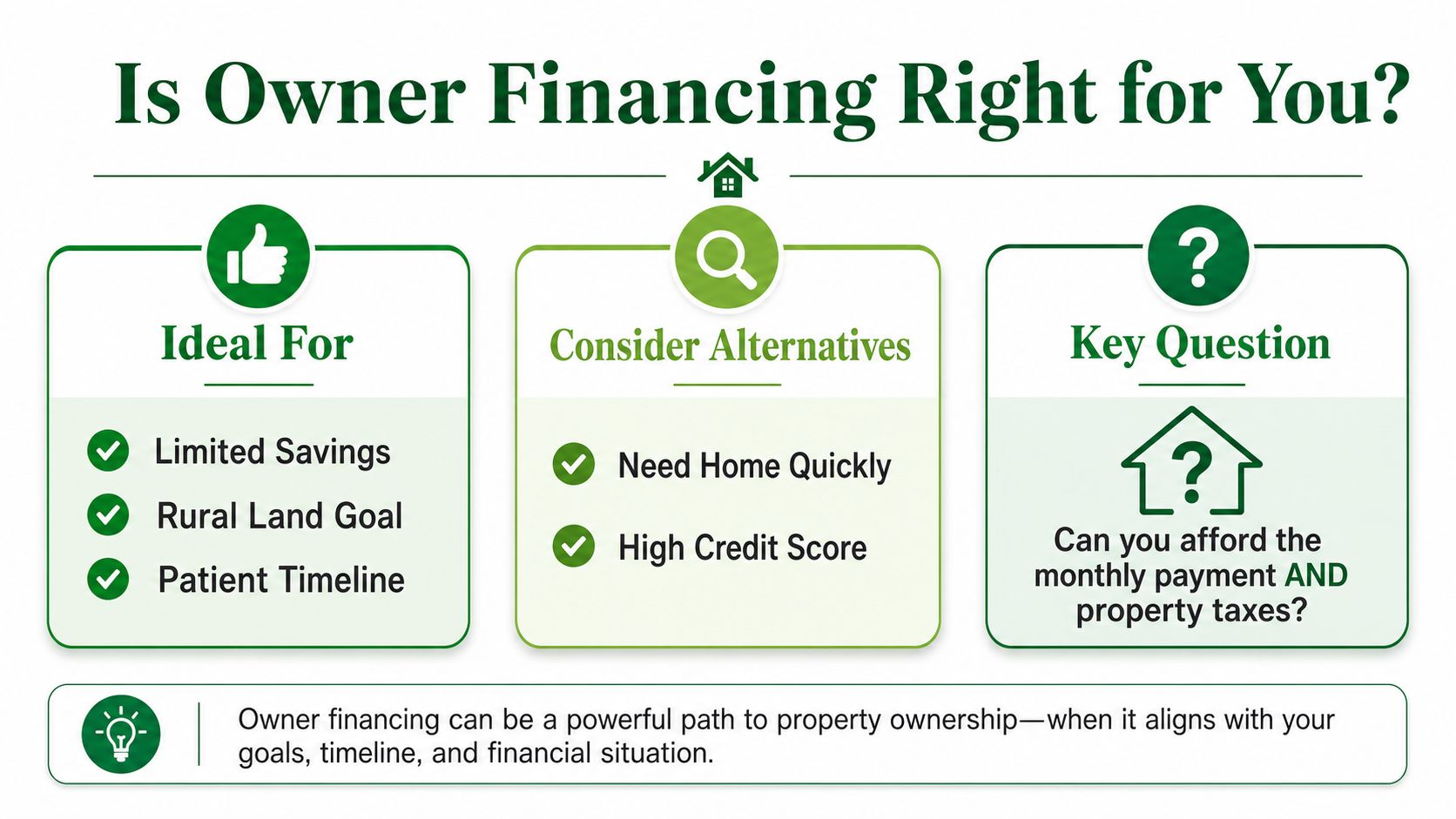
Owner financing makes the most sense when access matters more than perfect loan terms. If you have limited savings, thin credit, or you want to close quickly, owner financed land can open a door that a bank would keep shut. It also fits buyers who are looking at recreational, off-grid, or investment parcels rather than a primary home they need to occupy right away.
When it points you toward a bank instead
If you have strong credit, meaningful cash for a down payment, and a plan to build immediately, conventional financing may be the cleaner fit. A lower rate and a standard underwriting process can be worth the extra paperwork if you qualify comfortably. The key is matching the funding source to the goal, not forcing the deal into the wrong box.
Owner financing also works well for buyers who want to test land ownership before committing to a larger purchase. It creates a lower barrier to entry, but the buyer still needs to think like an owner, not a renter. That means planning for taxes, monthly payments, and the eventual title outcome.
A simple decision filter
Ask yourself three questions.
- Can I handle the monthly payment and all related ownership costs?
- Do I understand who holds title during the payment term?
- Does this parcel fit my long-term use plan?
If the answer to any of those is unclear, slow down. Compare at least a few parcels, calculate the full financing cost, and verify the land's limitations before you commit.
LandZero offers owner-financed vacant land with online browsing, budget filters, and simple payment options that fit buyers who want a lower-friction path into ownership. If you're comparing parcels and want to see how that model works in practice, visit LandZero and review the available land and payment terms before you decide.