

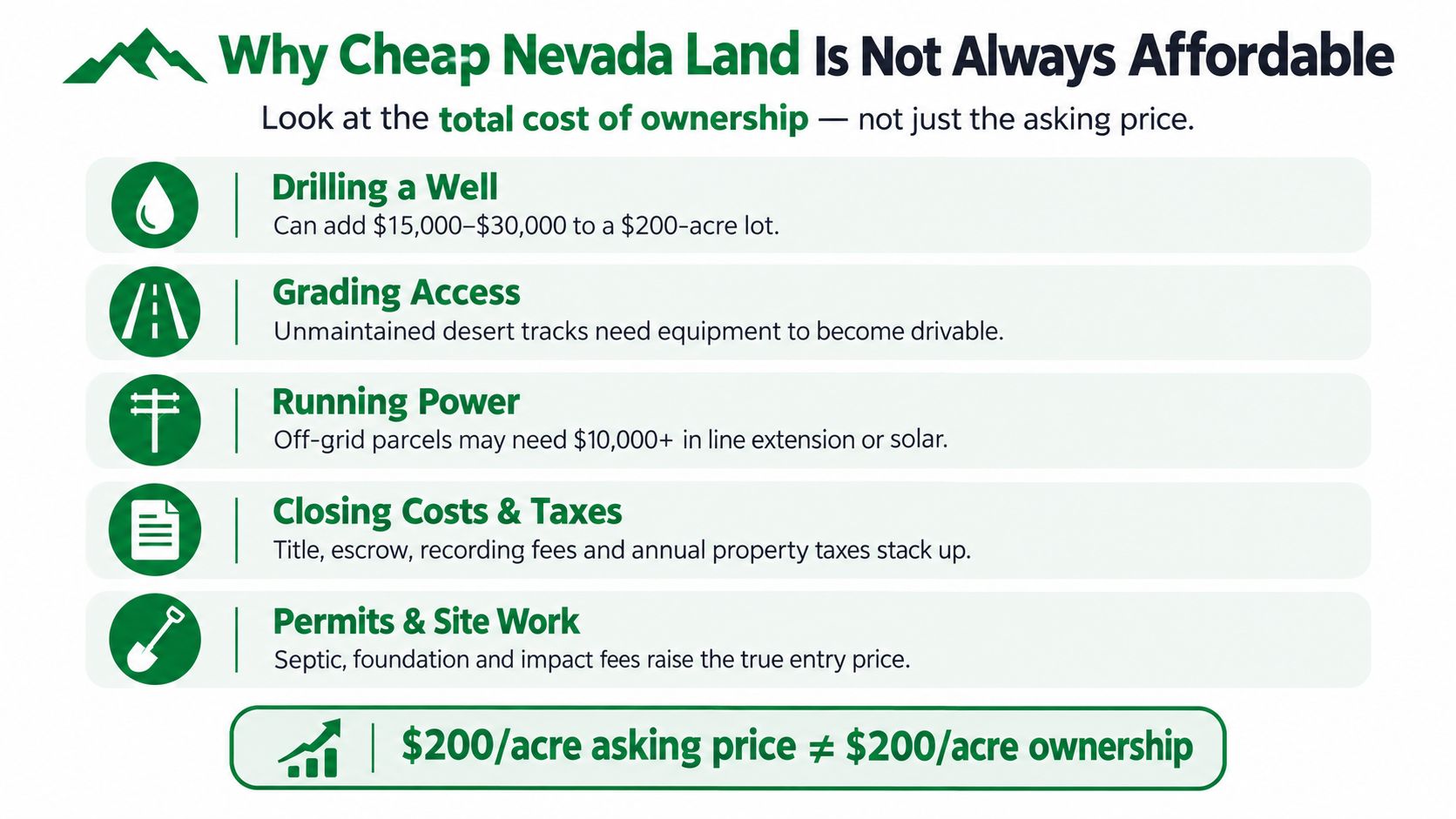
A low asking price is the most misleading fact in the cheap land Nevada market. A parcel can cost very little to acquire and still be expensive to use, insure, access, supply with water, or resell. Before you compare counties or financing terms, treat every listing as an unfinished project with unknown infrastructure.
The right question isn't, “How cheap is this land?” It's, “What will this parcel cost me before it can serve its intended purpose?” Water rights, septic approval, zoning, legal access, utilities, and title conditions determine that answer. Price matters, but it comes after usability.
Table of Contents
- Why Cheap Nevada Land Is Not Always Affordable
- How Nevada's Land Ownership Pattern Shapes the Market
- Where Cheap Nevada Parcels Actually Show Up
- What Inexpensive Nevada Parcels Often Lack
- The Risks Most Buyers Underestimate
- Financing Options for First-Time and Credit-Limited Buyers
- Your Next Steps Before You Buy
Why Cheap Nevada Land Is Not Always Affordable
A low listing price doesn't prove that a parcel is buildable, homestead-ready, or even practically reachable. Remote Nevada land can look attractive because the seller is pricing raw ground, while the buyer is mentally pricing a future cabin, RV site, workshop, or investment. Those are different assets.
Nevada's arid conditions make water the first cost question. A domestic well may qualify for a limited exemption only when it serves culinary and household needs for a single-family dwelling and stays within 2 acre-feet per year, approximately 651,700 gallons, according to the Nevada guide to water wells. That exemption isn't a general license for commercial activity, agriculture, multiple residences, or intensive irrigation.
The three silent costs behind a low price
Utility connection is often missing entirely. A parcel may sit far from power infrastructure, with no economical path to a grid connection. Solar, batteries, generators, or a long utility extension can change the purchase decision before construction begins.
Water sourcing can also erase the apparent bargain. You need to know whether a domestic well is legally available, whether the basin has restrictions, whether a prior right exists, and whether hauling and storage are the only realistic alternatives. Surface ownership doesn't automatically guarantee usable groundwater.
Site and use restrictions are just as important. Zoning, setbacks, wastewater rules, access easements, deed restrictions, and improvement covenants can prevent the use you had in mind. A parcel can be large enough for recreation but unsuitable for a legal residence.
Practical rule: Don't make an offer until you can describe the parcel's water plan, wastewater plan, access rights, and permitted use in writing.
Nevada's inexpensive land market rewards skepticism. Start with the APN, county records, and the intended use. If you want full-time housing, recreational camping, agricultural activity, or a long-term hold, each purpose creates a different due-diligence standard.
How Nevada's Land Ownership Pattern Shapes the Market
Nevada's cheap private land exists inside a much larger public-land system. The Bureau of Land Management's Nevada overview reports that it administers nearly 48 million acres, about 63% of the state's land base. That acreage is public land, not a supply of ordinary residential lots that buyers can purchase.
The ownership pattern explains why private parcels can be scattered, isolated, and inconsistent. Public, private, state, tribal, and local holdings may sit beside one another. Two parcels that appear close on a map can have completely different access rights, development potential, and title histories.
Nevada's history also matters. After the 1846 Treaty of Guadalupe Hidalgo transferred the territory from Mexico to the United States, Nevada entered statehood in 1864 without claiming most unreserved federal land. The federal government therefore retained a dominant role in land administration. Open-range cattle and sheep operations, silver discovered near Virginia City in 1859, and federal mining laws adopted in 1866 and 1872 all shaped how land was used and recorded.
Nevada land tenure snapshot
| Category | Approximate share | Implication for buyers |
|---|---|---|
| BLM-administered land | About 63% of Nevada's land base | Much of the surrounding acreage isn't available for private residential purchase |
| BLM acreage | Nearly 48 million acres | A large public-land footprint can separate private parcels from services and population centers |
| Privately owned land | Minority of the state's total land area | Private inventory may be fragmented and highly variable by county |
| Other public, state, tribal, and local holdings | Varies by location | Parcel-level mapping and title review are essential |
This geometry creates several recurring listing types. Some parcels sit in rural subdivisions created decades ago. Others reflect mining-era claims, ranch divisions, or isolated private holdings surrounded by public acreage. The low price may reflect weak access, limited services, or a narrow buyer pool rather than a hidden development opportunity.
Review the recorded legal description, not just a seller's map pin. Confirm whether a public road reaches the parcel, whether an easement is recorded, and whether the apparent route crosses land controlled by someone else. A visible track isn't proof of legal access.
The buyer who understands Nevada's ownership pattern looks for usable private land, not merely an inexpensive patch inside a vast desert expanse.
Where Cheap Nevada Parcels Actually Show Up
Cheap Nevada land appears most often in remote counties and older rural subdivisions, where distance from employment centers and utilities keeps demand narrow. Nye County is a common search area for buyers considering desert recreation, long-term holding, or rural living. Elko and Lander can appeal to buyers seeking larger open-country parcels, while Pershing, Humboldt, Esmeralda, and Lincoln offer different combinations of remoteness, road access, and nearby services.
The right county depends on your use. Don't choose a location solely because a listing platform sorts it into a low-price category.
Match the county to the intended use
- Nye County: Often attracts buyers interested in desert recreation, off-grid concepts, acreage, and long-term ownership. Verify water-basin conditions, county zoning, and access before treating a parcel as residential.
- Esmeralda County: Remote land may suit privacy, recreation, or a patient long-term hold. Minimal infrastructure makes full-time occupancy a separate and much more demanding question.
- Lander County: Rural acreage can appeal to buyers who value open space and access to regional communities. Check road conditions and services around the specific parcel rather than relying on the county name.
- Elko County: Ranch-country parcels may fit recreational use, seasonal placement, or long-term ownership. A rural setting doesn't establish that power, water, or wastewater are available.
- Pershing County: Parcels near established corridors may offer a more practical starting point than isolated desert ground, but proximity to a town doesn't guarantee service connection.
- Humboldt County: Land near major travel routes can be easier to evaluate for access and logistics. Confirm the exact distance to utilities and whether the road is public or privately maintained.
- Lincoln County: Buyers seeking quiet recreational or investment land should focus on legal access, county use rules, and resale demand.
Use a listing's price band as a filter, not as a valuation. A parcel near Tonopah, Ely, Lovelock, or Winnemucca may look inexpensive compared with land near Reno, Las Vegas, or Lake Tahoe, but the cost of reaching it and improving it can be substantial.
A practical search starts with three questions:
- What will I use it for? Recreation and a future hold tolerate more uncertainty than a primary residence.
- How often must I reach it? A parcel that works for occasional visits may frustrate anyone expecting regular commuting.
- What must already exist? If you need a permitted well, power, septic, or maintained road, exclude raw parcels that lack documentation.
The cheapest county isn't automatically the best county. The better purchase is the parcel whose restrictions and missing infrastructure match your budget.
What Inexpensive Nevada Parcels Often Lack
Most low-cost rural parcels are not miniature versions of suburban lots. They may have a legal description, a tax account, and a route visible on a map, but lack the infrastructure that makes a property convenient or immediately habitable.
Grid power is a common omission. Buyers may need solar, battery storage, a generator, or a utility extension. The correct choice depends on distance, terrain, intended load, and local provider requirements. Don't assume a nearby pole means affordable service.
Municipal water and sewer are also frequently absent. That leaves buyers evaluating a domestic well, a transferable water right, a shared arrangement, or hauled water with storage. Nevada's water-rights guidance makes the core issue clear: water is public, and non-domestic use generally requires a water right. Ownership of the surface parcel doesn't settle the water question.
What the missing features mean for use
| Missing feature | Recreation or occasional use | Full-time residence |
|---|---|---|
| Grid power | Often manageable with temporary systems | Requires a dependable power plan |
| Water service | Storage or hauling may be workable | Requires verified legal and practical supply |
| Sewer | May not matter for brief visits | Requires approved wastewater disposal |
| Paved road | Usually a convenience issue | Can become an access, safety, and maintenance problem |
| Cell and internet coverage | An inconvenience | A serious issue for work, emergencies, and daily life |
| Surveyed boundaries | Tolerable only with caution | A major concern before improvements or fencing |
Road access deserves special attention. Some parcels have a dirt track but no recorded easement. Others have legal access that is physically rough, seasonal, or dependent on roads maintained by someone else. Treat physical access and legal access as separate investigations.
Cheap parcels also tend to lack nearby groceries, fuel, hospitals, and reliable communications. Satellite internet may be the only practical option, and cell coverage can vary across basin country. The absence of an HOA may appeal to buyers who want fewer restrictions, but county zoning and state rules still apply.
For recreation, a missing feature may be acceptable. For full-time residence, water, wastewater, legal access, and emergency connectivity can disqualify the property.
The Risks Most Buyers Underestimate
The most expensive mistake is treating a listing description as a development opinion. Sellers can accurately describe acreage and still leave unanswered whether the parcel supports a home, septic system, well, or reliable year-round access.
Water deserves the first phone call. Ask the Nevada Division of Water Resources whether the parcel lies in a basin with restrictions, whether a domestic well is eligible, whether a prior right is attached, and whether your intended use fits the domestic-well exemption. If you plan agriculture, livestock at meaningful scale, multiple units, commercial activity, or intensive irrigation, assume you need a separate water-right analysis.
Ask these questions before paying
- Can I legally obtain and use water? Verify the basin, well eligibility, existing well records, water rights, and whether hauling is the only workable option.
- Can the soil support wastewater disposal? Nevada's individual sewage system process requires permits, plan review, installation, inspection, and final approval. The Nevada individual sewage disposal system guidance lists a $498 single-family permit fee and a possible $332 extension fee, with permits generally expiring after one year. Those fees are only part of the feasibility question.
- Does zoning allow my use? Nye County's rural-estate regulations identify RE-1 with a minimum of 1 gross acre and RE-2 with a minimum of 2 gross acres. Review the Nye County rural-estate ordinance for the exact district, permitted uses, and applicable conditions.
- Do I have recorded legal access? A dirt track across the desert isn't enough. Require public frontage or a recorded easement that reaches the parcel.
- What does the title contain? Review mineral reservations, old claims, quitclaim instruments, liens, tax status, and any unusual exceptions before closing.
- Could I resell it? Remote land can have a narrow buyer pool. A parcel with no water path, no legal access, or no realistic use may remain difficult to sell regardless of price.
Septic feasibility can defeat an otherwise appealing parcel. Poor soil, rock, drainage, flood exposure, and separation requirements may limit the buildable area or require an engineered system. Get a qualified professional to evaluate the specific parcel rather than relying on a neighbor's system.
The key question isn't whether someone can drive to the parcel. It's whether you can prove a lawful, approvable route for your intended use.
For a practical overview of bringing services to raw property, review this guide on bringing utilities to your land. Use it as a checklist, then confirm every point with the responsible county, utility, water, and title professionals.
Financing Options for First-Time and Credit-Limited Buyers
Financing can spread out the purchase, but it cannot fix land with no usable water path, failed septic conditions, restrictive zoning, or unlawful access. A zero-down contract may preserve cash for due diligence, water research, road work, or professional reports. It can also leave you making payments on a parcel that never supports your intended use.
Traditional banks are often a poor fit for remote raw land. They may require a strong appraisal, documented access, acceptable collateral, verified utilities, and a borrower profile that justifies the underwriting work. Parcels near established population centers, especially those with documented improvements, have a better chance than isolated desert acreage.
Owner financing gives the seller more control over approval and payment terms. Some sellers do not require a conventional credit review, which can help first-time and credit-limited buyers. Read the agreement line by line. Confirm the interest calculation, late-payment rules, default remedies, balloon provisions, deed timing, taxes, insurance, and whether the arrangement is a land contract or another secured transaction. For buyers without conventional credit, review this guide to buying land with no credit.
Nevada land financing options compared
| Feature | Cash purchase | Owner financing | Bank or USDA loan |
|---|---|---|---|
| Upfront cash | Highest | May be lower, depending on seller terms | Usually requires borrower funds and closing costs |
| Approval | Based on available funds | Seller-specific | Formal underwriting |
| Credit review | Not relevant to approval | Varies by seller | Central to approval |
| Best fit | Buyers seeking simplicity and full control | Buyers preserving cash or lacking conventional access | Improved parcels and eligible residential projects |
| Main risk | Cash is committed immediately | Contract terms and default consequences | Rejection, appraisal, or collateral requirements |
| Due diligence | Still required | Still required | Still required, often before final approval |
Zero-down terms deserve careful review. They reduce the cash needed to start, not the cost of property taxes, travel, surveys, engineering, utility research, or future improvements. Keep a separate reserve for those expenses. The first monthly payment is only the entry point, not the full cost of buying cheap Nevada land.
A bank or USDA Rural Development loan may apply when the property and intended residence meet program requirements. This route is more structured and depends on location, property condition, and intended use. Confirm eligibility with a lender before making an offer.
Family partnerships can work when the agreement is written clearly. Define ownership shares, payment responsibilities, use rights, exit terms, and what happens if one partner wants to sell. Informal co-ownership creates disputes when the property needs money or a decision.
Choose financing after verifying the land. Cash suits a documented parcel and a buyer who wants full control. Owner financing can help with access to credit, but the contract must protect the buyer. Institutional financing fits a more conventional, well-documented property. If water, septic, zoning, or access remains uncertain, keep your cash available for verification rather than committing to payments.
Your Next Steps Before You Buy
Start with a short list, not an emotional tour. Filter by county, intended use, access expectations, and budget. Record the APN for every candidate and discard listings that won't provide a legal description or clear seller identity.
Verify the parcel before negotiating
- Pull the county record. Use the APN to review the assessor record, parcel map, acreage, ownership, tax status, and adjoining parcels.
- Order preliminary title work. Ask for recorded easements, exclusions, liens, mineral reservations, and other exceptions. Make sure the legal description matches the parcel you think you're buying.
- Call planning and zoning. Confirm the zoning designation, minimum lot size, setbacks, permitted dwelling types, RV rules, livestock rules, and any special overlays.
- Investigate water. Contact the applicable water authority and a qualified well professional. Ask about basin conditions, existing records, drilling eligibility, expected supply, and the intended use.
- Test wastewater feasibility. Have a licensed engineer or qualified specialist assess soils, drainage, setbacks, and the likely septic path. Don't assume a nearby home proves your parcel will qualify.
- Prove access. Match the physical route to a recorded public road, easement, or right-of-way. Inspect the route in person when possible, including drainage crossings and rough sections.
- Compare the market. Review recent comparable sales, not just active listings. Check whether similar parcels sold because of verified improvements or merely because of low pricing.
Use a written offer with a due-diligence period and contingencies for title, zoning, access, water, and wastewater. A listing's “off-grid” label doesn't answer any of those questions.
For unfamiliar legal descriptions, use this guide to legal land descriptions before you compare the listing map with county records. Small differences in lot, block, section, or parcel language can identify entirely different ground.
Before the offer, check property taxes, HOA or CC&R documents, road-maintenance obligations, and any recorded restrictions. Ask what personal property, water equipment, or improvements are included. Keep copies of every document and write down the name and date of each county or utility contact.
At closing, verify that funds go through the agreed escrow or closing process, the deed is properly notarized, the final legal description matches the title work, and the recording office confirms acceptance. If you plan to place a structure, update the insurance binder and confirm the policy covers the intended use. Don't celebrate the low purchase price until the recorded documents, tax transfer, and title conditions are complete.
LandZero offers low-cost Nevada vacant-land listings with owner-financing options, including online purchasing and zero-down initiation on eligible financed parcels. If you're comparing cheap land Nevada opportunities, review the parcel's access, water, zoning, and septic feasibility first, then browse LandZero for listings that fit your budget and intended use.