

You've found a rural parcel listed for less than you expected, and the monthly payment looks manageable. Then you notice the road may be private, power lines stop miles away, and the county website says little about whether you can build. That's the point where buying cheap land stops being a simple bargain hunt and becomes a total-cost decision.
The right question isn't only, “How low is the price?” It's, “Why is this land inexpensive, what will ownership cost, and can I legally use it for my purpose?” This guide shows how to buy cheap land without confusing a low listing price with a low-cost property.
Table of Contents
- Why Cheap Land Is Harder to Find Than You Think
- Finding Affordable Parcels Using Smart Search Strategies
- The Hidden Costs That Make Cheap Land Expensive
- Using Zero-Down Owner Financing to Acquire Land
- Negotiating and Choosing Between Payment Options
- Your Action Plan for Buying Affordable Land
Why Cheap Land Is Harder to Find Than You Think
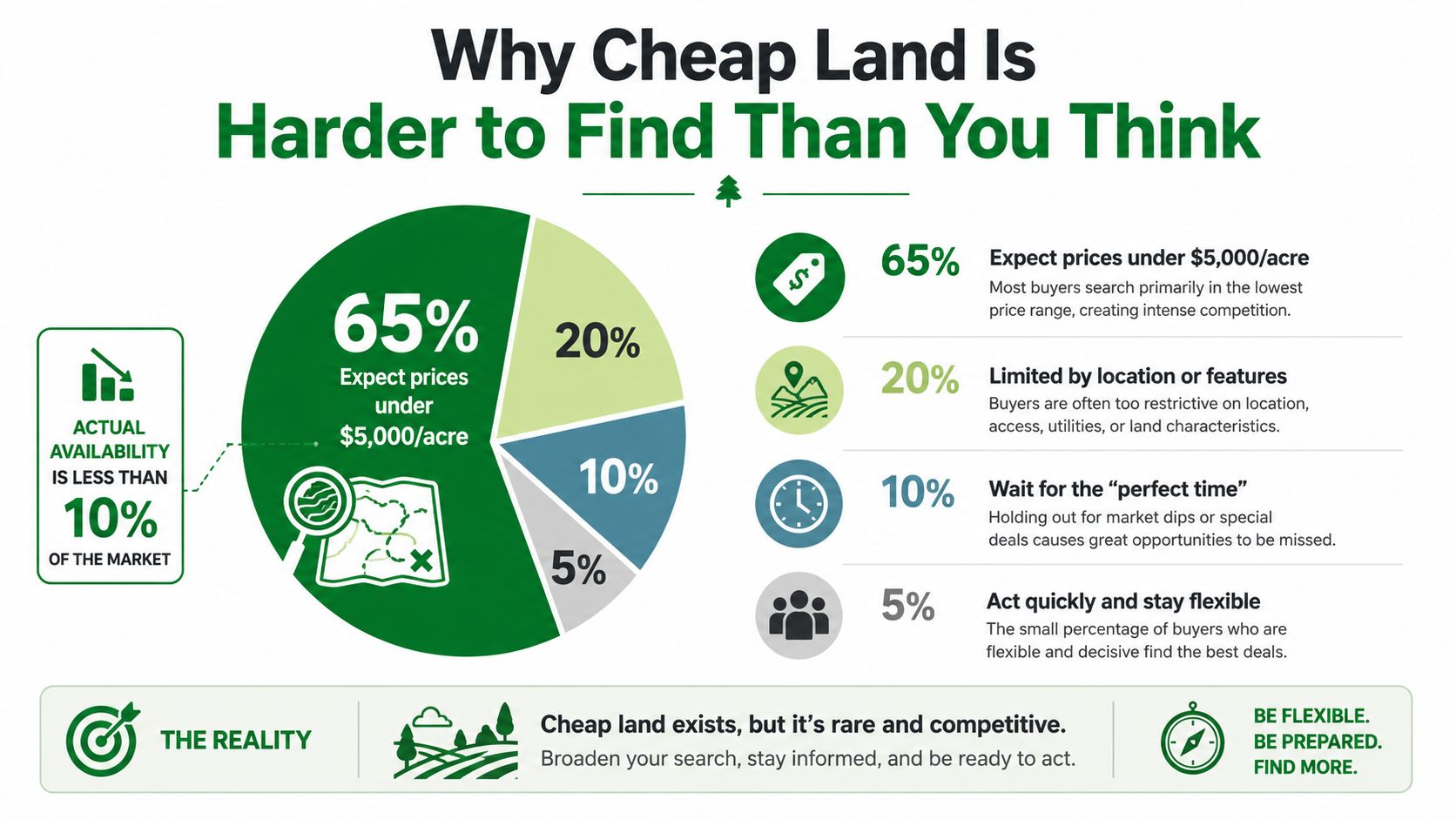
A first-time buyer often searches by price, sorts from lowest to highest, and assumes the cheapest result is the best starting point. That approach produces plenty of listings, but it doesn't separate usable rural land from parcels with no legal access, severe terrain, restrictive zoning, or no practical water solution.
The national market gives useful context. USDA has tracked U.S. farmland values since 1912, and its long record shows how dramatically land values can change. Average farm real estate values were about $69 per acre in 1920, fell to roughly $31 per acre in 1934, and reached $131 per acre by 1963. USDA reported an average of $4,500 per acre in 2026, an increase of $150 per acre, or 3.4%, from 2025. These figures come from the USDA 2026 land values report.
Why geography controls the bargain
Affordable land is concentrated in places where population density, agricultural productivity, and development pressure are limited. Recent reporting places the median county farm real estate value at $4,382 per acre, while only 2% of U.S. counties, 61 out of 3,072, average under $1,000 per acre. The cheapest county medians cluster in the arid West and northern Plains, according to this U.S. land value report.
New Mexico has the lowest state county median in that reporting, at $796 per acre, while Rhode Island reaches $24,586 per acre, creating a 31-fold gap. Nevada, Wyoming, and New Mexico also frequently appear among lower-cost markets in USDA regional data.
Practical rule: Cheap land usually reflects local economics, water access, soil productivity, or limited development demand. It rarely appears cheap because a seller simply forgot to update the listing.
A low price can still be attractive if your goal is recreation, long-term holding, or a modest off-grid project. It becomes dangerous when you need immediate residential use but haven't confirmed access, septic feasibility, water rights, or permitted structures. Start with the county, not the listing headline.
Finding Affordable Parcels Using Smart Search Strategies
A disciplined search keeps you from spending hours on parcels that never fit your budget or intended use. Begin by writing down the total cash you can commit, the maximum monthly payment you can sustain, and the purpose of the land. A recreational parcel, future homesite, and agricultural holding require different filters.
Build the search around the use
Use budget collections to create a first pass, but don't treat the price band as your final decision. A parcel under a low threshold may fit your purchase budget while failing your access or development requirements. Conversely, a slightly higher-priced parcel near an existing road or utility corridor may carry a lower total cost.
Search by state and county next. Low-cost opportunities are more common in sparse-population, non-coastal markets, particularly in the West and northern Plains. The seven-step state land search guide can help organize that process, but county-level verification still belongs to the buyer.
Use a spreadsheet with columns for:
- Parcel identity: Record the parcel number, legal description, acreage, and listing location.
- Intended use: Note whether camping, an RV, a dwelling, livestock, or recreational use is permitted.
- Access status: Separate a visible route from a recorded legal easement.
- Infrastructure distance: Record what you learn about power, water, septic, and road conditions.
- Ownership cost: Add taxes, association charges if any, financing obligations, and planned improvements.
Treat every listing as an opening claim
Map images and listing descriptions are useful for narrowing choices, not proving suitability. Check the county assessor's parcel map, planning department records, recorded plat, and deed history. Ask the county whether the parcel has legal access, what zoning applies, whether minimum build requirements exist, and whether any recorded restrictions affect your plans.
Then contact the utility providers and local contractors. A power company can explain whether service is nearby, while a well contractor or health department can describe local water and septic conditions. You don't need perfect estimates at the search stage, but you do need enough information to reject obviously unsuitable parcels.
Contact owners with focused questions
When a property survives the first review, ask the seller for the legal description, title information, access documents, tax status, and known restrictions. Don't rely on a promise that “people camp there” or “utilities are close.” Those statements may describe informal use rather than a legally permitted or financially practical use.
The process works because each filter removes a different risk. Price identifies possibility, geography improves the odds, county records establish legal facts, and a site visit tests physical reality.
The Hidden Costs That Make Cheap Land Expensive
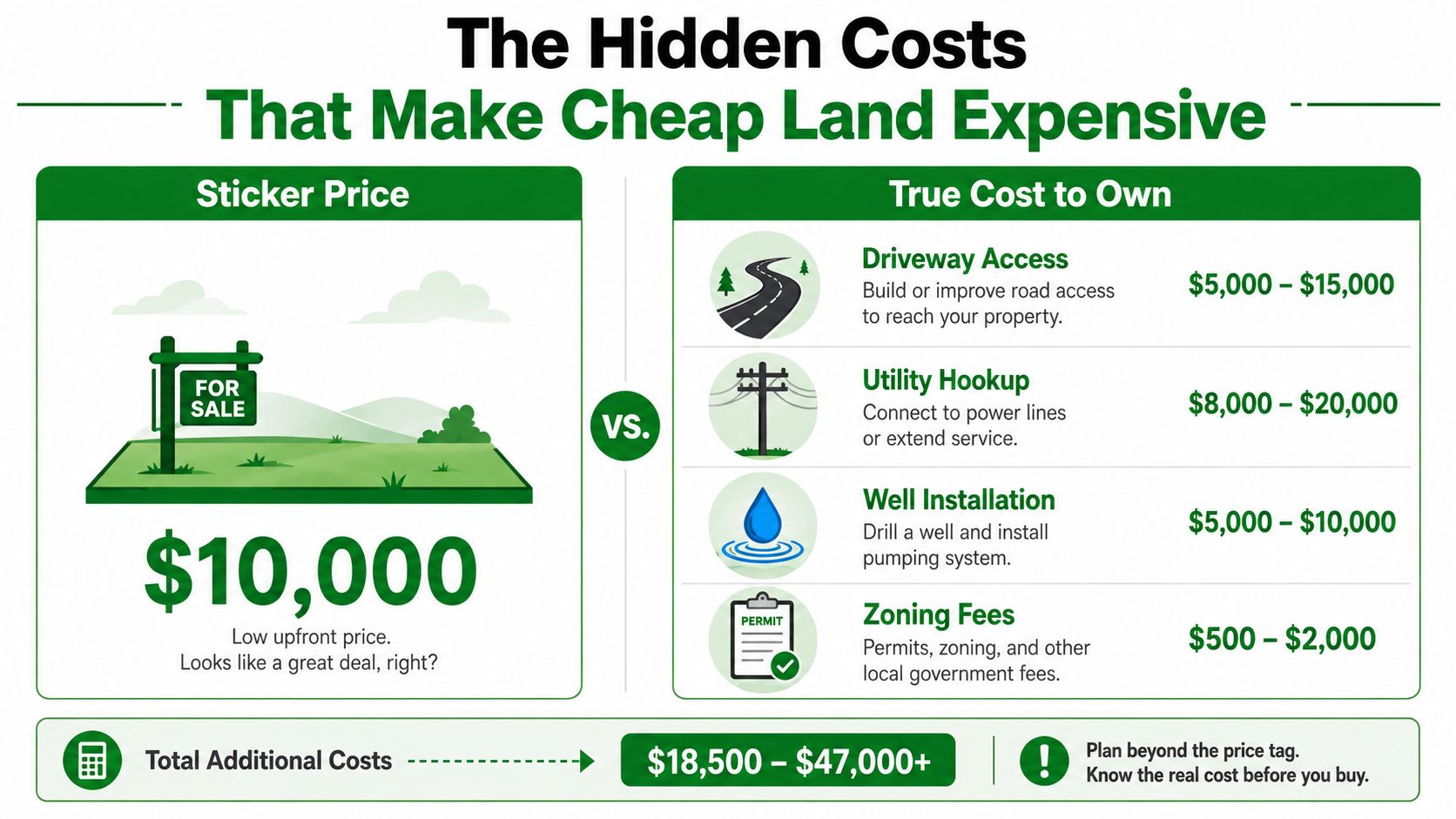
The purchase price can be the smallest part of owning raw land. A parcel that looks affordable online may need a survey, an access improvement, utility connections, a well, septic installation, permits, and ongoing tax payments before it supports your intended use.
Independent estimates place survey costs around $400 to $1,800, utility hookups around $9,000 to $34,500, and well-plus-septic installation around $6,000 to $20,000. These ranges come from this first-time land buyer cost guide. Difficult terrain, long utility runs, poor soil, and remote access can push actual costs higher.
Infrastructure changes the definition of affordable
A survey may be unnecessary for a simple hold in some situations, but it becomes important when boundary uncertainty, an easement, or a planned building site is involved. Access has two separate costs: confirming that you have a legal route and making the physical route usable.
Utilities deserve the same separation. A nearby line doesn't guarantee an inexpensive connection, and a parcel without public water or sewer may require both a well and an approved septic system. Before closing, ask the county health department about soil testing and septic approval, then speak with local contractors who understand the area.
The raw land development cost guide is useful for building a broader project budget, but local quotes matter more than national assumptions. A remote parcel can be inexpensive precisely because development is difficult.
Carrying costs and tax status
Property taxes continue whether or not you build. Current guidance cites national effective property-tax rates around 0.90%, while some agricultural-exempt parcels may have carrying costs as low as $1,000 to $3,000 per year. Those figures and the related tax risks are discussed in this 2026 raw land ownership cost guide.
Agricultural exemptions require particular care. If the property stops qualifying, rollback exposure can reach $50,000 to $100,000 or more, depending on the jurisdiction and circumstances. Ask the assessor what exemption applies, what activity maintains it, and what happens if you change the use.
Budget the land twice: once for acquisition, and again for the work required to make it legally and physically useful.
Keep a reserve for recurring taxes and maintenance instead of directing every available dollar to the purchase. The cheapest parcel is only affordable when its access, infrastructure, tax treatment, and intended use fit the same financial plan.
Using Zero-Down Owner Financing to Acquire Land
Bank financing can be a poor fit for inexpensive raw land. Lenders may prefer completed homes, established infrastructure, and conventional collateral. Buyers with limited credit history can also face underwriting requirements that have little connection to whether a particular rural parcel suits their goals.
Owner financing changes who receives the payments. Instead of borrowing through a bank, the buyer signs an agreement with the seller and pays according to the contract. With a zero-down structure, ownership begins with the first scheduled installment rather than a traditional upfront deposit, subject to the seller's agreement and the documents governing the transaction.

Understand the agreement before the payment
“Zero down” doesn't mean zero responsibility. You still need to understand the purchase price, payment schedule, interest or finance charge, late-payment rules, default provisions, taxes, insurance responsibilities, and the point at which legal title transfers.
Ask whether the arrangement uses a deed of trust, land contract, installment contract, or another structure. The legal effect varies by state. Have a local real estate attorney or title professional review unfamiliar documents, especially when the seller retains title until the balance is paid.
A seller-financed transaction should also identify the parcel precisely. Match the contract to the recorded legal description and confirm that the seller has authority to convey the property. The guide to buying land without traditional credit offers additional context, but it shouldn't replace independent review of the actual agreement.
Match the payment to your ownership plan
Financing helps preserve cash for surveys, taxes, access, and future improvements. That flexibility can matter more than a small reduction in the purchase price, particularly when the parcel needs immediate work.
The trade-off is a continuing obligation. If the land doesn't work for your intended use, you may still owe the contracted payments. Review the total amount paid over time, not just the monthly figure, and confirm whether early payoff changes the cost.
LandZero offers vacant-land listings with owner financing, online account management, zero-down initiation, and no credit checks. Treat those features as transaction terms to compare carefully, alongside title, access, zoning, and total ownership costs.
Negotiating and Choosing Between Payment Options
Paying in full and financing solve different problems. Cash can simplify closing and may come with a listed discount, while financing preserves liquidity and spreads the purchase across scheduled payments. Neither option is automatically cheaper once taxes, infrastructure, and opportunity cost enter the calculation.
| Factor | Pay in Full | Owner Financing |
|---|---|---|
| Upfront cash | Requires the full agreed purchase amount and associated transaction costs | May begin with the first scheduled payment under a zero-down agreement |
| Total purchase cost | Compare the cash price and any listed discount | Review the complete payment total, including finance charges |
| Cash reserves | Ties up capital immediately | Preserves cash for due diligence, taxes, and improvements |
| Approval process | Usually avoids lender underwriting | Terms depend on the seller's contract and approval process |
| Risk after closing | No scheduled land payment remains, but taxes and upkeep continue | Missed payments can trigger contractual consequences |
| Best fit | Buyers with sufficient reserves and a clear use plan | Buyers who need liquidity or don't want bank financing |
Negotiate the terms, not only the price
A seller may have limited room on price but more flexibility on payment timing, early payoff, or included transaction costs. Ask for the complete written terms before treating a monthly figure as affordable. Compare the full financed amount with the cash price, then decide whether preserving capital justifies the difference.
Never use all available cash to buy land that still needs access or utilities. A cash discount has little value if it leaves you unable to complete essential due diligence or handle recurring taxes.
Questions that expose the real deal
Ask who pays property taxes during the contract, whether there are late fees, what happens after a missed payment, whether early payoff is allowed without penalty, and how title is recorded. Confirm that the agreement identifies the parcel and explains every party's obligations.
Negotiation insight: The strongest offer is one you can perform without relying on optimistic assumptions about future development.
If the seller won't provide clear documents, access evidence, or tax information, walk away regardless of the payment method. Cheap land rewards patience, not urgency.
Your Action Plan for Buying Affordable Land
Start with a written use case. Decide whether you want recreational access, a future homesite, an investment hold, or agricultural use. That decision determines which zoning questions, infrastructure checks, and tax conditions matter most.
Then create a total-cost worksheet. Include the purchase price, financing total if applicable, survey needs, access work, utility connections, well and septic feasibility, permits, taxes, and a reserve for unknowns. If the numbers only work before those items are added, the parcel isn't affordable for your plan.
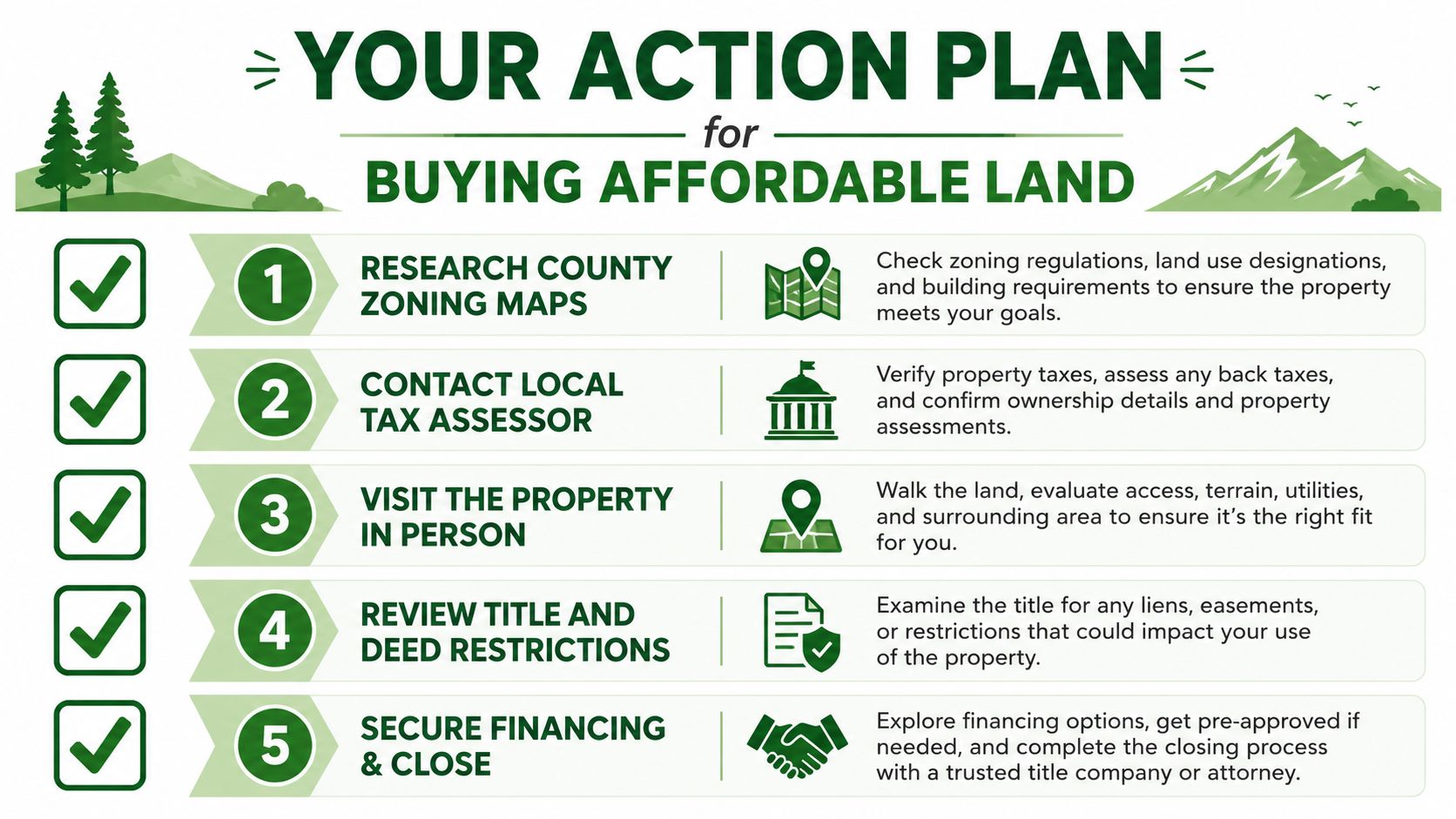
Follow the verification sequence
Research county zoning maps: Confirm the designation, permitted uses, setbacks, minimum size rules, and restrictions on camping, RVs, dwellings, or livestock.
Contact the local tax assessor: Verify the current tax status and ask whether an agricultural exemption exists, what maintains it, and whether a change in use can create rollback exposure.
Visit the property in person: Walk the parcel if lawful and safe. Compare the terrain, route, drainage, neighboring uses, and apparent boundaries with the listing and recorded documents.
Review title and deed restrictions: Confirm ownership, liens, easements, access rights, covenants, and the exact legal description through county records or a title professional.
Secure financing and close: Compare cash and owner-financed totals, read default terms, confirm payment responsibilities, and close only after the property passes your use and cost tests.
The decision rule is simple. If you can't verify legal access, permitted use, title, tax status, and a realistic infrastructure path, pause the purchase. A low price doesn't compensate for land you can't reach, develop, or hold comfortably.
Cheap land can be a practical entry into ownership when you evaluate the entire obligation rather than the advertised number. Use county records, local professionals, a site visit, and a written budget before signing.
If you're ready to compare affordable parcels with structured owner-financing options, browse the state and budget-based listings at LandZero. Review each property's terms, verify the local conditions independently, and choose only land whose total cost matches your actual plan.