
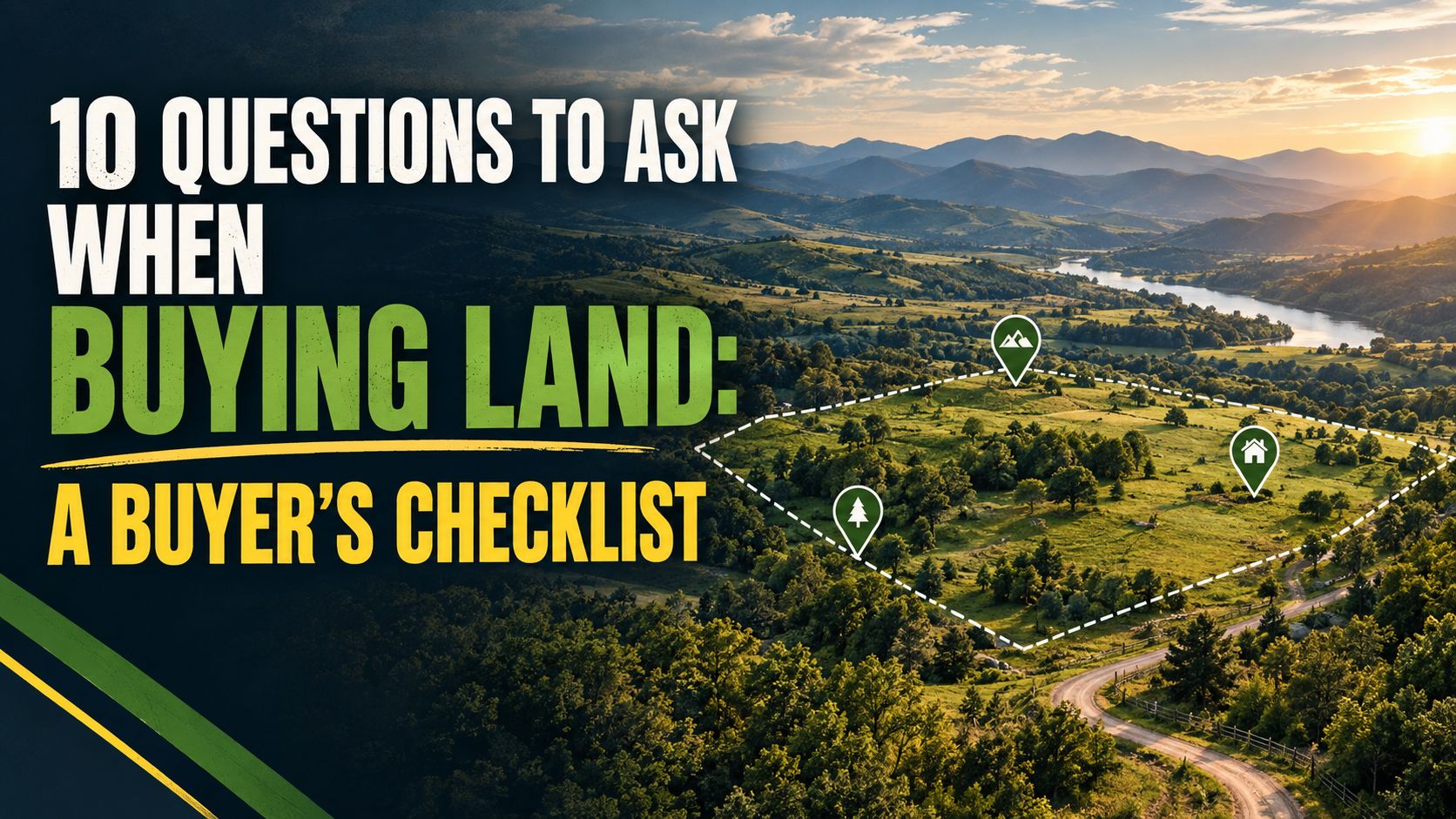
Owner-financed land can move from a listing to an online checkout before you've walked the parcel, called the county, or read the deed. Zero-down terms and no credit check may make the purchase accessible, but they don't remove the risks. A missing easement, unusable soil, unpaid tax bill, or restrictive deed can turn a cheap parcel into a long-term liability.
The right questions to ask when buying land depend on who can answer them. Sellers know the property's history, county offices control zoning and permits, and title companies trace ownership, liens, easements, and recorded rights. Get answers from the right source, request documents rather than promises, and keep written confirmation before you pay the first installment.
Table of Contents
- 1. Does the parcel have legal, physical, and recorded access?
- 2. Is the title clear of liens, back taxes, and undisclosed encumbrances?
- 3. Where are the exact boundaries, and is there a current survey?
- 4. What zoning, land use rules, and building restrictions apply?
- 5. Is the land located in a flood zone, wetland, or other environmental hazard area?
- 6. Is the soil suitable for septic systems, wells, and foundations?
- 7. What utilities are available, and what will off-grid systems cost?
- 8. Who owns the water, mineral, and subsurface rights?
- 9. What are the property taxes, HOA fees, and ongoing ownership costs?
- 10. What are the full financing terms, default rules, and deed transfer conditions?
- 10 Key Questions to Compare When Buying Land
- Turn These Answers Into a Pre-Purchase Checklist
1. Does the parcel have legal, physical, and recorded access?
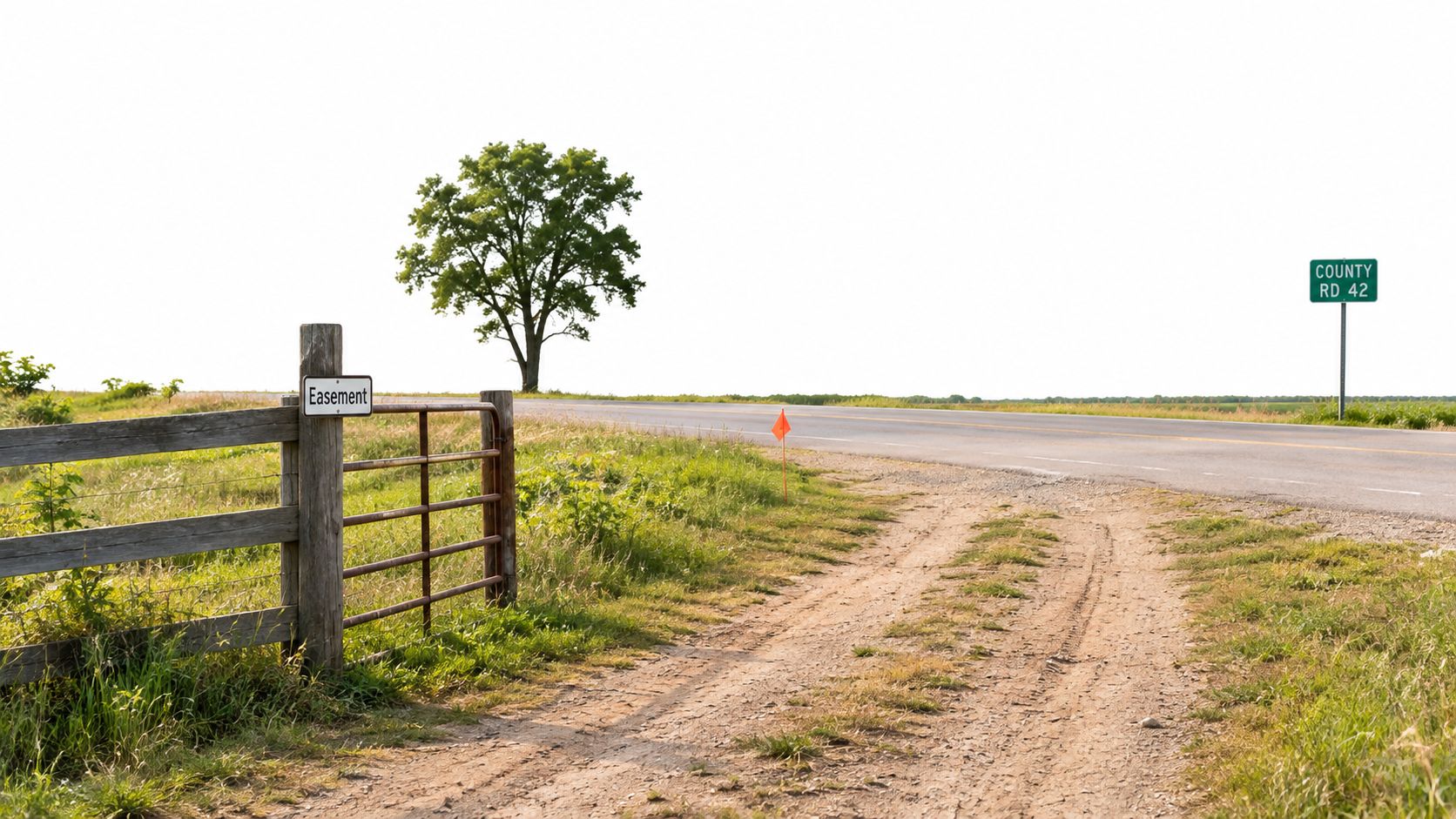
Ask the seller to show exactly how you'll reach the parcel, then verify the route with the county road department and the county recorder. “Road access” in a listing might mean a public road, a private road, a seasonal trail, or a driveway crossing someone else's land. Only a public connection or a properly recorded easement gives you dependable legal access.
Request a copy of every access easement, including any utility easement and road-maintenance agreement. Check the legal description, width, permitted uses, and whether the easement reaches a public road. A verbal promise from a neighbor isn't a substitute for a recorded document.
What to verify on the ground
Drive the full route, not just the last stretch beside the parcel. Look for locked gates, steep grades, washed-out culverts, narrow bridges, mud, snow, and turns that construction or emergency vehicles couldn't manage. County GIS maps and satellite imagery can help you trace the route before visiting, but they won't prove that you have a legal right to use it.
Practical rule: Legal access and usable access are separate tests. You need both before you buy.
Ask the county road department whether the road is public, county-maintained, private, or seasonal. If it's private, identify who maintains it and whether your parcel shares the expense. Visit in more than one season when possible. A road that looks adequate in dry weather may be unusable after heavy rain or winter freeze.
2. Is the title clear of liens, back taxes, and undisclosed encumbrances?
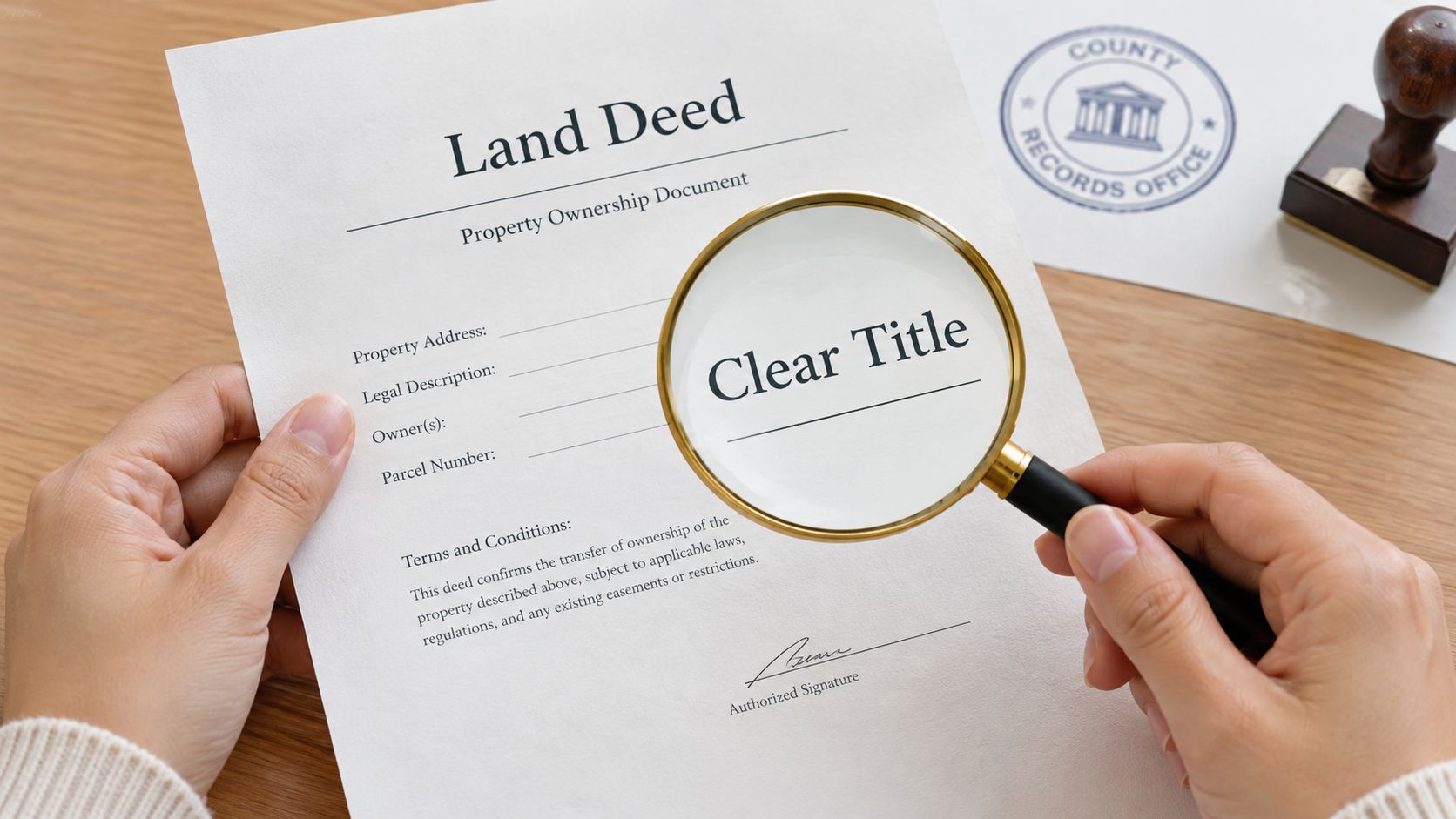
Ask the seller for a current preliminary title report, then have a title company confirm what it finds. The report should identify the current owner, legal description, liens, judgments, unpaid taxes, easements, covenants, restrictions, and other recorded exceptions. A listing page or tax record alone doesn't establish clean title.
The county recorder can help you locate deeds and recorded claims. The county treasurer can confirm whether property taxes are current. Those offices answer different questions, so don't assume that a clear tax account means the title is free of other claims.
Documents that deserve careful review
- Preliminary title report: Check the vesting deed, legal description, exceptions, and recorded encumbrances.
- Tax account statement: Confirm current charges, delinquent taxes, penalties, and special assessments.
- Recorded deed and restrictions: Look for limits on homes, mobile homes, commercial activity, access, livestock, or subdivision.
- Purchase deed provision: Confirm whether the seller will provide a warranty deed, and when it will be recorded.
A buyer might discover an old contractor lien or a deed restriction that prohibits the intended home after assuming the seller's payment plan was straightforward. The seller should clear unresolved claims before closing, not ask you to accept them and sort them out later.
Ask whether the deed transfers and records at the beginning of the contract or only after the final payment. Owner financing can use different structures, including a land contract, installment contract, or deed held until payoff. Have a real estate attorney review the documents when the arrangement or parcel value justifies it, and consider title insurance.
3. Where are the exact boundaries, and is there a current survey?
Ask the seller for the recorded plat, prior survey, corner information, and any known boundary-dispute records. Then compare those documents with the county assessor's parcel map. County GIS is useful for orientation, but it's generally not a substitute for a boundary survey.
Online listings often display approximate acreage or a simplified outline. A fence, driveway, shed, or clearing may appear to define the parcel while sitting across the actual boundary. If you build from the listing map, you could place a home, driveway, or septic field on the wrong land.
Use the survey for decisions, not decoration
Walk the boundary with the survey in hand and look for iron pins, monuments, witness posts, fences, and other markers. Ask the seller whether neighbors have disputed a line or claimed any portion through long use. A licensed surveyor can locate corners, identify encroachments, and prepare a current boundary survey suitable for planning and construction.
A buyer who plans a homesite should treat the survey as part of feasibility, not as an optional closing document. Setbacks, driveway placement, septic reserve areas, and easements can reduce the usable building area even when the parcel's total acreage sounds sufficient.
For a clearer explanation of the documents and decisions involved, review LandZero's guide to land survey requirements before calling a surveyor.

4. What zoning, land use rules, and building restrictions apply?
Ask the county planning or zoning department for a written zoning verification tied to the parcel number. The office should confirm the zoning designation, permitted uses, minimum lot size, setbacks, frontage, height rules, dwelling requirements, and subdivision limitations. Tell staff exactly what you want to do, whether that's a permanent home, tiny home, RV, cabin, farm, livestock operation, or recreational use.
A zoning label doesn't prove that the parcel is practically usable. A dwelling might be allowed in principle while septic approval, driveway standards, floodplain rules, or minimum frontage prevent construction. Ask the county building department and environmental-health department which permits apply before you rely on the seller's description.
Check private rules separately
County rules aren't the only restrictions. Ask the seller and title company for HOA covenants, conditions and restrictions, deed restrictions, conservation easements, and private road agreements. A private restriction can prohibit a mobile home or limit structures even when county zoning permits them.
“Buildable” should mean permitted for your intended use and serviceable under the site's actual constraints.
A buyer planning a tiny home on a small rural parcel may learn that the county requires a larger minimum lot for a permanent dwelling. Another buyer may find that agricultural zoning allows a home and barn, but only after the parcel meets septic and access requirements. Request written answers, save the staff member's name and date, and don't treat a casual phone response as a permit.
Use LandZero's guide to understanding property zoning in the United States to organize your questions before contacting the county.
5. Is the land located in a flood zone, wetland, or other environmental hazard area?
Ask the county floodplain administrator which effective map applies, then compare the parcel with FEMA's National Flood Hazard Layer. FEMA classifies areas with at least a 1% annual chance of flooding as high risk, so the designation can affect building requirements, insurance, access, and financing. Also ask whether a preliminary map revision or updated local study is pending.
FEMA mapping isn't complete evidence by itself. Columbia Law School summarizes concerns that FEMA maps cover only about one-third of the United States, that many maps are decades old, and that standard maps generally don't capture future sea-level rise or increasingly extreme precipitation. A parcel outside a mapped high-risk zone can still collect runoff, sit beside a wash, or lose access during heavy rain.
Investigate conditions beyond the map label
The Congressional Budget Office reported in 2024 that approximately 17 million U.S. properties face at least a 1% annual chance of experiencing flooding of one foot or more. Over a 30-year period, that represents about a 25% chance of at least one such flood. Flooding is also frequently excluded from ordinary property insurance, so ask an insurer whether separate coverage is available and affordable. Read the CBO's flood-risk analysis before treating a low-priced parcel as a low-risk parcel.
Check the National Wetlands Inventory, state wildfire maps, local drainage records, culverts, washes, steep slopes, and signs of erosion. Walk the land after rain if possible. FEMA's National Flood Insurance Program reported that nearly one-third of flood-insurance claims from 2014 through 2024 came from locations outside mapped high-risk areas, which is why local evidence matters as much as the zone name.
6. Is the soil suitable for septic systems, wells, and foundations?
Ask the county environmental-health department what testing it requires for septic approval, then review the parcel in the USDA's Web Soil Survey. The tool provides map units, interpretive tables, thematic maps, and downloadable SSURGO data for GIS analysis. It can screen for drainage, permeability, slope, shrink-swell potential, depth to bedrock, seasonal wetness, and erosion susceptibility.
The map is a starting point, not an approval. The USDA Natural Resources Conservation Service cautions that onsite investigation may still be necessary for soil-quality, engineering, conservation, and other site-specific decisions. Request a licensed septic evaluation, perc test, survey, and relevant geotechnical advice when you plan to build.
Ask for evidence tied to the intended use
- Septic approval: Ask whether a perc test exists, whether it remains valid, and what system design the soil supports.
- Well feasibility: Ask the state water agency and nearby owners about well permits, depth, yield, and water quality.
- Foundation conditions: Ask a qualified professional to evaluate bearing conditions, groundwater, bedrock, slope, and grading needs.
- Road and driveway conditions: Confirm whether soil, drainage, and slope can support construction traffic and a permitted driveway.
A parcel with clay soil, shallow rock, or a seasonal water table may still work for recreation but fail as a homesite. Ask the county for written confirmation rather than treating a generalized soil rating as approval. The useful question is simple: what evidence proves this exact site can support the improvements you intend to add?
7. What utilities are available, and what will off-grid systems cost?
Ask each utility provider about service at the parcel, not merely service in the nearby community. The electric cooperative should tell you where the nearest line and transformer are and whether it will provide a written extension estimate. The water or sewer authority should confirm service boundaries, connection requirements, capacity, and fees.
Internet and cell coverage deserve the same treatment. Check the FCC broadband map, carrier coverage maps, and the exact coordinates. Then test reception on the property if remote work, security monitoring, or emergency communication matters.
Price the complete system
A pole at the road doesn't mean power is available at your building site. A water line nearby doesn't prove that you can connect. Ask for written information about:
- Electricity: Line distance, transformer needs, extension terms, and whether overhead or underground service is required.
- Water: Public connection availability, well-permit rules, drilling conditions, storage, and treatment.
- Wastewater: Sewer connection feasibility or septic approval, reserve area, and maintenance requirements.
- Communications: Fixed broadband, satellite service, cellular signal, and installation limitations.
- Off-grid equipment: Solar generation, batteries, water storage, generator backup, and waste systems.
A recreational buyer may accept limited power and connectivity. A buyer planning year-round occupancy usually needs a more dependable system and a larger contingency budget. Compare utility estimates with the purchase price before you decide that inexpensive land is affordable.
LandZero's guide to bringing utilities to your land can help you prepare the provider calls and separate confirmed service from assumptions.
8. Who owns the water, mineral, and subsurface rights?
Ask the seller which rights are included, then have the title company trace prior reservations and conveyances. Surface ownership may not include mineral rights, water rights, timber, grazing, wind, or other interests. The deed and title exceptions should state what transfers and what remains with another party.
Request copies of mineral reservations, leases, water-right certificates, well permits, grazing agreements, and access arrangements. If mineral rights were severed decades ago, another owner might retain rights to lease or develop them, subject to applicable law and recorded terms. That can affect surface use, privacy, roads, and future resale.
Water rules depend on the state
Ask the state water agency whether a well permit is required, whether existing rights attach to the parcel, and whether your intended use is allowed. In western states such as Arizona, Colorado, Nevada, New Mexico, and Utah, water generally follows prior appropriation rules, so owning land doesn't automatically guarantee water access.
A buyer in an active oil, gas, or mining area should have a real estate attorney review the title chain and operating documents. Ask who can enter the land, where access routes run, who pays for damage, and whether existing leases survive the sale.
The seller's statement that “the land includes everything” isn't enough. Rights must be confirmed in the deed, title commitment, agency records, and lease documents.
9. What are the property taxes, HOA fees, and ongoing ownership costs?
Ask the county treasurer for the current tax account, payment history, delinquency status, and any special assessments. Ask the assessor how the parcel is classified and whether an agricultural, timber, or open-space status could change after purchase. A favorable current bill may not continue if your use changes.
Then ask the seller for every private charge connected with ownership. That can include HOA dues, road-maintenance contributions, improvement-district charges, gate fees, conservation obligations, and shared well or access costs. Require copies of the governing documents, not just an estimate over the phone.
Build a holding-cost budget
Include the costs that continue even when the land remains unimproved:
- Property taxes: Confirm the current bill, due dates, delinquent amounts, and possible reassessment.
- Insurance: Ask whether vacant-land or liability coverage is available and whether flood or wildfire exclusions apply.
- Road maintenance: Identify mandatory contributions and seasonal repair responsibilities.
- Association charges: Review dues, special assessments, rules, and enforcement rights.
- Site management: Account for vegetation control, fencing, security, trash removal, and periodic inspections.
A buyer may choose one county over another after comparing recurring costs rather than focusing only on the purchase price. Set reminders for tax dates and payment obligations, especially if you'll hold the parcel before building. The county treasurer's account and the title report should agree before closing.
10. What are the full financing terms, default rules, and deed transfer conditions?
Ask the seller for the complete owner-financing agreement, promissory note, amortization schedule, payment instructions, and deed-transfer terms before checkout. The advertised monthly payment doesn't tell you the total amount paid, interest cost, late charges, payoff requirements, or consequences of default.
Review the agreement with particular care if it uses a land contract or keeps the deed with the seller until final payment. Confirm whether your interest is recorded, who pays taxes and insurance, whether prepayment is allowed without a penalty, and how a payoff is documented.
Put default rules in writing
Look for the exact answer to each question:
- Payment schedule: What is due, when is it due, and how are payments credited?
- Late payment: What late fee applies, and when does it begin?
- Cure period: How much time do you have to correct a missed payment?
- Forfeiture: What happens to your payments and improvements after default?
- Early payoff: Can you pay the balance early, and will the seller release and record the deed promptly?
- Transfer: Can you sell, assign, or refinance your interest before payoff?
Zero down and no credit check reduce the initial barrier, but they don't reduce the contractual obligation. Compare the financed total with the listed cash price and choose a payment method that creates a reliable record. If the seller offers an online customer portal, use it consistently and save confirmations.
10 Key Questions to Compare When Buying Land
| Item | 🔄 Implementation complexity | ⚡ Resource requirements | 📊 Expected outcomes | Ideal use cases | ⭐ Advantages / 💡 Tip |
|---|---|---|---|---|---|
| Does the parcel have legal, physical, and recorded access? | Moderate, requires record review and site visit | County recorder/GIS, in‑person drive, easement docs | Confirm year‑round vehicle access and recorded easement status | Remote/rural parcels, building or emergency access planning | Ensures usability and resale; tip: obtain recorded easement and visit in another season |
| Is the title clear of liens, back taxes, and undisclosed encumbrances? | Moderate–High, title search and possible legal review | Preliminary title report/title insurance, recorder, attorney | Verify ownership, reveal liens, enable clean transfer/financing | Owner‑financed deals, higher‑value purchases | Protects from inherited debts; tip: get a preliminary report or low‑cost title policy |
| Where are the exact boundaries, and is there a current survey? | Moderate, compare legal description; survey if needed | County plat/GIS, licensed surveyor (if building) | Accurate acreage, located corners, identified encroachments | Building, fencing, subdivision, value verification | Prevents boundary disputes; tip: budget for a survey when planning structures |
| What zoning, land use rules, and building restrictions apply? | Low–Moderate, contact planning dept and review codes | County planning/zoning maps, written confirmation of uses | Determine permitted uses, setbacks, and permit needs | Planned development, permanent dwellings, commercial proposals | Clarifies legal uses; tip: get written confirmation from the zoning office |
| Is the land located in a flood zone, wetland, or other environmental hazard area? | Low–Moderate, map review and site check | FEMA, NWI, wildfire maps, possible enviro reports | Identify flood/wetland/fire risks and mitigation/permit requirements | Low‑lying parcels, coastal/riverine, fire‑prone zones | Avoids uninsurable or unbuildable lots; tip: cross‑check FEMA and NWI viewers |
| Is the soil suitable for septic systems, wells, and foundations? | Moderate, may need perc or geotech testing | USDA Web Soil Survey, perc test, county health dept, driller | Confirm septic, well feasibility, and foundation suitability | Homesteads, permanent residences, septic installations | Prevents costly system failures; tip: review USDA soils and plan a perc test if building |
| What utilities are available, and what will off‑grid systems cost? | Moderate–High, gather quotes and design options | Utility extension estimates, FCC coverage maps, solar/well contractors | Realistic total cost to connect utilities or build off‑grid systems | Remote/off‑grid parcels, cost‑sensitive buyers, recreation | Clarifies total ownership cost; tip: get a power extension quote before buying |
| Who owns the water, mineral, and subsurface rights? | High, deed chain research and state records | County recorder, state water agency, legal counsel | Determine severed mineral/water rights and any reserved access | Western states, mineral/energy regions, agricultural use | Protects against extraction or water disputes; tip: search recorder for reserved rights |
| What are the property taxes, HOA fees, and ongoing ownership costs? | Low, look up tax records and association documents | County treasurer/assessor, HOA/road association documents, budget tool | Annual carrying cost estimate and delinquency risks | Long‑term holders, investors, budget‑conscious buyers | Prevents surprise liabilities; tip: factor taxes/fees into annual budget and set reminders |
| What are the full financing terms, default rules, and deed transfer conditions? | Moderate, review contract, amortization, and legal clauses | Full amortization schedule, contract review, attorney if needed | Understand total cost, default consequences, and deed timing | Zero‑down owner financing, buyers with limited credit | Clarifies payment obligations and deed timing; tip: request written deed transfer timing and full amortization schedule |
Turn These Answers Into a Pre-Purchase Checklist
Take these questions to the people who can verify them. Ask the seller for property history, surveys, leases, restrictions, prior testing, and the complete financing documents. Ask the county recorder for deeds, easements, reservations, and liens. Ask the county treasurer for tax records and special assessments. Ask planning, building, road, floodplain, and environmental-health offices for written answers tied to the parcel number.
A title company should issue a preliminary title report or title commitment and explain every exception. Don't skip exceptions that sound technical. An easement may control your only driveway, a mineral reservation may affect future surface use, and a deed restriction may prohibit the structure you planned to build.
Use the county's effective flood data and ask whether preliminary revisions or local studies exist. Review the USDA Web Soil Survey, then arrange parcel-specific testing where septic, wells, foundations, grading, or roads matter. Confirm utility availability directly with providers and request written extension estimates. A map showing a nearby line is not a connection quote.
The most important distinction is between legal permission and practical feasibility. Zoning may permit a dwelling, but access, septic, drainage, slope, water, or power can still make the project uneconomic. A parcel outside a mapped high-risk flood area may still experience local runoff or lose access. A low price doesn't compensate for land you can't reach, insure, permit, or use.
Put due-diligence protections in the purchase agreement. Preserve the right to cancel if title review, access verification, survey results, environmental investigation, septic testing, utility estimates, or financing review contradicts your intended use. Set deadlines for each investigation and identify who pays for testing. For an owner-financed purchase, confirm when ownership begins and what happens if the transaction ends before final payoff.
LandZero offers vacant-land listings across multiple U.S. states, budget-based browsing, and owner financing through its FlexPay program. Its online process, FAQ, and Land Guide can help you identify documents and county questions, but you should still verify each parcel independently before committing.
A parcel that passes all ten questions isn't automatically perfect. It is a parcel you understand, with its access, title, boundaries, permitted uses, hazards, soil, utilities, rights, ownership costs, and financing terms documented well enough to make an informed decision.
If you're comparing affordable vacant land, use LandZero to browse parcels by state and budget, review owner-financing options, and access practical land-buying guides. Start with the listing documents, then take the ten questions above to the seller, county offices, utility providers, and title company before you pay the first installment.