
You open a land marketplace, enter a modest budget, and receive parcels from deserts, forests, farmland, and remote mountain country. One listing looks affordable, another appears larger, and a third promises owner financing. Yet the price alone doesn't tell you whether you can reach the property, install a septic system, build a cabin, or resell the parcel later.
That's why land for sale by state is a better starting point than a nationwide price hunt. Each state combines different terrain, private-land availability, water conditions, infrastructure, zoning rules, and buyer demand. Treating the state as a mini-market helps you compare realistic opportunities instead of comparing unrelated parcels by acreage alone.
Table of Contents
- Why Buying Land Feels Overwhelming and How State Pages Fix It
- How State Pages and Budget Filters Work Together
- What Makes Each State Market Different
- Four Questions to Answer Before You Pick a State
- Matching Your Goal to the Right State Profile
- How Financing Changes the State Comparison
- Hidden Costs That Cheap State Listings Often Hide
- Your Repeatable State-by-State Buying Workflow
Why Buying Land Feels Overwhelming and How State Pages Fix It
A first-time buyer can open a nationwide search and see a low-priced lot in the Southeast beside western acreage, farmland, or an off-grid parcel miles from a paved road. The listings may share a budget filter, yet they can serve entirely different purposes. One might support a weekend retreat, while another may be difficult to reach or impossible to develop as planned.
Start with feasibility, not price. Two parcels listed for the same amount can differ in road access, water availability, soil, flood exposure, public-land density, and practical building conditions. A parcel near a maintained road may have nearby utilities and a county process that fits your goal. Another may cost less because its terrain is steep, its access is uncertain, or its soil creates septic problems.
A nationwide search puts these unlike situations in one pile. You can spend hours comparing acreage and prices before noticing that the parcels were never realistic alternatives.
A state is a useful first filter
A state page works like a labeled tray rather than one oversized storage box. It narrows the market to a region where climate, terrain, infrastructure, land availability, and local rules share some context. From there, compare parcels against your intended use, whether that means recreation, a homesite, agriculture, or a cabin.
The United States has about 3,531,905 square miles of land area, based on Census Bureau state-land-area data. Alaska, Texas, California, Arizona, and Colorado differ sharply in physical scale. That scale affects how far listings may be from population centers, how much private land is available, where roads and utilities reach, and how public land or environmental constraints shape the buying choice.
State pages do not certify that a parcel is suitable. They give you a more useful starting point for asking the right questions. Before opening a budget filter, check whether a state's soil, flood exposure, public-land density, and travel distance match the way you intend to use the property.
Compare the search experience
| Browsing Method | Listings to Review | Decision Criteria | Time to Shortlist |
|---|---|---|---|
| Nationwide search | Mixed markets across the country | Mostly price and acreage | Difficult to control |
| State-first search | A defined regional inventory | Climate, access, rules, use, and price | Easier to manage |
| State plus budget | Listings within a geographic and financial range | Affordability and feasibility together | More focused |
| State plus budget plus due diligence | A small group of plausible parcels | Practical buildability and intended use | Strongest shortlist |
Use the LandZero land-for-sale-in-America page to see available regions, then select a few states and examine their constraints. Let the budget filter remove unaffordable listings. Let due diligence decide whether an affordable parcel deserves serious consideration.
Practical rule: Use the state to narrow the market, the budget to narrow the inventory, and due diligence to decide whether a parcel belongs on your shortlist.
How State Pages and Budget Filters Work Together
A land marketplace works much like a grocery store. You wouldn't compare every item in the building at once. You'd choose an aisle, look at the products in that category, and then check prices, ingredients, and quantities.
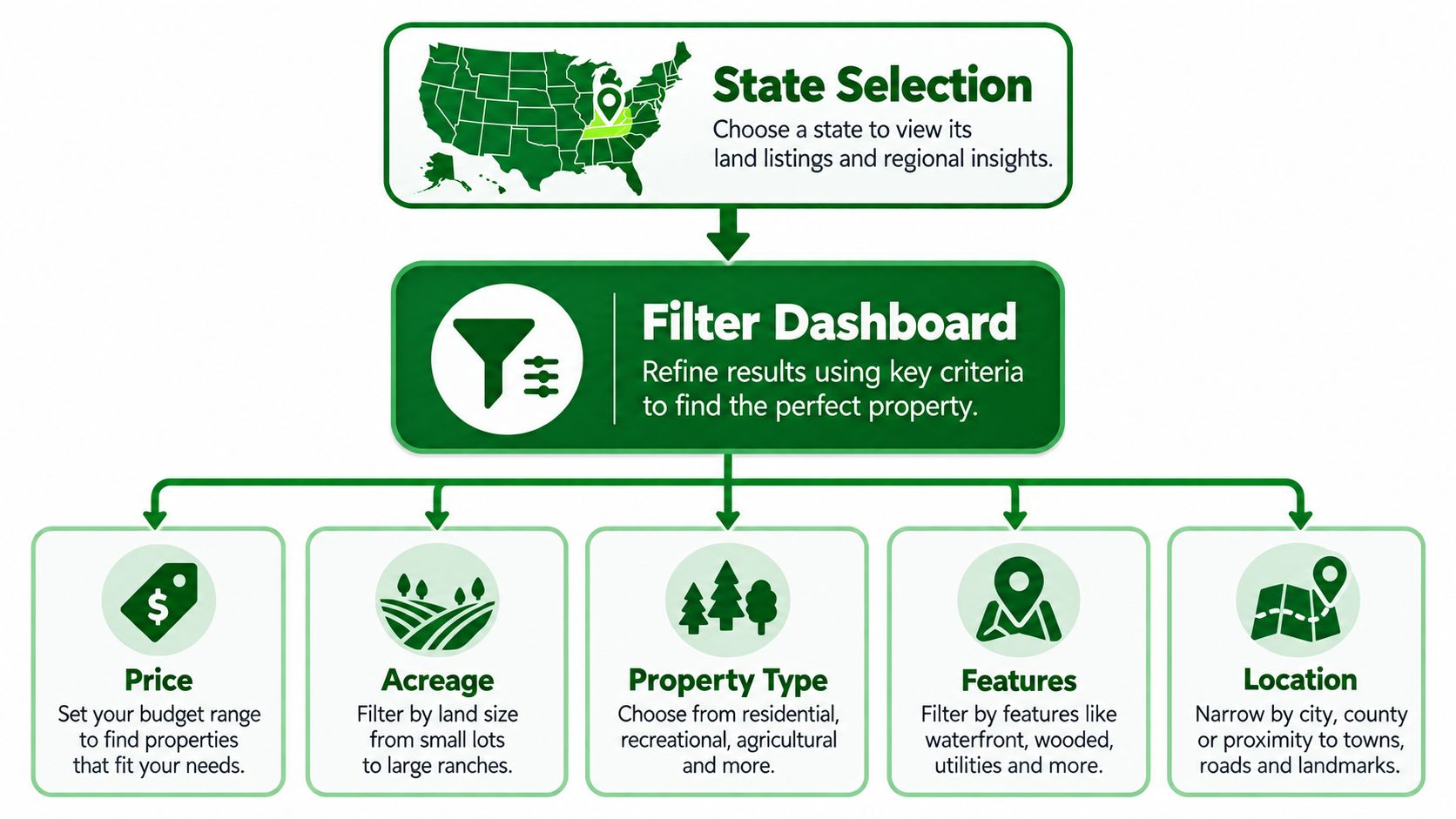
Land browsing follows the same logic. Start with the broad national inventory only long enough to identify possible states. Move into a state page, then use a budget collection to find parcels that fit your financial ceiling. On LandZero, those collections include Land Under $5k, $5k to $10k, and $10k & Up.
Follow the filters in the right order
Define your total cash limit. Decide what you can commit without using money reserved for travel, professional inspections, taxes, or improvements. The listing price is only the first part of your land budget.
Choose a small group of states. Select states that fit your intended use and lifestyle. A recreational buyer may care about access to open terrain, while a homesteader may care more about water, soil, and local rules.
Open the budget collection. A price band helps you avoid emotionally attaching yourself to parcels that exceed your limit. It also makes comparisons more consistent because you're reviewing properties with broadly similar acquisition costs.
Check the listing details. Review acreage, road information, utilities, zoning notes, taxes, and any available maps. Don't assume a missing detail means the condition is favorable. Treat it as a question to verify.
Compare total feasibility. A parcel at the top of your range may be more practical than a cheaper parcel that needs difficult access, a well, engineered drainage, or an alternative septic solution.
Understand financing before you compare prices
Owner financing changes the first question from “Can I pay the entire price today?” to “Can I manage the payment structure and the property's future costs?” LandZero's published process describes zero-down owner financing, no credit checks, and zero closing costs, with checkout and payment management handled online. Those terms can make more listings available to buyers who aren't using a bank loan, but you still need to read the contract, payment schedule, taxes, default provisions, and ownership terms carefully.
A zero-down arrangement doesn't make a parcel inexpensive to own. You'll still need to investigate access, water, septic suitability, taxes, and permissible uses. Financing solves one acquisition barrier, not every land-use problem.
What Makes Each State Market Different
A first-time buyer may see a large state and assume it offers the best chance of finding cheap acreage. The more useful question is whether the state's conditions fit the intended use. State size matters, but soil, water, terrain, public-land density, flood exposure, road access, and county rules can matter more than the number of square miles.
The Census Bureau's state land-area figures show the scale clearly: Alaska has approximately 571,390 square miles of land area, Texas about 261,232 square miles, California about 155,860 square miles, Arizona about 113,655 square miles, and Colorado about 103,637 square miles. That scale may support more rural or recreational listings, yet some areas are remote, federally administered, difficult to reach, or unsuitable for building.
A smaller state may offer fewer listings while keeping parcels closer to roads, utilities, population centers, and resale markets. A large map, in other words, is a bigger search area, not a guarantee of better choices.
Private inventory and public ownership are different things
The Bureau of Land Management administers approximately 245 million acres of public land nationwide, about one-tenth of the country's land base. Its holdings include nearly 48 million acres in Nevada, approximately 22.8 million acres in Utah, 15 million acres in California, 12.1 million acres in Arizona, and 8.3 million acres in Colorado, according to the agency's overview of managed lands.
These figures help explain why a state can appear enormous while offering a much smaller pool of ordinary privately transferable parcels. Public land can affect recreation, access, grazing, mineral activity, neighboring values, and development expectations. It should not be counted as private inventory available for a typical purchase.
Use the numbers as context, not as a promise
| State | Land Area (sq mi) | BLM Acres (approx.) |
|---|---|---|
| Nevada | 109,860 | 48 million |
| Utah | 82,170 | 22.8 million |
| Arizona | 113,655 | 12.1 million |
| Colorado | 103,637 | 8.3 million |
| California | 155,860 | 15 million |
The table provides context, not a buying decision. Land area measures physical scale. Public-land figures show that some of that scale may sit outside ordinary private sale. Neither measure confirms a legal road, usable soil, reliable water, low flood exposure, or permission to build.
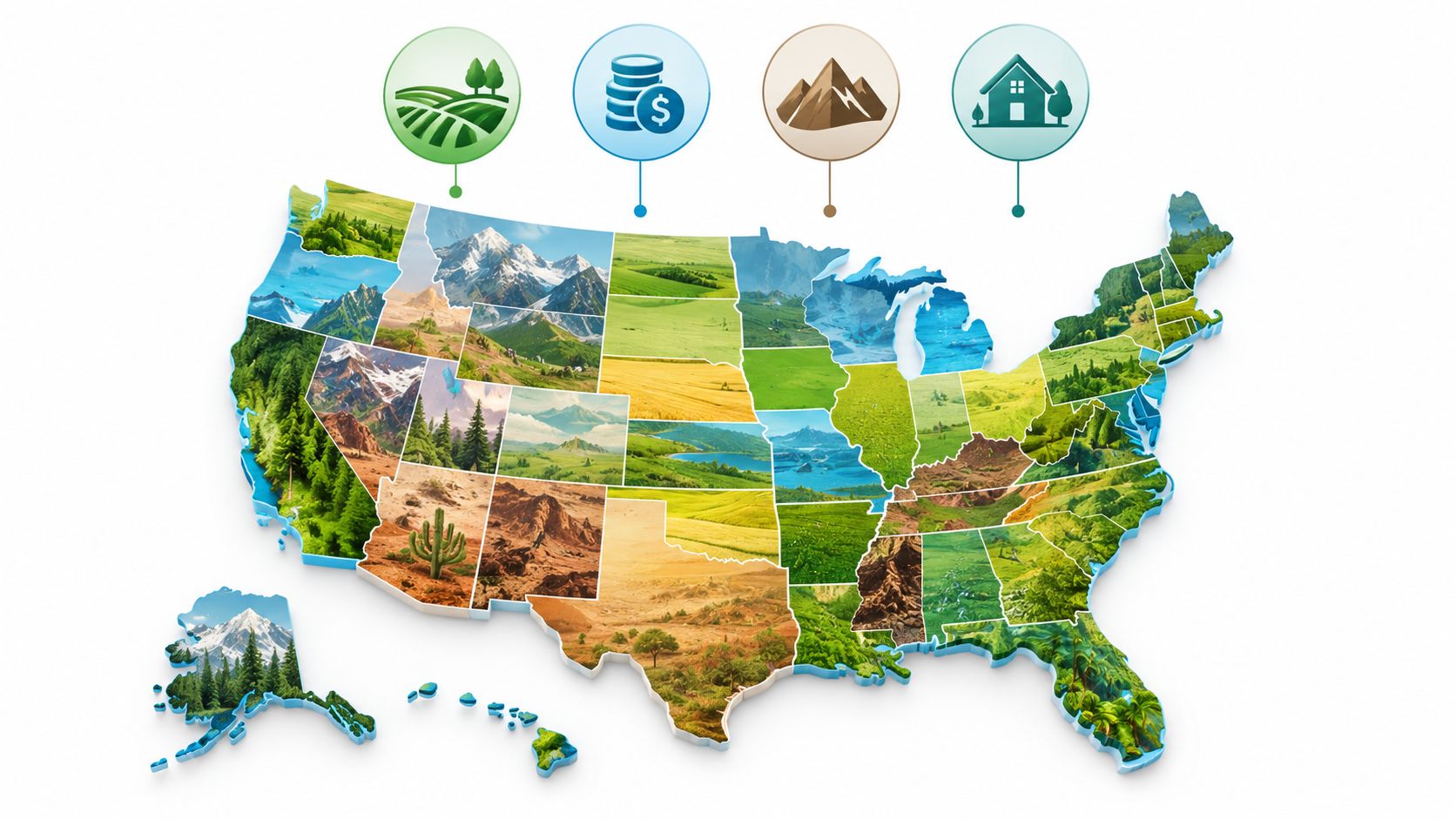
Western states often call for closer checks on remoteness, public-land boundaries, water availability, terrain, and flood conditions. Southeastern and Great Lakes markets may combine different levels of rainfall, vegetation, private ownership, population access, and county regulation. Compare feasibility before price: the stronger state is the one where your intended use has a realistic chance of working.
Four Questions to Answer Before You Pick a State
A listing can look affordable on a state page and still fail your plan once you check the parcel. Before saving dozens of properties, test each state for feasibility, not just price. Soil, public-land density, flood exposure, and intended use can matter more than the budget filter you first click.
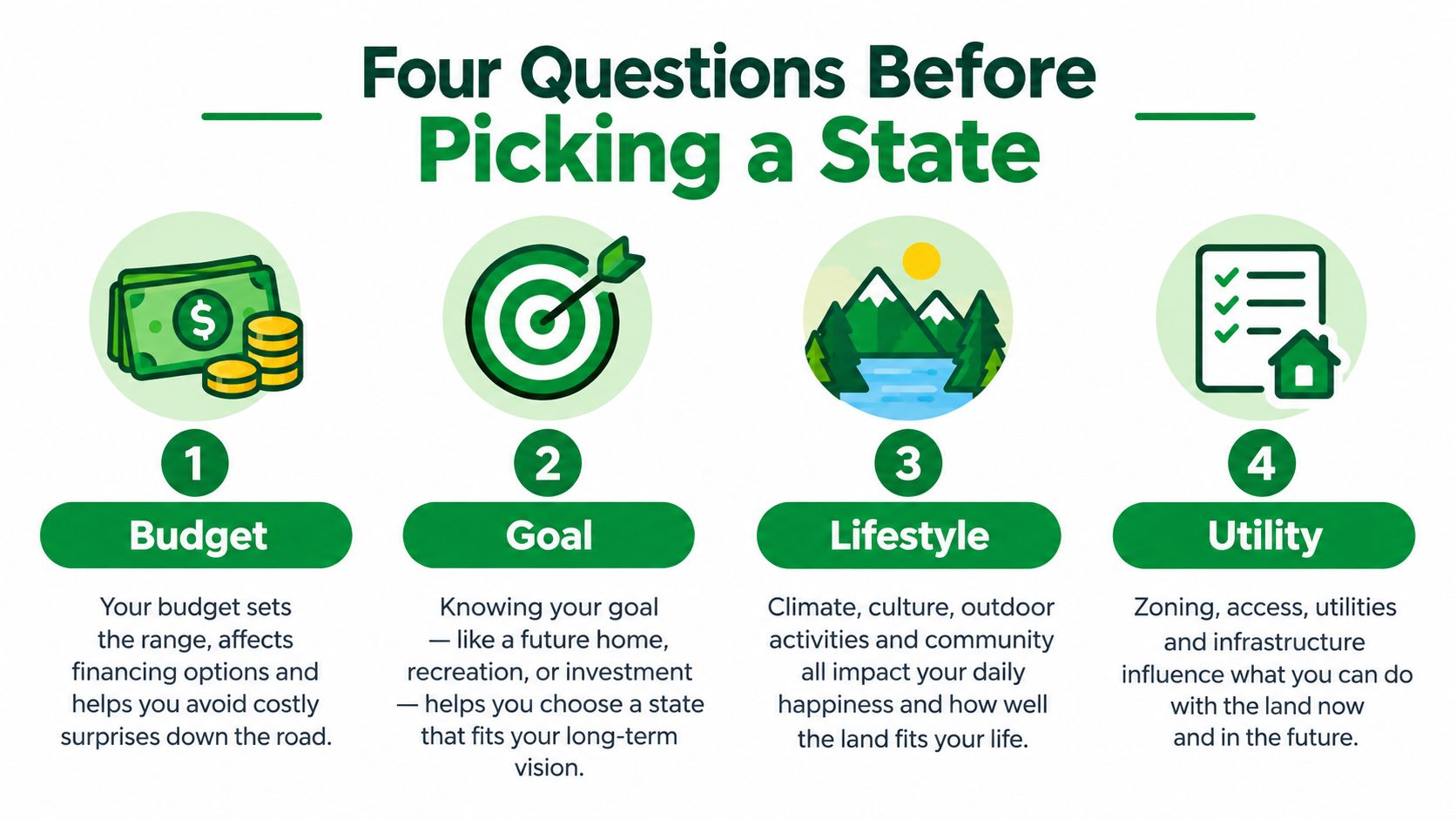
What will you use the land for?
Occasional camping, a manufactured home, a garden, a workshop, and a full-time residence each require different conditions. Write your intended use in one sentence before browsing. That sentence gives you a test for every listing. Then check county zoning, minimum dwelling rules, camping restrictions, road standards, and permits for the specific parcel.
A state page can narrow the search, but the county usually determines whether your plan is allowed.
Can you reach it and connect essential services?
Check for recorded access, road frontage, maintenance responsibility, and seasonal road conditions. Confirm whether electricity, a well, public water, sewer, or septic service is available. “Nearby utilities” may mean a line exists somewhere in the area, not that it reaches the property. Ask for the connection point and determine who would pay to extend service.
Access works like the path to a building site. If the path is legally uncertain or unusable in part of the year, the parcel may not support the use you have in mind.
Will the soil support your plan?
Review the parcel's mapped soil units and their limits for dwellings, excavation, septic absorption, construction, and water management using USDA NRCS soil survey resources. The SSURGO database can show information about available water capacity, flooding frequency, salinity, soil reaction, and development limits.
Soil maps screen properties; they do not approve a building site. Boundaries can miss lot-level conditions, so a site-specific evaluation or percolation test may be needed if you are considering septic installation. A low listing price does not compensate for soil that cannot support your intended use.
Does water or flooding change the economics?
Check the exact parcel location in FEMA's National Flood Hazard Layer, then confirm the result with the local floodplain administrator. FEMA hazard data uses flood maps and modeling, but sparsely developed areas may have limited published water-surface elevations. A map may therefore show risk without answering every construction question.
Flood exposure can affect elevation work, drainage, design, insurance, and permitting. Base-flood elevations should not be your only elevation source for construction or floodplain decisions. Compare these costs before applying a budget filter, because a cheaper state may produce a more expensive workable site.
Use these checks as one connected decision. Your intended use sets the rules, access and utilities determine whether you can operate there, soil affects construction and septic options, and water or flooding can change the total cost. For a practical search routine, follow this seven-step guide to finding cheap land in a state as a supplementary checklist, and complete the checks before photos or price make you attached to a parcel.
Matching Your Goal to the Right State Profile
The same state can be a strong match for one buyer and a poor fit for another. Start with the use case, then choose the state profile that supports it.
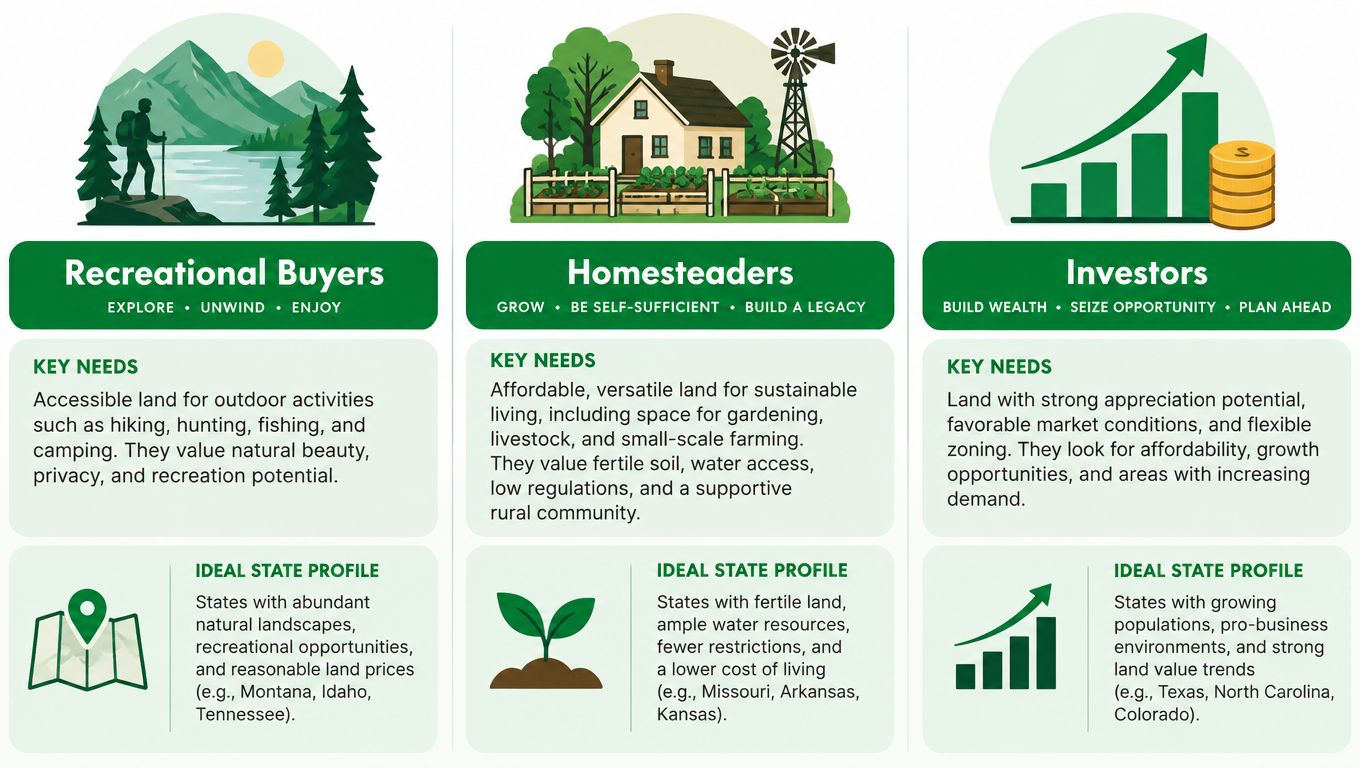
Recreational buyers
A weekend-use buyer may value scenery, privacy, access to public recreation, and a route that remains usable across the seasons. Arizona and Colorado may attract this shopper because of their western topography, but the buyer still needs to verify whether the parcel itself has legal access, camping permissions, water availability, and terrain suitable for the intended activities.
A remote parcel can provide solitude while making every visit more expensive and time-consuming. For recreation, proximity to a usable road and a clear understanding of local rules may matter more than adding acreage.
Homesteaders
A homesteader usually needs more than open space. Soil, water, sunlight, drainage, access, permitted structures, septic approval, and proximity to supplies all affect whether the plan can function.
Michigan or Florida may appeal to buyers seeking a different climate and water context than the arid West, but neither state should be treated as automatically suitable. Vegetation, wetlands, flooding, soil limitations, county rules, and utility availability can vary by parcel. A garden plan and a residence plan should each be checked against local requirements.
Investors focused on resale
An investor needs to think about the next buyer before purchasing. Resale potential depends on access, legal use, location, demand, taxes, title, and the cost of making the parcel understandable and usable to someone else.
Nevada or New Mexico may attract attention because of broad rural terrain and western land availability, but a low acquisition price doesn't create liquidity by itself. An investor should ask who would buy the parcel later, why they would want that location, and what problem the property solves.
| Buyer Goal | Priority Features | Best-Fit State Profiles | Top Verification Step |
|---|---|---|---|
| Recreation | Access, scenery, privacy, permitted camping | Rural western or mountain markets with usable access | Confirm road rights and local camping rules |
| Homesteading | Soil, water, septic, structures, climate | Markets with workable soil and practical utility options | Review soil data and county development rules |
| Investment resale | Demand, access, legal use, understandable value | Markets connected to a plausible buyer pool | Identify the likely resale audience |
The best state isn't the one that sounds exciting in a listing headline. It's the one whose conditions support your use without forcing you to solve a completely different problem after closing.
How Financing Changes the State Comparison
A price filter shows the listed amount. Financing shows how that amount enters your life.
Two parcels can carry the same advertised price but require different first payments, monthly obligations, term lengths, and total costs. If one seller requires a large deposit and another offers a zero-down structure, the two parcels aren't equally accessible even before you compare roads, utilities, or soil.
Separate acquisition from ownership
When reviewing an owner-financed listing, write down:
- Initial payment: What must you pay to begin?
- Monthly installment: How much leaves your account and when?
- Term: How long will payments continue?
- Payoff terms: Can you pay the balance early, and is there a discount?
- Ownership documents: When and how does legal ownership transfer?
- Default provisions: What happens if a payment is missed?
- Property expenses: Who handles taxes, assessments, and other charges?
LandZero describes FlexPay as direct seller financing with zero-down initiation, online checkout, a customer portal, and an option to pay in full at a listed discount. It also publishes zero closing costs and no credit checks as part of its process. Those are useful features to compare, but the buyer should still read the specific contract for the parcel and understand every obligation.
Use financing to widen the search carefully
No-credit-check financing can remove a bank approval barrier for buyers with limited or thin credit histories. It doesn't remove the need for a sustainable budget. A monthly payment that fits today may become difficult if you also need to fund a well, driveway, survey, septic evaluation, taxes, or travel.
The comparison should therefore include two columns:
| Cost Category | Questions to Ask |
|---|---|
| Acquisition | What are the listed price and financing terms? |
| Immediate cash | What must be paid before or at checkout? |
| Monthly commitment | Can the payment remain comfortable alongside existing expenses? |
| Development readiness | What work is needed before the intended use is possible? |
| Exit flexibility | Could the parcel appeal to another buyer if plans change? |
A state with more expensive listings may become accessible through financing, while a cheaper state may still be unaffordable after site work. Compare the payment plan and the parcel's practical readiness together, not as separate decisions. For background on purchasing land without traditional credit underwriting, review the guide to buying land with no credit, then verify the terms attached to the exact property you're considering.
Hidden Costs That Cheap State Listings Often Hide
The cheapest listing is often the one that demands the most questions. A low price may reflect distance from maintained roads, uncertain water, poor septic conditions, flood exposure, difficult terrain, or restrictions on building.
The USDA's 2025 farm benchmarks show why broad averages can mislead small-parcel shoppers. U.S. farm real estate averaged $4,350 per acre, cropland averaged $5,830, and pastureland averaged $1,920, according to the 2025 USDA land values report. Those figures describe farm real estate, cropland, and pastureland. They aren't direct price guides for a small recreational, residential, or off-grid parcel.
State variation is also substantial. The same report places average cropland at $1,320 per acre in Montana and $32,900 per acre in Rhode Island. That contrast doesn't tell you what a particular listing will cost or whether it can be developed. It shows why a state average is a poor substitute for parcel-level research.
Inspect the practical warning signs
- Access uncertainty: The listing doesn't clearly identify a public road, recorded easement, or maintenance arrangement.
- Utility assumptions: The description says utilities are “nearby” without explaining connection distance or cost.
- Soil limitations: The soil map suggests shallow bedrock, saturation, expansive behavior, salinity, or poor septic suitability.
- Flood exposure: The parcel lies near a mapped hazard area or requires local confirmation before construction.
- Use ambiguity: The listing suggests camping, housing, or development without naming the relevant county rules.
- Remote resale risk: The parcel has a low price but no obvious audience beyond bargain hunters.
The right response isn't to reject every inexpensive parcel. It's to price the unknowns before committing. Ask for documents, contact the county, inspect maps, request a soil evaluation when appropriate, and calculate the cost of access and utilities separately from the purchase price.
Budget reality: A cheap parcel is only a bargain if the land's access, water, soil, flood exposure, and legal use fit your plan.
USDA's published methodology also makes clear that agricultural land-value estimates don't answer questions about septic approval, minimum dwelling size, water access, or county zoning. Use the benchmark to understand broad agricultural context, not to justify a purchase decision for a different type of property.
Your Repeatable State-by-State Buying Workflow
Start by writing your intended use and maximum total budget. Choose two or three candidate states, then compare each state's private-land context, access patterns, climate, rules, and likely utility requirements. Within each state, use a budget collection, shortlist parcels, and run the four checks: intended use, access and utilities, soil, and flood exposure.
Next, compare financing terms with the cash you can sustain. Save the listing documents, contact the county for unresolved questions, and reject parcels whose unanswered risks could overwhelm your budget. For continued education, use the Land Guide library and FAQ resources alongside your parcel research.
LandZero lists vacant land by state and budget, with owner-financing options designed for online purchase, including zero-down initiation and no credit checks. Visit LandZero to choose a state, set a realistic price range, and begin comparing parcels by feasibility rather than headline price.